How long does MVP development take? What goes in v1
For founders · Updated

Filip Papranecfounder of Digitaliko
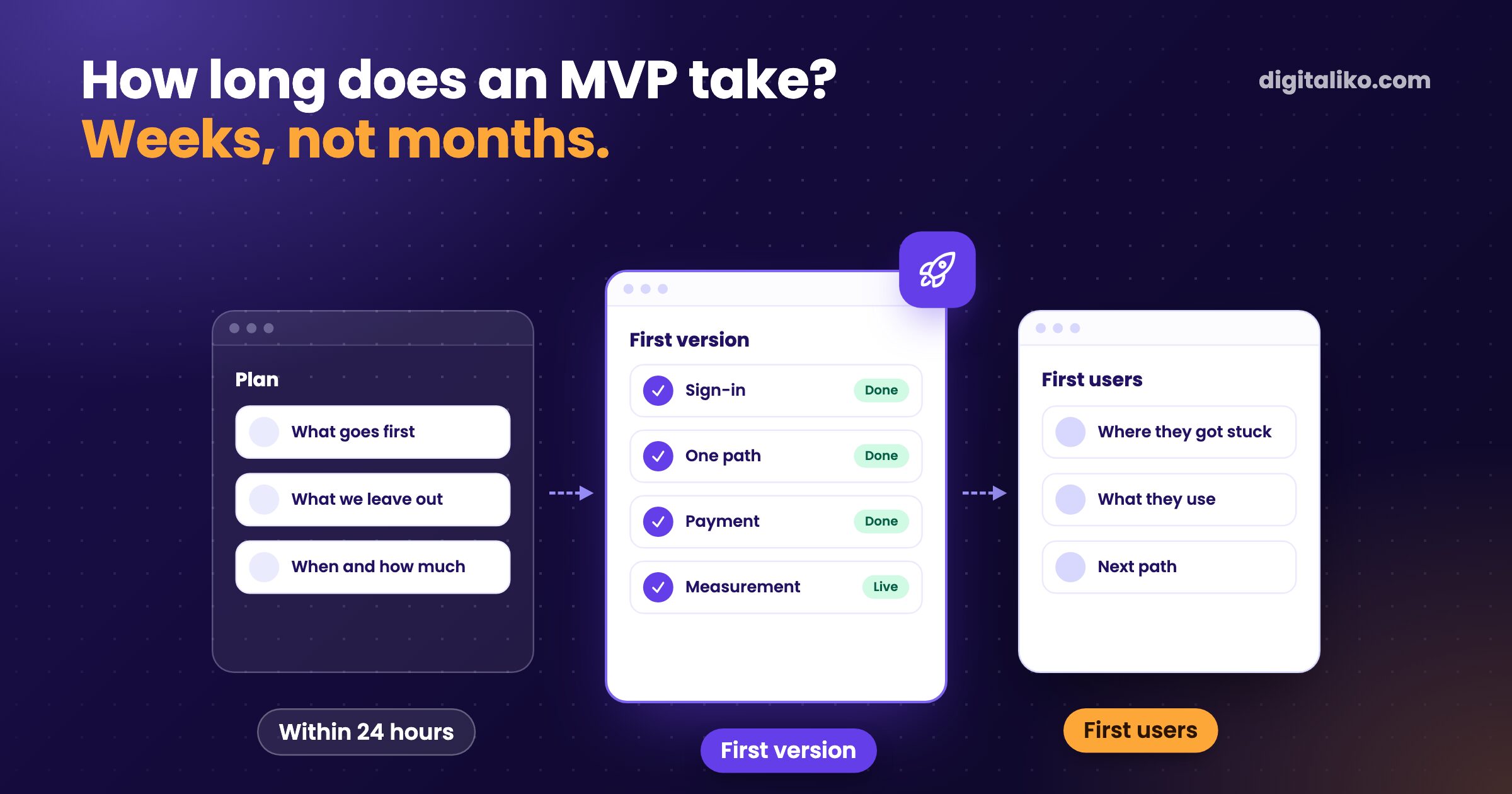
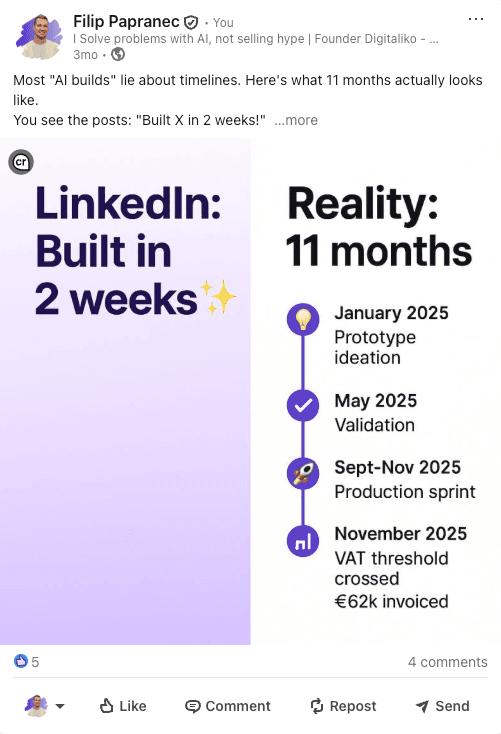
The investor asks for a date, and the agency talks about a quarter with a Figma file as the first milestone. The first usable version of an MVP should take weeks, not months. It holds one path a customer pays for, and nothing else. If the plan talks about a quarter before the first user, the scope is wrong.
Below: how long it takes with us, what goes into the first version and how to spot a badly set plan.
How long does MVP development take?
With us, a first version is counted in weeks. Two numbers from our projects:
- working days to the first version on one project
- under 10
- to launch the whole system on another project
- 1 month
The number is not the most important part. What matters is what reaches users in that time. A week of development nobody uses costs more than a month you learn something from.
Technology does not set the length. What sets it is how many things you decide to leave out of the first version.
What goes into the first version of an MVP?
The first version answers one question: will anyone pay for it? The list of what belongs in it is short. The list of what waits is longer.
Version one
Goes into version one
- One path a customer pays for. From sign-in to the result they want.
- A way to find out if they would pay. A payment, a binding order or at least a trial subscription.
- A simple admin for you. Just enough that you never have to write into the database.
- Measurement. Where people drop off and what they actually use.
Waits for version two
- A mobile app and a web app at once.
- Roles and permissions for every user type.
- Connections to every system that might be useful one day.
- Reports and charts for data you do not have yet.
A company once sent us a brief dozens of pages long: web and mobile, many modules, several languages and a plan to sell it on to others. Instead of a price for the whole thing, we wrote down what was simple and what was complex. The first version had just a few modules and one language.
What does a sensible timeline look like?
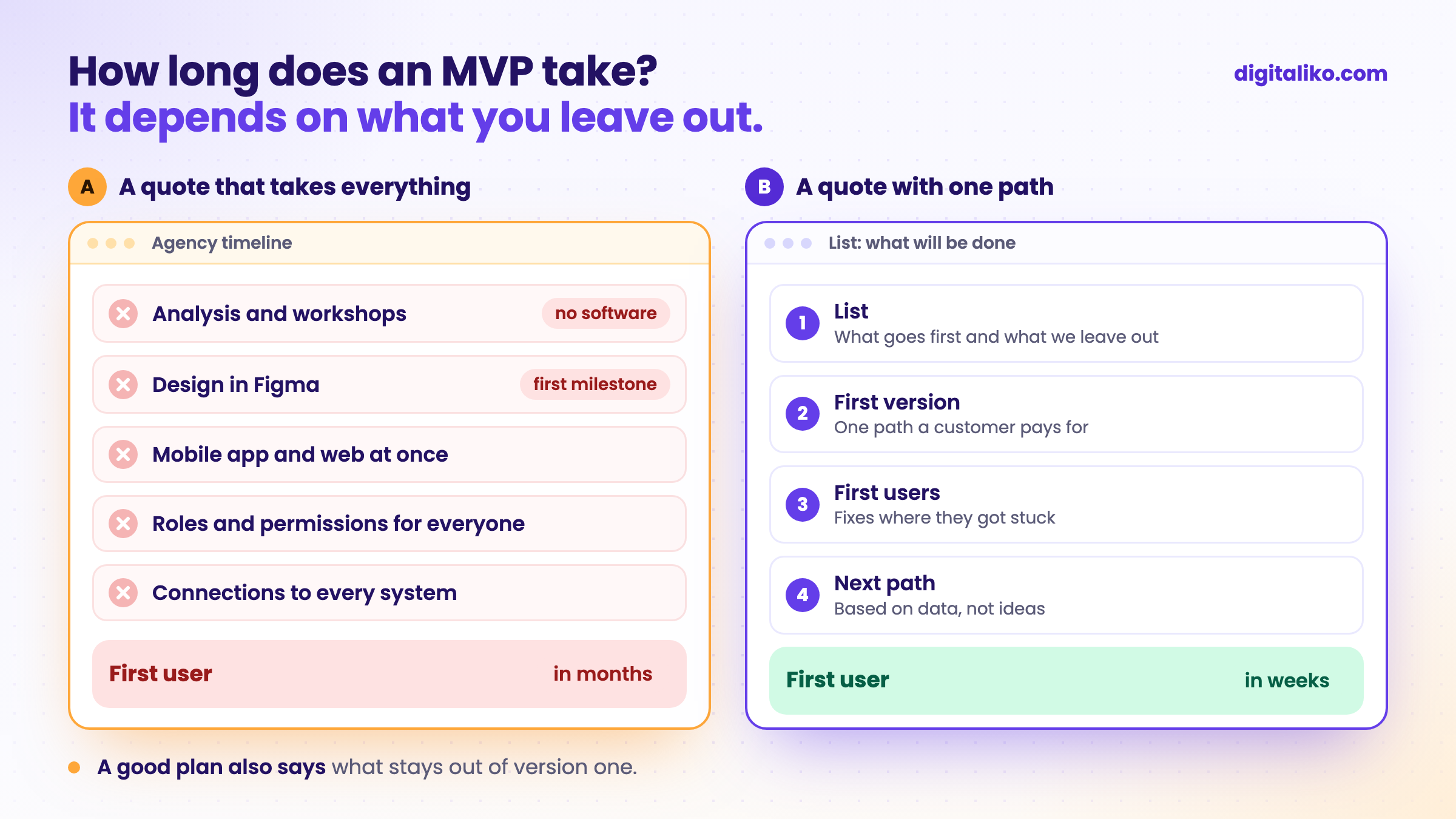
With us, every step has a clear output. No step is "analysis" without software at the end.
01
List
What goes first, when and for how much. Done when you can explain it to a co-founder in a few minutes.
02
First version
One path that works for real. Done when the first person outside the company goes through it alone.
03
First users
Fixes based on where they got stuck. Done when they come back without you asking.
04
Next path
The next feature based on data, not ideas. You can say why this one.
When it goes live, we stay with you for another 30 days until everything runs. MVP development for founders built this way is our everyday work. Before launch, go through the 25 checks before launch (PDF).
How do you spot a badly set scope?
Design matters, but nobody pays you for a Figma file. And until the first user arrives, you burn money and learn nothing. Take the quote on your desk. Tick what is true about it.
If this has already happened to you, read The agency did not deliver the app. What now?. If you have a prototype from an AI tool that stalled halfway, continue with From a vibe-coding prototype to production.
When we don't recommend it
- You have not talked to a single customer yet. Start with conversations and a clickable prototype. You do not need development for that.
- You want a finished platform with everything in month one. We will not promise that. We start with what the first users need.
- You are looking for someone to build it for equity. We do not do that. Look for a technical co-founder.
- You do not want to discuss features. We will say no. Without that, a first version in weeks does not happen.
At this stage you often don't need months of development and a robust architecture. A prototype that tests your key assumptions is enough.

Need a date you can defend?
Tell us what the product should do and for whom. We get back to you within two business days, and together we pick what to fix first. We write down what goes first, when, and what we leave out for now.
If you'd rather talk first, book a 15-minute meeting with Filip.
What is the one thing your first customer would pay for tomorrow?
In short
- The first usable version of an MVP should take weeks, not months.
- Version one holds one path a customer pays for, a way to find out if they would pay, and measurement.
- Every step of the timeline ends with software or a result you can check.
- Figma as the first milestone and nobody saying no are signs of a badly set scope.
Frequently asked questions
How long does MVP development take?
The first usable version should be in users' hands in weeks, not months. On one project we had it in under 10 working days. If the plan talks about a quarter before the first user, the scope is wrong.
What is an MVP?
The smallest version of a product that tells you whether customers want it. It is not a demo or a Figma file. It is software people actually use and ideally pay for.
What should the first version of an MVP include?
One path a customer pays for, from sign-in to the result. Plus a way to find out whether they would pay, and measurement. Everything else waits for version two.
Why do agencies quote months for an MVP?
Often because they put everything the founder mentioned into the first version. The first milestone then becomes design, not software. A shorter plan appears when someone says no to features the first customer does not need.
Who owns the MVP code?
You do, from day one. Code, data and infrastructure belong to you, so later you can raise money or hire your own developers without a migration.
Ask AI about this article
The AI also draws on our other articles and experience from real projects.
ChatGPTClaudePerplexity