What is an AI agent? Plain answer, business examples
AI agents · Updated

Filip Papranecfounder of Digitaliko
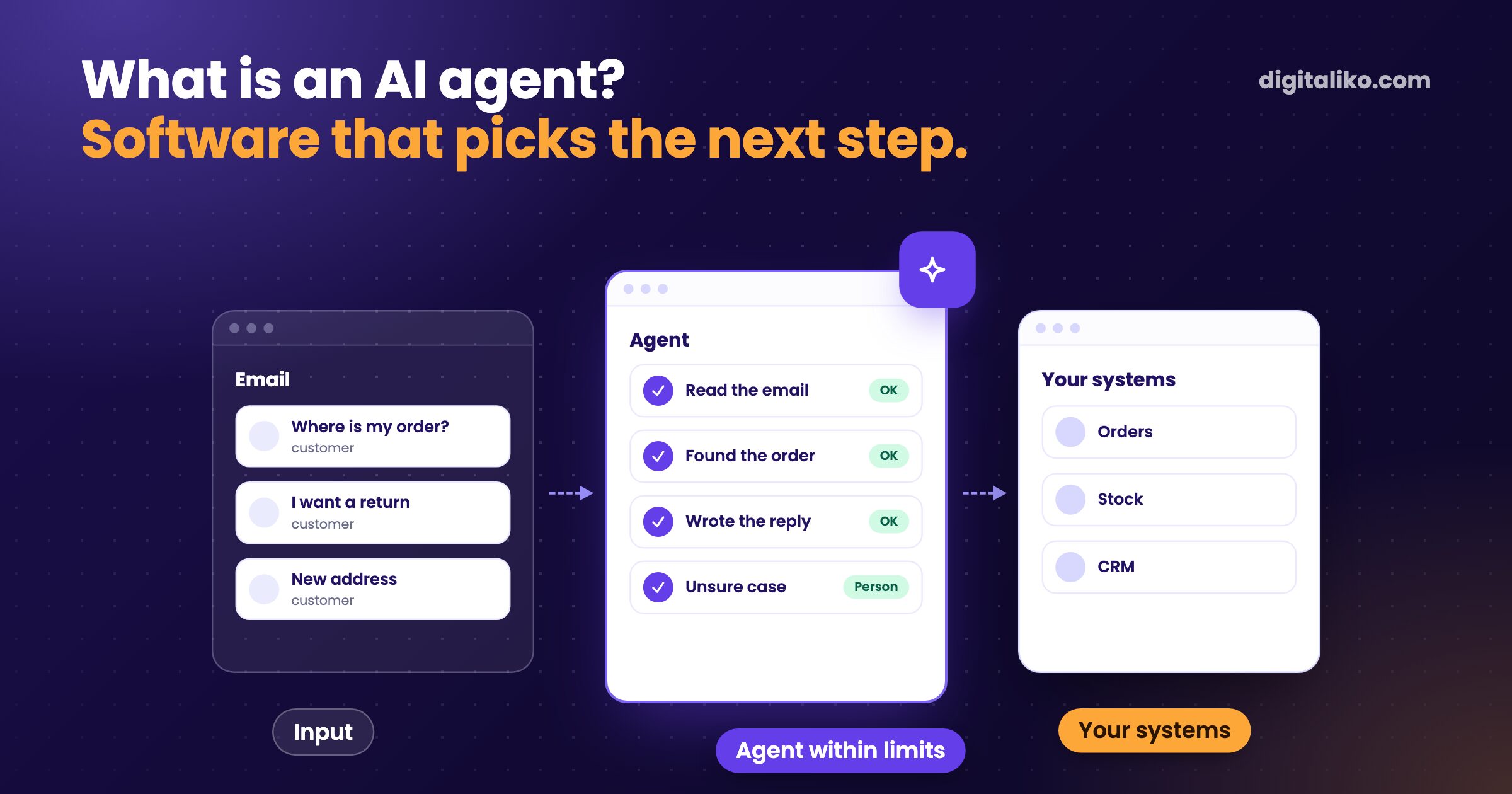
An AI agent is software that gets a goal and picks the next step itself. It reads an email or a document, decides what to do and uses your systems. You set the limits, and what it does not know goes to a person.
Below: how it differs from a chatbot and from automation, a real example with numbers, and a list of when you do not need an agent.
What is an AI agent in simple terms?
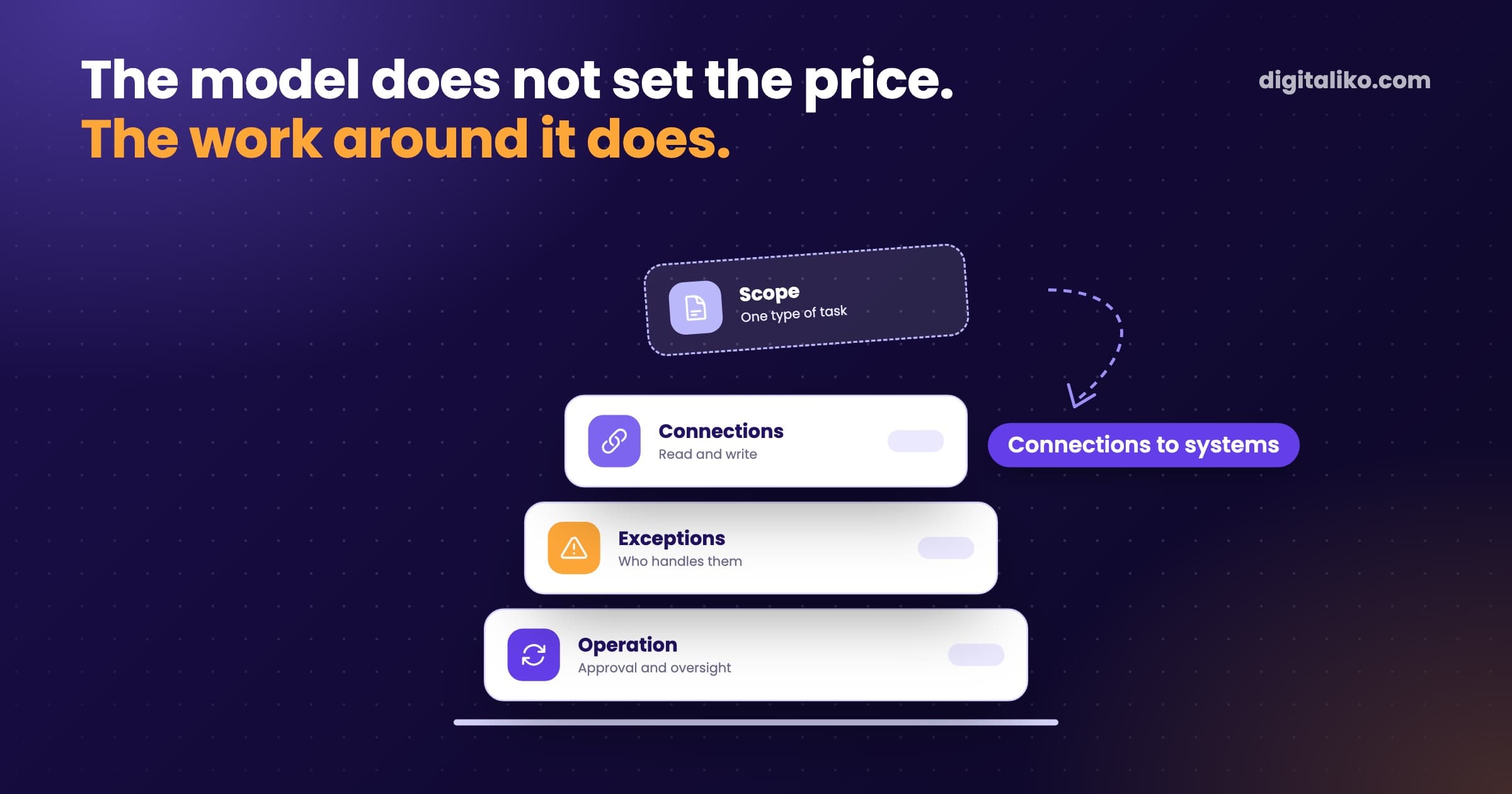
An agent is not one program. It is four parts doing one job together:
- The model. A language model that reads text and proposes what to do next.
- Tools. Access to your systems: orders, stock, email, CRM.
- Rules. What it may do alone, what never, and when it must ask.
- A person for exceptions. Someone specific who gets what the agent does not know.
Without tools it is just a chat. Without rules and a person it is a risk, not an agent.
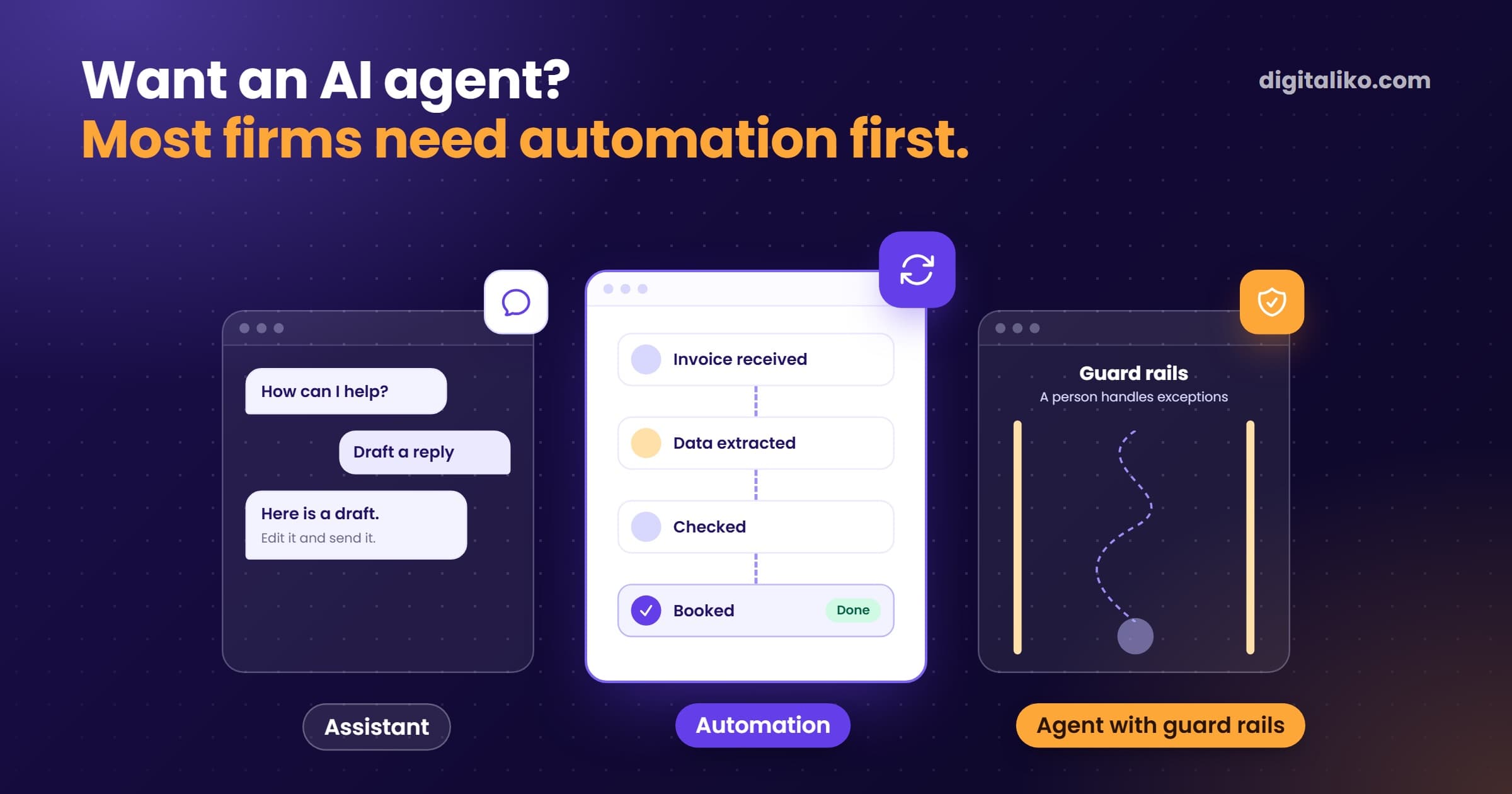
What is the difference between an AI agent, a chatbot and automation?
These three words get mixed up. Yet each means something different and is introduced differently.
| Chatbot | Automation | AI agent | |
|---|---|---|---|
| What it does | Answers questions in a window | Follows the same steps every time | Picks the next step based on what it reads |
| Who decides | The person asking | A rule, a person for exceptions | The agent, within limits |
| Example | A question about opening hours | An invoice from email into accounting | A reply to a customer about their order |
| What it needs | Texts to answer from | A written process and examples | Process, examples, rules and a person for exceptions |
If you are torn between automation and an agent, we cover it in AI agent or automation: what do you need?.
What does an AI agent look like in a company?
An agent is not only for email. You can give it almost any job a person does at a computer:
- Email and messages. Replies to customers, sorting enquiries.
- Documents. Invoices, orders, contracts: it reads them and writes the data where it belongs.
- Work inside systems. The agent drives a browser or a whole computer like a person (browser use, computer use). It can click through a system that has no API.
- Research and summaries. It gathers data from several sources and prepares the basis for a decision.
The rule is the same for all of them: one task, clear limits and a person for the exceptions.
With us, the agent most often works on email. Every customer writes differently, and the right reply depends on their order. Fixed steps cannot handle that.
For a client selling online we built a customer support agent.
- Reply time to customers. Customer support now handles only the complex cases.
- < 5 min
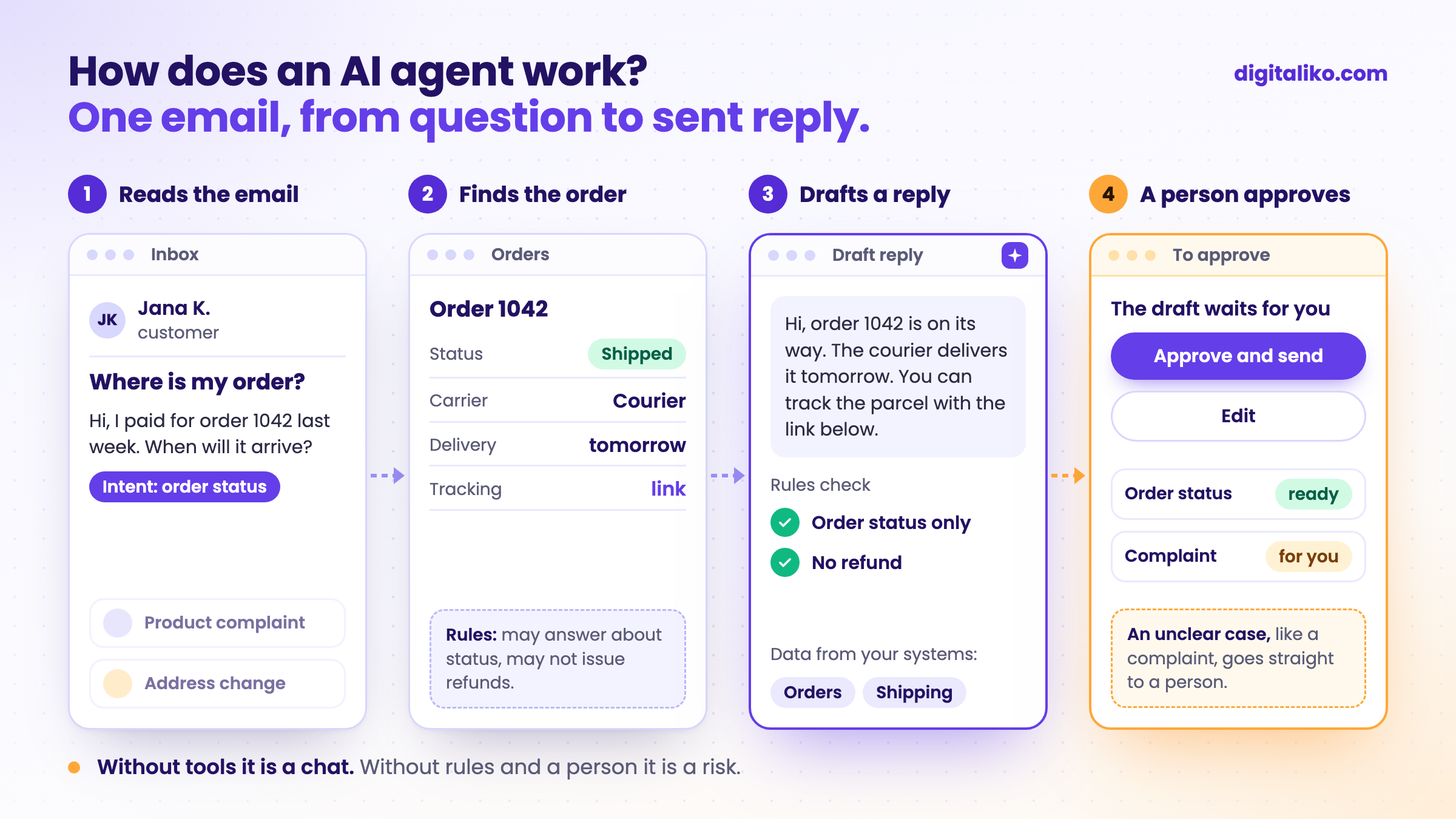
One email goes like this:
- The agent reads the email and works out what the customer wants.
- It finds their order and the shipment status.
- It writes the reply in the founders' words.
- It sends it, or hands it to a person if it is not sure.
It did not work like that on day one. At first the agent only drafted, and we sent every reply by hand. It never sent anything on its own without us.
What surprised us most was the speed. Customers wrote that they did not expect a reply on a Sunday evening. And their problem was solved.
People weren't surprised that software replied. They were surprised that someone replied on a Sunday evening and solved their problem.

The whole process is in AI agent for customer emails: how to start.
Why an AI agent is not a digital employee
Agents are often described as an employee for everything. We disagree. An agent runs on a language model, and that model works with probabilities. Sometimes it is wrong.
So we never give it access to everything. It gets one task, a precise brief and clear limits. A person decides the important steps.
We got this wrong too. We once designed an agent around how we imagined the work. Real emails looked different.
Don't give an agent just 'reply'. Give it the types of email that really come in and how to answer each one. Those are its limits.
Today we start from past communication:
01
We read old emails
02
We list the types that come in
Shipment status, complaint, angry customer, thank-you.
03
Rules for each type
The agent gets rules on how to reply.
When do you not need an agent?
More often than you would expect. When an owner says "I want an AI agent", they usually want one job to be simpler. Agents are trendy. Often plain software, a different automation or a changed process is enough. You do not need an agent if at least one of these is true. Tick what applies to you:
An agent makes sense where a person reads free text all day and picks between several steps. How we build one for you is on Custom AI agent for business.
When we don't recommend it
- You just want to try AI. You do not need us for that. Start with an AI chat subscription.
- You expect 100 % accuracy without a person. That agent does not exist. If nobody can take the exceptions, do not start.
- You want one agent for everything at once. We start with one job that happens every day. The next one comes once the first is running.
- The process lives in one person's head. We write it down together first. Only then does an agent make sense.
Not sure an agent would help?
Tell us which work you want gone. We get back to you within two business days, and together we pick what to fix first. We will also tell you if you do not need an agent.
If you'd rather talk first, book a 15-minute meeting with Filip.
Which work in your company does a person do today that software should do?
In short
- An AI agent gets a goal and picks the next step itself, within the limits you give it.
- A chatbot answers, automation follows the same steps, an agent acts on what it reads.
- An agent gets one task, rules and a person who takes the exceptions.
- When the work goes the same way every time, automation is enough.
Frequently asked questions
What is an AI agent in simple terms?
Software that gets a goal and picks the next step itself. It reads an email or a document, decides what to do and uses your systems. You set the limits, and what it does not know goes to a person.
What is the difference between an AI agent and a chatbot?
A chatbot answers questions in a chat window. An AI agent acts: it finds the order, drafts the reply, writes a value into a system. A chatbot asks a person, an agent works for them within limits.
Is an AI agent the same as automation?
No. Automation follows the same steps every time. An AI agent chooses its steps based on what it is reading. That is why an agent needs more rules and someone who takes the exceptions.
Can an AI agent work without a person?
For selected types of tasks, yes, but only after you have approved its drafts for a while. Cases where it is not sure must always go to a person.
When do I not need an AI agent?
When the work repeats the same way, automation is enough. When you only want to write faster, an AI chat subscription is enough. An agent makes sense when someone reads free text and picks between several steps.
Ask AI about this article
The AI also draws on our other articles and experience from real projects.
ChatGPTClaudePerplexity