AI assistant on your company data: pros and risks
AI agents · Updated

Filip Papranecfounder of Digitaliko
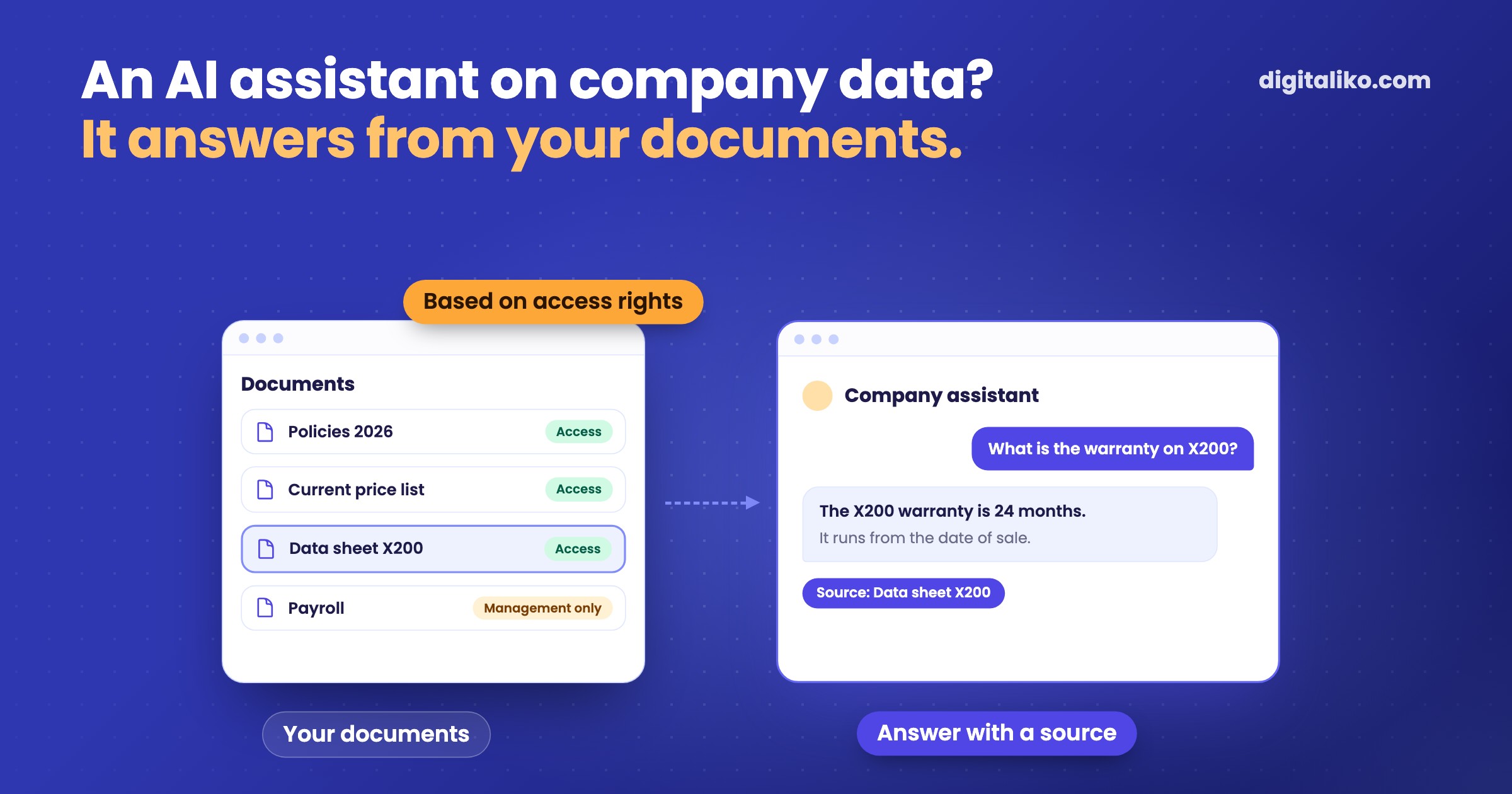
An internal AI assistant for your company answers employees from your own data: policies, price lists, product data sheets, contracts or orders. People ask in their own words and see which document each answer comes from. It saves searching and questions like “where is that spreadsheet”. There are three risks: wrong answers, people seeing what they shouldn’t, and data ending up where it shouldn’t.
Below you’ll find what an assistant brings, how to limit those three risks and how to roll it out so people actually use it.
What can an internal AI assistant do, and how is it different from ChatGPT?
ChatGPT and similar tools answer from what the model has learned and from what you upload to them right now. An internal assistant has access to your documents and systems. For each question it searches them for related excerpts and answers only from those. This method is called RAG. How to build it technically, with permissions and tests, is in RAG on company data: how to build one that does not lie.
| ChatGPT with an uploaded file | Internal AI assistant | |
|---|---|---|
| Where it answers from | The file you upload and the model’s memory | Your documents and systems |
| Up to date | Until someone uploads a new version | Reads the current version |
| Who sees what | Whoever has the file sees everything | Based on access rights |
| Source with the answer | Sometimes | Always, with a link to the document |
| Fits | One person and a few documents | A team and hundreds of documents |
If your company lives in one office suite, first look at what its own built-in assistant offers. If your documents and data sit in several places or in your own system, an off-the-shelf assistant often can’t see them.
What does an assistant bring to a company?
- Fewer questions for experienced people. “What is the warranty on this model?” “Where is the latest price list?” The assistant finds the answer, not the colleague who knows it by heart.
- Faster onboarding. New people don’t have to read all the policies and procedures at once. They ask when they need to.
- One place instead of ten folders. The assistant searches across the documents you have given it access to.
What these have in common is that they are about finding, not deciding. The assistant finds and summarises. A person decides.
What are the risks and how do you limit them?
1. Wrong answers. The model works with probabilities and sometimes makes things up. That is why the assistant should answer only from the documents it finds, always show the source and say “I don’t know” when it finds no answer. More on this in AI hallucinations: why AI makes things up, how to limit it.
2. People see what they shouldn’t. If the assistant reads payroll, customer contracts and policies all at once, it will answer from them to anyone. The assistant itself must respect access rights: whoever can’t see a document in the folder must not get it in an answer either.
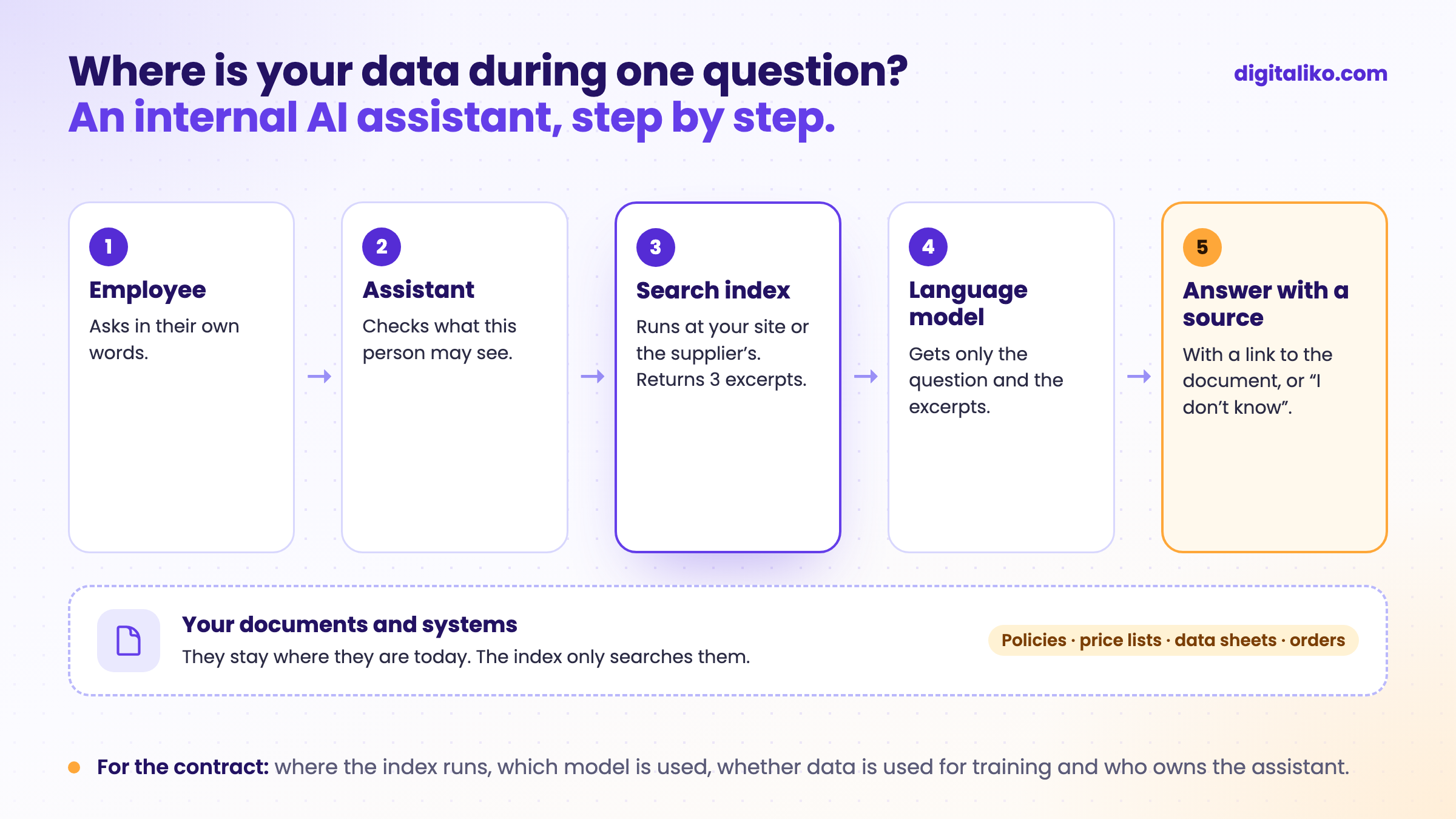
3. Data ends up where it shouldn’t. The documents stay where they are today. But the assistant builds a search index, and with each question the language model gets the question and a few excerpts. So it matters where the index runs and who operates the model. For a single question it looks like this:
What should you get in writing from the supplier?
A supplier’s promise won’t help you if it isn’t on paper. Before you sign, ask for written answers to four questions:
How agents that read outside text defend themselves is covered in Prompt injection: how to protect an AI agent at work. For an internal assistant the same applies to documents that came into the company from outside. This is not legal advice.
How do you roll out an AI assistant so people use it?
An assistant “for everything” answers everything averagely, and after a week people stop opening it. We recommend starting with a narrow area:
01
Pick one area
For example product data sheets or internal policies. Where people ask the most.
02
Clean up sources and rights
Which documents are valid, which are old and who may see what. The assistant must not read old versions.
03
Test questions with the right answer
Dozens of questions people really ask, each with the answer the assistant should give.
04
Pilot with a small group
People rate the answers. Wrong answers go back into the sources or the tests.
Step 2 takes the most time and matters most. If a folder holds three price lists and only one is valid, the assistant will answer from any of them. A wrong answer with a source is still a wrong answer.
Are you ready for an internal assistant?
Tick what is true for you:
When we don’t recommend it
- There are only a few documents and everyone knows them. One well-organised folder or a page of links is enough.
- The documents are out of date and nobody knows which are valid. The assistant will answer wrongly, fast. Clean up the sources first.
- The answer is meant to decide about money or law. The assistant finds the material, a person decides.
- Your office tools already have an assistant that can see your documents. Try that one first. Build your own only when it isn’t enough.
Do your people keep asking the same things?
Tell us what people in your company ask most often and where the answers are. We get back to you within two business days with a few questions about your work. Then we agree on what we do first.
If you’d rather talk first, book a 15-minute intro call.
How we build AI agents and assistants on company data is described on Custom AI agent for business. The assistant and the code are yours from day one.
Which question in your company can only one person answer?
In short
- An internal AI assistant answers from your documents and systems and shows the source with every answer.
- There are three risks: wrong answers, people seeing what they shouldn’t, and data ending up where it shouldn’t.
- For the contract: where the index runs, which model is used, whether your data is used for training and who owns the assistant.
- Start with one area, cleaned-up documents and test questions with the right answer.
Frequently asked questions
What is an internal AI assistant for a company?
An assistant that employees ask in their own words and that answers from company documents and systems: policies, price lists, product data sheets, orders. With every answer it shows which document it is based on.
Isn’t uploading documents to ChatGPT enough?
For a few documents and one person it often is. The trouble starts when documents change, when there are many of them and when not everyone may see everything. Then you need an assistant that respects access rights and always reads the current version.
Where does company data stay?
The documents stay where they are today. The assistant builds a search index, and with each question the language model gets only the question and a few related excerpts. Where the index runs, which model is used and whether the provider may use the data for training should be written into the contract.
What is RAG?
RAG (retrieval-augmented generation) is a method in which the assistant first searches the documents for excerpts related to the question and only then writes the answer from them. That way it answers from your data, not from what the model remembers.
Can a company AI assistant make things up?
Yes, if it is not told not to and nobody checks it. That is why it should answer only from the documents it finds, always show the source and say “I don’t know” when it finds no answer.
Ask AI about this article
The AI also draws on our other articles and experience from real projects.
ChatGPTClaudePerplexity

