AI Engineer roles compared: what each one really does
For CTOs and engineersCTO decisions

Filip Papranecfounder of Digitaliko
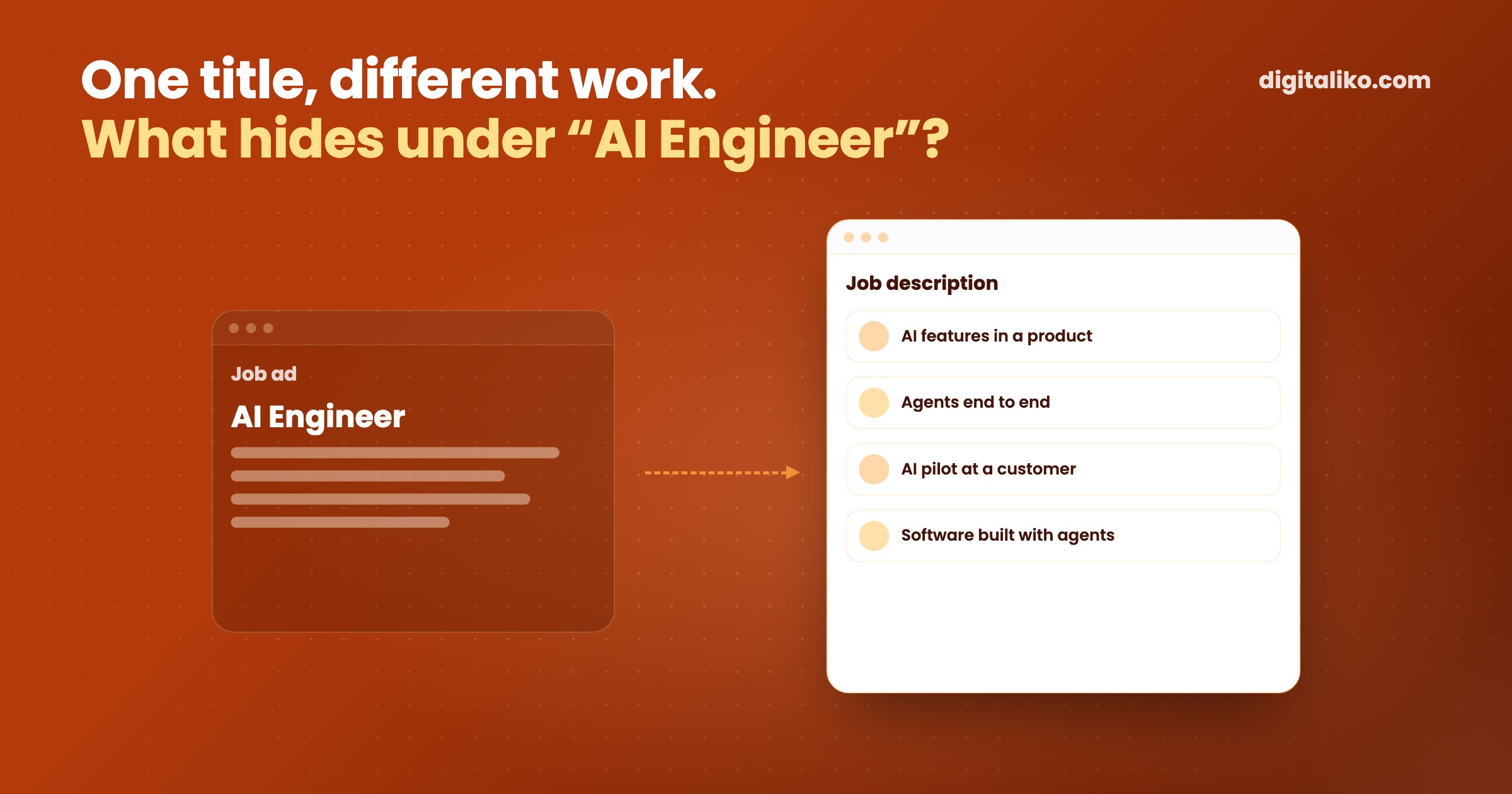
Companies hire very different people under the title "AI Engineer". One adds AI features to a product, another builds agents, a third trains models. The job title predicts little; the job description decides.
Below we compare four main AI roles that build things, and three related ones. We use the names the market uses, not ours. For each: which titles appear in job ads, what the descriptions ask for and what work really hides under the title.
The article has two readers. A CTO or head of IT who is about to hire. And a developer who wants to find their way among AI roles.
Where the comparison comes from
This is not a quantitative study. It is one pass through AI job descriptions on LinkedIn over one month, November 2026. We read the job description, not the title. For each ad we noted what the person is actually supposed to do.
For rough context: that month it was 228 distinct ads. Of 45 titled "AI Engineer", 23 added AI features to a product, 9 built agents and 4 trained models. Another 27 were titled "Forward Deployed Engineer", 25 "Agentic" or "Agent Engineer" and 8 asked explicitly for AI-native development. This is not a market share.
It works the other way round too. The same work carries different titles. "Forward Deployed Engineer", "AI Agent Deployment" and "Applied AI Engineer" describe the same work at a customer.
The AI roles in one table
| Role | Titles in job ads | What the ad asks for | The real work | Who it suits |
|---|---|---|---|---|
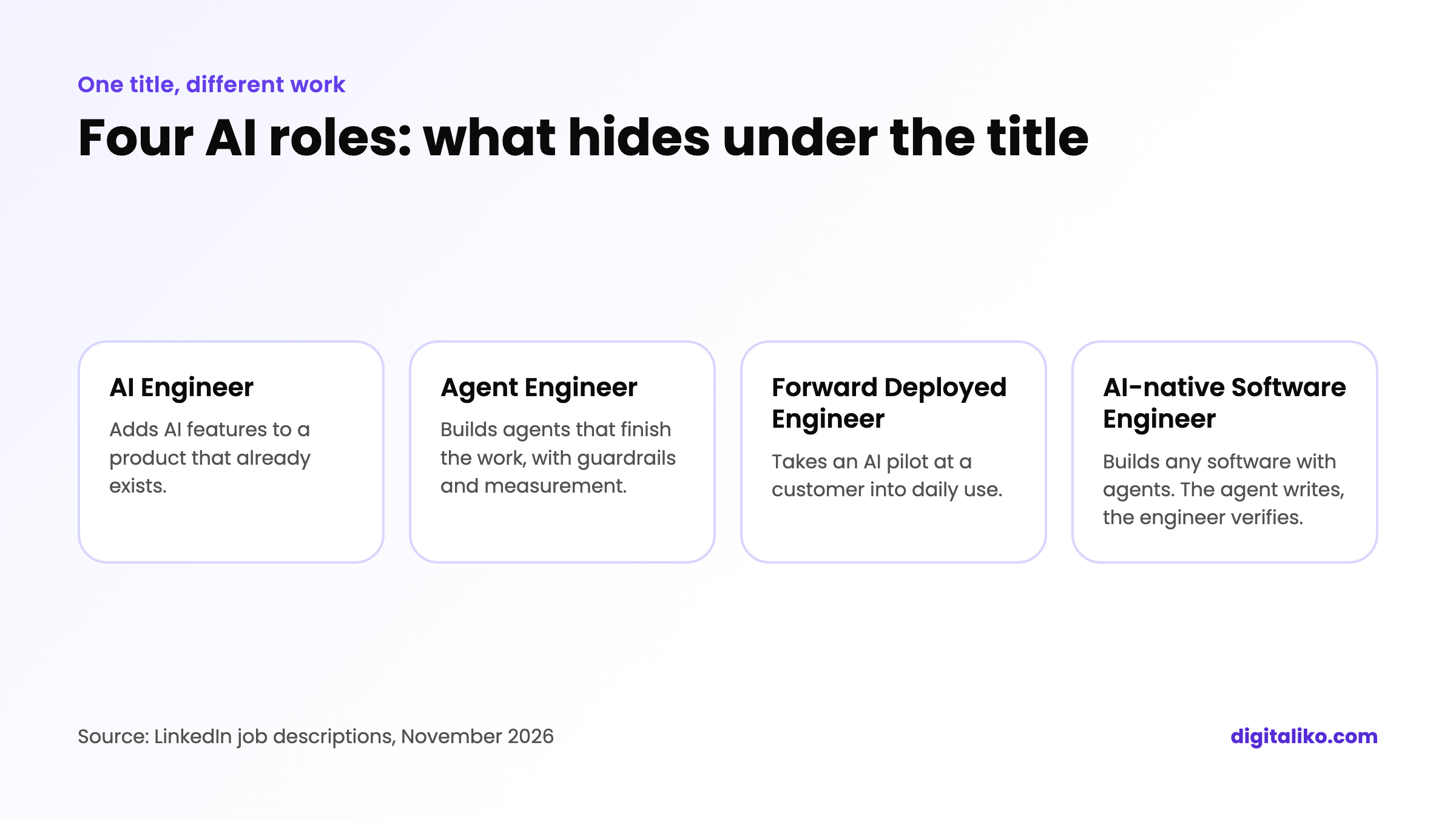
| AI Engineer | Applied AI, GenAI, LLM Engineer, AI Software Engineer, AI Developer | Python, cloud (AWS Bedrock, Azure), RAG, accuracy measurement, coding agents | mostly AI features in an existing product | a product developer who wants to add AI to the product |
| Agent Engineer | Agentic AI Engineer, AI Agent Engineer, Autonomous AI Systems Engineer | evals, MCP, Python, LangGraph or CrewAI | an agent that finishes the work, with guardrails and a human to approve | a backend developer who likes to measure and build safeguards |
| Forward Deployed Engineer | FDE, AI Forward Deployed Engineer, AI Agent Deployment | work with the customer, Python and TypeScript, React | an AI pilot at a customer taken into daily use | a developer who likes sitting with the customer |
| AI-native Software Engineer | Agentic Software Engineer, Software Engineer AI Native, Senior Software Engineer (Agentic Development) | coding agents (Claude Code, Cursor, Copilot), TypeScript, React, AWS, MCP | any software; the agent writes, the engineer directs and verifies | an experienced developer who wants to direct and verify more than type |
| Applied AI / Solutions Engineer | AI Solutions Architect, Solutions Engineer, Presales, AI Application Engineer | deep cloud, years of architecture, sales experience | designing AI solutions for large companies, demos and pilots before a sale | an architect or presales engineer |
| ML Engineer | ML Engineer, LLM Engineer (Post-Training), Data Scientist & AI Engineer | model training, Python, research | training and tuning models, data science | a data scientist, not an application developer |
| Head of AI / fractional CTO | Head of AI, fractional CTO | owning the AI roadmap and quality, often part time | owns the AI plan, quality and the rules for building with AI | an experienced leader on a part-time basis |
The contract type is almost always the same: full time. Contract or freelance work shows up only rarely. Ads from German-speaking countries often ask for German, especially for customer-facing work.
AI Engineer: the broadest title
Titles in job ads: AI Engineer, Applied AI Engineer, GenAI Engineer, LLM Engineer, AI Software Engineer, AI Developer.
What the descriptions ask for: Python first and one big cloud, most often AWS Bedrock or Azure. Often RAG, meaning answers from company data, and accuracy measurement. More and more often TypeScript too, and coding agents as an everyday tool.
What hides under the title: most often an AI feature in a product that already exists. Search, summaries, an assistant inside the app. The same title is also used for building agents, training models or automation in low-code tools. The most misleading one is "LLM Engineer": in some ads it means research and post-training of models, not building an application.
Who it suits: a product developer who knows the product and wants to add AI to it. A CTO writing the ad should say in the first line which of these jobs they mean.
Agent Engineer: agents that finish the work
Titles in job ads: Agentic AI Engineer, AI Agent Engineer, Agentic AI Developer, Autonomous AI Systems Engineer, Staff AI Engineer (Agentic Systems).
What the descriptions ask for: measuring agent accuracy (evals) is almost always there. Often MCP, the standard an agent uses to call tools and systems. Python, sometimes TypeScript, and frameworks such as LangGraph or CrewAI.
What hides under the title: here the title matches the work best. Most ads with "agentic" in the title really are about building agents. The agent calls tools, keeps context and has guardrails. For important steps it waits for a person. One line keeps coming back: the job is to take agents from a demo into real daily use.
Who it suits: a backend developer who is not afraid of measuring and building safeguards. Why measurement matters is in our article AI agent evaluation: measuring accuracy in production.
Forward Deployed Engineer: an AI pilot at the customer
Titles in job ads: Forward Deployed Engineer, AI Forward Deployed Engineer, FDE (Applied AI / LLM Agents), AI Agent Deployment, Applied AI Engineer (Startups).
What the descriptions ask for: working directly with the customer and their people. Technically Python and TypeScript, often React. German in German-speaking countries.
What hides under the title: the engineer sits with the customer and turns a vague business problem into AI software on the customer's systems. Mostly AI vendors and consultancies hire for it. The reason is simple: pilots at customers often stay pilots. The titles differ, the work is the same in every ad.
Who it suits: a developer who likes to listen, turns a vague brief into a solution and does not mind changing surroundings.
01
What AI should do
A feature in a product, an agent, a pilot at a customer, or the whole development with agents?
02
For whom
For the product's users, for an internal team, or for a vendor's customer?
03
Which tools
Python and cloud, agent frameworks, or coding agents such as Claude Code?
04
How success is measured
Agent accuracy, a feature in daily use, or the speed and quality of the whole team?
These four questions help you read any job ad. They also help you write one that the right person applies to.
AI-native Software Engineer: all development with agents
Titles in job ads: Senior Agentic Software Engineer, Senior Software Engineer (Agentic Development), Software Engineer AI Native, Senior Full-Stack Developer (AI-Driven Development), AI Developer Enablement Lead.
What the descriptions ask for: coding agents as the main tool: Claude Code, Cursor or Copilot. Then TypeScript, React, AWS and MCP. The descriptions talk about specs, rules for agents, automatic checks and review.
What hides under the title: the engineer does not build an AI feature. They build any software and the agent is their main tool. The agent writes, the engineer directs through a spec, sets up checks and verifies the result. Companies hire for speed and, above all, to change how the whole team builds. One ad drew the line itself: if you build AI applications rather than software with the help of agents, this role is not for you.
Who it suits: an experienced developer who can judge code they did not write and wants to direct and verify more than type. Roles with this title are still few. But more and more ads for other roles name coding agents as an everyday tool. What this way of working looks like is in Vibe coding vs agentic engineering: what's the difference?
Three related roles
Applied AI / Solutions Engineer. Under titles such as AI Solutions Architect, Solutions Engineer or Presales there are two jobs. The architect designs AI solutions for large companies on one of the big clouds and asks for years of architecture experience. Presales runs demos and pilots and carries a sales target. Both are closer to selling than to building.
ML Engineer. ML Engineer, LLM Engineer (Post-Training), Data Scientist & AI Engineer. Trains and tunes models, does data science. This is not application building. When a company needs an AI feature in its product, an ML Engineer is usually not who it is looking for.
Head of AI / fractional CTO. Owns the company's AI plan, quality and the rules the team follows when building with AI. Often part time. It showed up only rarely in our pass.
One title was missing completely: Prompt Engineer. Writing prompts appeared only as one requirement inside other roles.
What to take from the comparison
If you are hiring, first decide which work you need first, then pick the title. If you are looking for a role, read the description, not the headline. Sometimes the answer is that you do not need a new hire: someone builds it and your IT keeps control.
In short
- "AI Engineer" is an umbrella title. Most often it means AI features in a product, but also agents or models.
- The Agent Engineer builds agents with guardrails and measurement. Here the title matches the work best.
- The Forward Deployed Engineer takes an AI pilot at a customer into daily use.
- The AI-native Software Engineer builds any software with agents and verifies the result.
- Read the job description, not the title.
Frequently asked questions
What does an AI Engineer do?
Most often they add language model features to an existing product, such as search, summaries or an assistant. The same title is also used for building agents or training models. The job description decides, not the title.
What is the difference between an AI Engineer and an Agent Engineer?
An AI Engineer adds AI to a product as one feature. An Agent Engineer builds an agent that does the work end to end: it calls tools, has guardrails, a human to approve and measured accuracy.
What is a Forward Deployed Engineer?
An engineer who sits with a customer and turns a vague problem into AI software that runs on the customer's systems. AI vendors and consultancies hire them so a pilot at a customer does not stall.
What is an AI-native Software Engineer?
A developer who builds any software with agents as the main tool. The agent writes, the engineer directs through specs, sets up checks and verifies the result. They do not build an AI feature; they change how a team builds software.
Is this comparison a market statistic?
No. It is one pass through LinkedIn job descriptions over one month. It helps you find your way among the titles, not measure the market.
Ask AI about this article
The AI also draws on our other articles and experience from real projects.
ChatGPTClaudePerplexity

