Human in the loop: when should an AI agent wait?

Filip Papranecfounder of Digitaliko
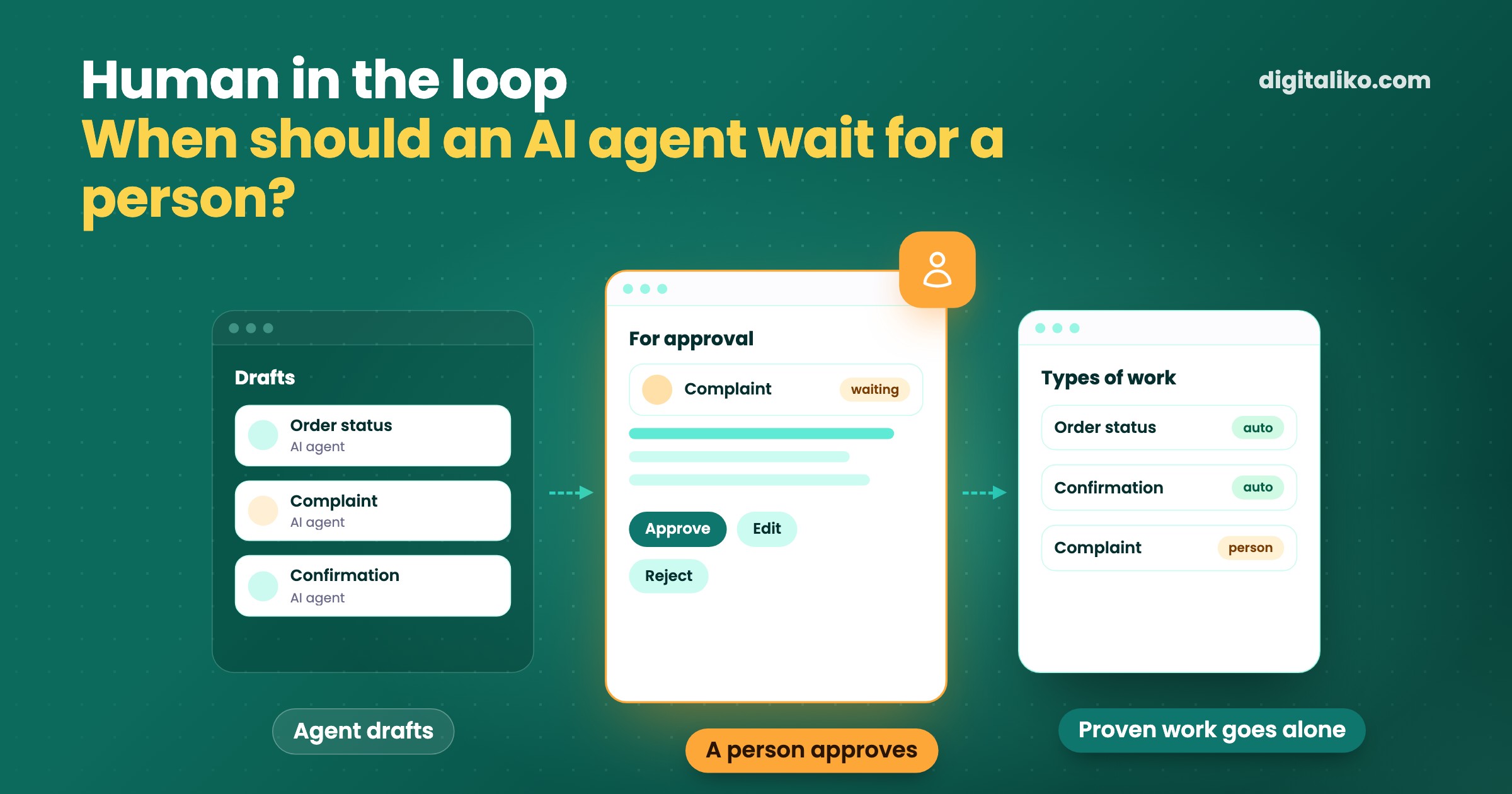
Human in the loop means an AI agent does the work, but a person checks or approves it at agreed points. The agent prepares a reply, an order or a record, and a person confirms, edits or rejects it. The question for a business is not whether to keep a human in the loop, but at which steps.
Below: which steps to approve, how to avoid overloading people with approvals and when to let the agent work alone. The short definition is also in our glossary.
What is human in the loop, simply put?
The agent works and stops at an important step. It sends a draft to a person and waits. The person has three options: approve, edit or reject. Only then does the agent continue.
The second half of the loop matters just as much. Every correction goes back into the agent’s material: its examples, rules and types of cases. Without that, people fix the same mistakes over and over and the loop leads nowhere.
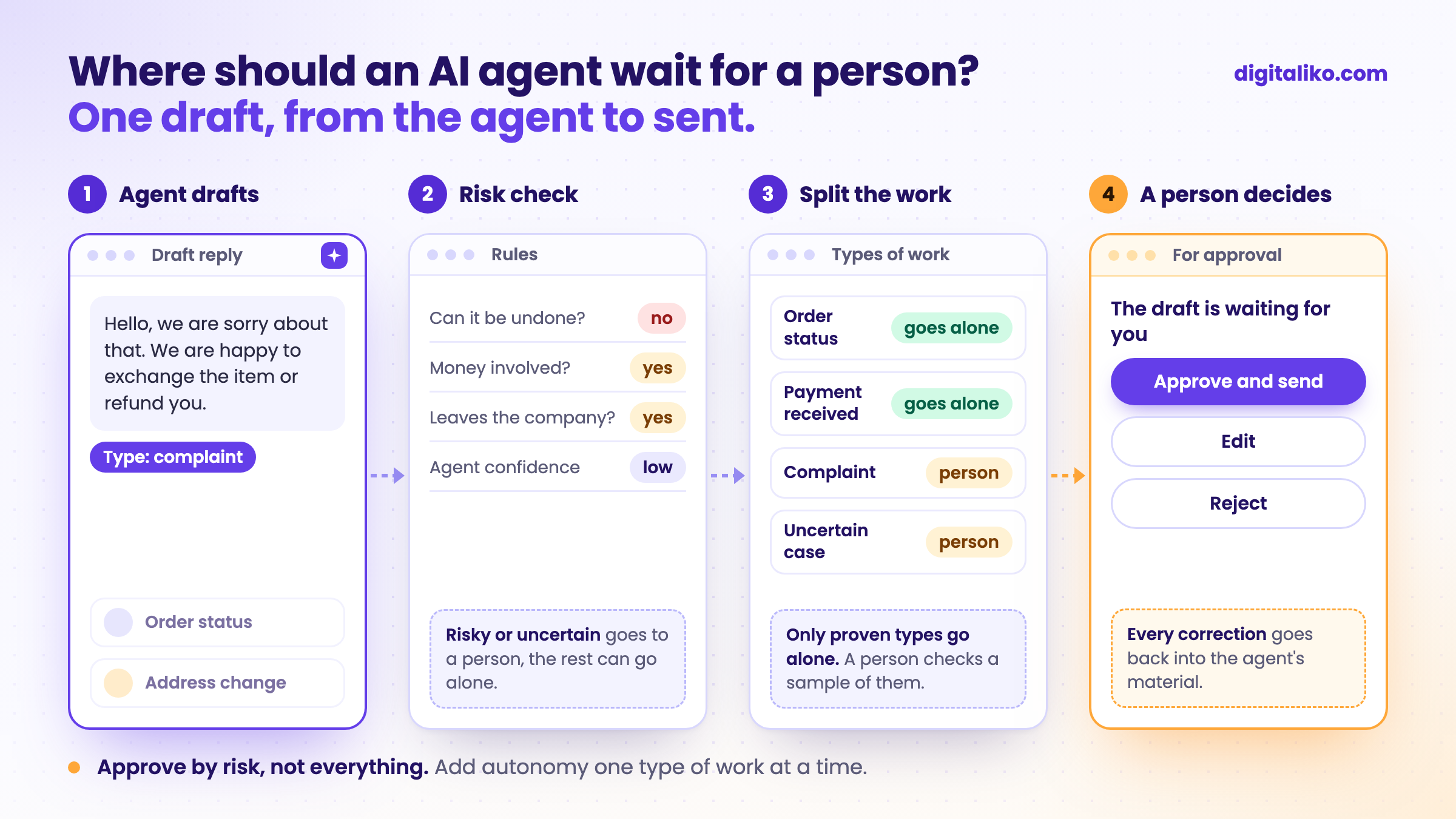
With AI agents this is not extra caution. An agent runs on a language model, which works with probabilities and sometimes gets things wrong. A human in the loop is the reason you can use an agent even where a mistake costs money.
Human in the loop, on the loop, out of the loop: what is the difference?
Articles about AI use three levels. They differ in when a person steps into the work.
| Human in the loop | Human on the loop | Human out of the loop | |
|---|---|---|---|
| When a person steps in | Before the step, approves it | After the step, watches and can intervene | Never |
| Does the agent wait? | Yes | No | No |
| Fits | Risky and irreversible steps | Proven types of work, sample checks | Cheap, reversible tasks |
| Example | Reply to a complaint | Reply to “where is my order?” | Sorting mail into folders |
One agent can use all three at once, a different one for each type of work. That is exactly how it should look.
Which steps should a person approve?
Not all of them. If a person approves every step, the agent saves nothing and people stop using it. Approval belongs where a mistake is expensive. Tick what applies to the step you want to give the agent:
In the agents we build, a person approves the important steps. Code works the same way: AI writes it, a senior checks every change. What an agent must not do at all, even with approval, is in AI guardrails: what a business AI agent must not do.
How do you avoid approval fatigue?
This is where human in the loop breaks most often. A person gets dozens of drafts a day. They read the first ones carefully. A week later they click “approve” without reading, because the agent has always been right so far. Formally they are in the loop, in reality they are not.
The effect has a name: automation bias, the tendency to rely on a machine’s output more than it deserves. The AI Act names it in Article 14 on human oversight of high-risk AI systems. Most business agents are not in that category, but the principle applies to all of them. This is not legal advice.
What helps:
- Less to approve. Only types of work where a mistake is expensive. The rest runs alone or goes into sample checks.
- Material next to the draft. The person sees what the agent used: the order, the history, the rule. They do not have to look for it.
- Clear buttons. Approve, edit, reject. When rejecting, one sentence on why. It goes back into the material.
- Measure corrections. How many drafts people change. When corrections for a type of work disappear, approval there no longer protects anything.
Honestly: we do not have an exact number for how many drafts a day a person can check properly. It depends on the work. Checking a reply about a delivery takes seconds, checking a price quote takes minutes.
When can you let the agent work alone?
Autonomy is not handed over at once. It is added one type of work at a time, as the agent proves it can handle it. We go in this order:
01
The agent drafts, a person approves everything
The first weeks. Every correction goes into the agent’s material.
02
Proven types go alone
Only those where approval stopped producing corrections.
03
A person checks a sample
For types that run alone, part of the results is reviewed regularly.
04
Uncertain cases always go to a person
What the agent does not know, it does not guess. It passes it on.
Step 1 looks like a delay. In fact it is the only way to find out what the agent can handle. Teams that skip it either switch the agent off or spend more time correcting it than it saved.
What does it look like in practice?
For a client selling online we built a customer support agent. It replies to customers in under 5 minutes. Cases it is not sure about go to a person.
- Response time to the customer. Customer support now handles only the complex cases.
- under 5 min
The human in the loop did not slow the work down here. It moved it. Support stopped writing routine replies and spends its time on cases that need judgment. The whole process is in AI agent for customer emails: how to start.
Software development works the same way. Most of our code is written by AI, and a senior checks every change before it is deployed. How that works is in AI software factory with a human in the loop.
When we don’t recommend it
- The task is cheap and reversible. Sorting mail into folders or internal notes. Approval would cost more than the mistake.
- The approver has neither time nor material. Someone who cannot judge a draft just clicks through it. Give them the material first, or pick someone else.
- A fixed rule always gives the same result. Then you need neither an agent nor approval. Automation is enough, as we explain in Agentic workflow vs automation.
- Corrections do not go down even after weeks. More approval will not help. The problem is in the material or in a type of work that does not suit the agent.
Not sure where a person should wait in your process?
Tell us what work you want to give an agent. We get back to you within two business days with a few questions about your work. Then you get a list: what will be done and how you can check it. It also says which steps a person approves.
If you’d rather talk first, book a 15-minute intro call.
How we build such an agent is on Custom AI agent for business. What an agent is and when you do not need one is in What is an AI agent?
Which step in your company would you never give an agent without a check?
In short
- Human in the loop: the agent does the work, a person approves, edits or rejects it at agreed points.
- Approve by risk: irreversible steps, money, anything that leaves the company, and uncertain cases.
- Approval clicked through without reading is worse than none. Give people fewer drafts, with the material next to them.
- Add autonomy one type of work at a time, once corrections disappear. Uncertain cases always go to a person.
Frequently asked questions
What is human in the loop?
Human in the loop means an AI agent does the work, but a person checks or approves it at agreed points. The agent prepares a draft and the person confirms, edits or rejects it. Only then does the agent continue.
What is the difference between human in the loop and human on the loop?
With human in the loop, the agent waits until a person approves the step. With human on the loop, the agent acts on its own and a person watches and can step in. The first fits risky steps, the second proven types of work.
Which AI agent steps should a person approve?
Steps that cannot be undone, cost money, leave the company or concern complaints and legal matters. And anything the agent is not sure about.
How do you stop people from approving blindly?
Give them less to approve, and better: only risky types of work, with the material the agent used next to the draft. Track how many drafts they correct. When corrections for a type of work disappear, let it run alone and check a sample.
When can an AI agent work without approval?
For a type of work where you approved drafts for a while and corrections stopped coming. A mistake must be cheap and reversible. The agent still passes uncertain cases to a person.
Ask AI about this article
The AI also draws on our other articles and experience from real projects.
ChatGPTClaudePerplexity

