Agentic AI for business: what it is and what it means

Filip Papranecfounder of Digitaliko
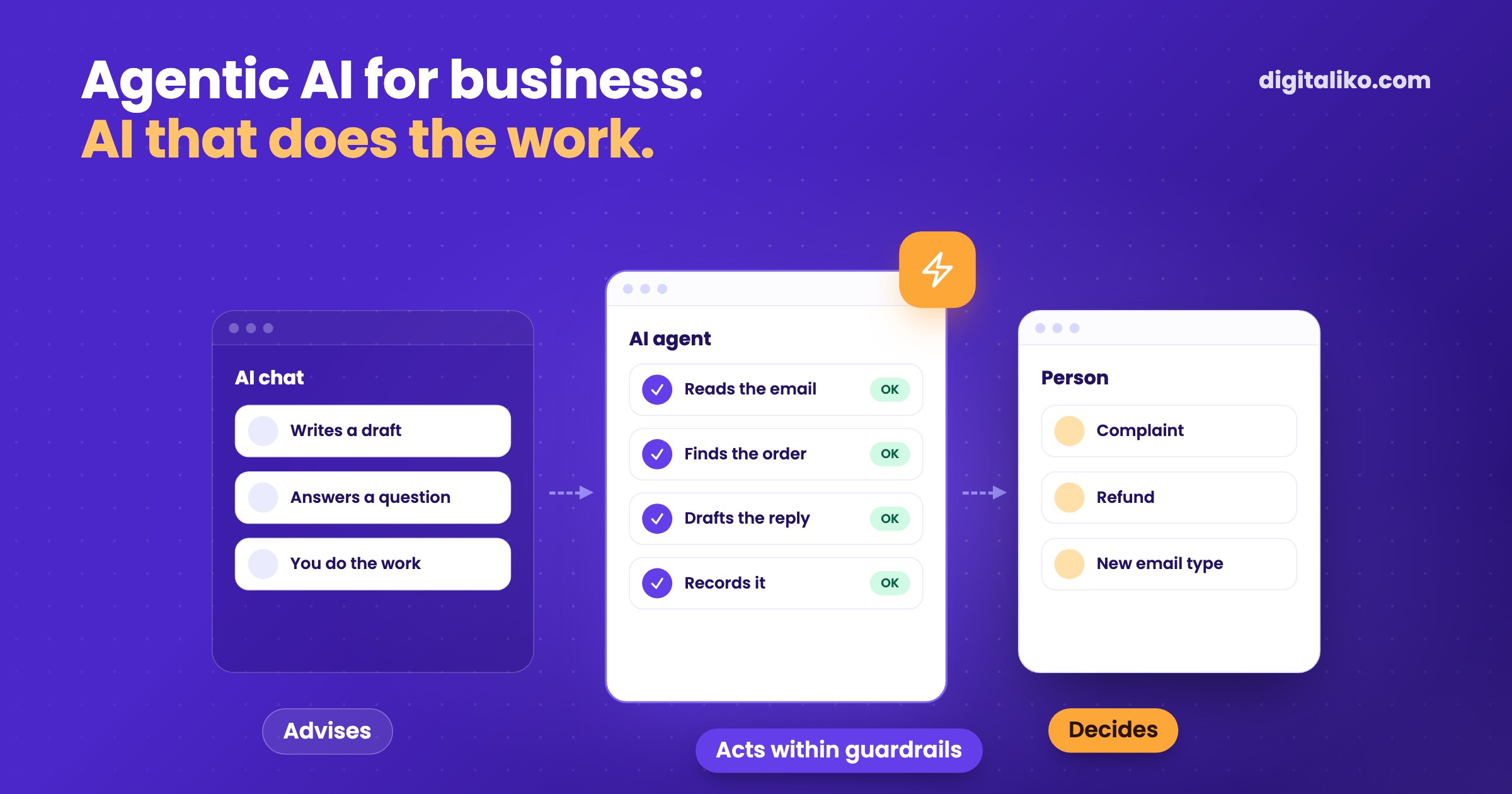
Agentic AI is AI that does not just answer but does the work itself. It gets a goal, breaks it into steps, uses your systems and sees the result through. You set the guardrails, and what it does not know, it hands to a person.
For a business owner, this is the shift from AI that advises to AI that does. Below: how it differs from generative AI and automation, an example from practice, and what to prepare before you let an agent into your company systems.
What is agentic AI in simple terms?
Most companies know AI as a chat. You type a question, get an answer and then do the work yourself. Agentic AI does that work: it opens the email, finds the order, drafts the reply and records what needs recording.
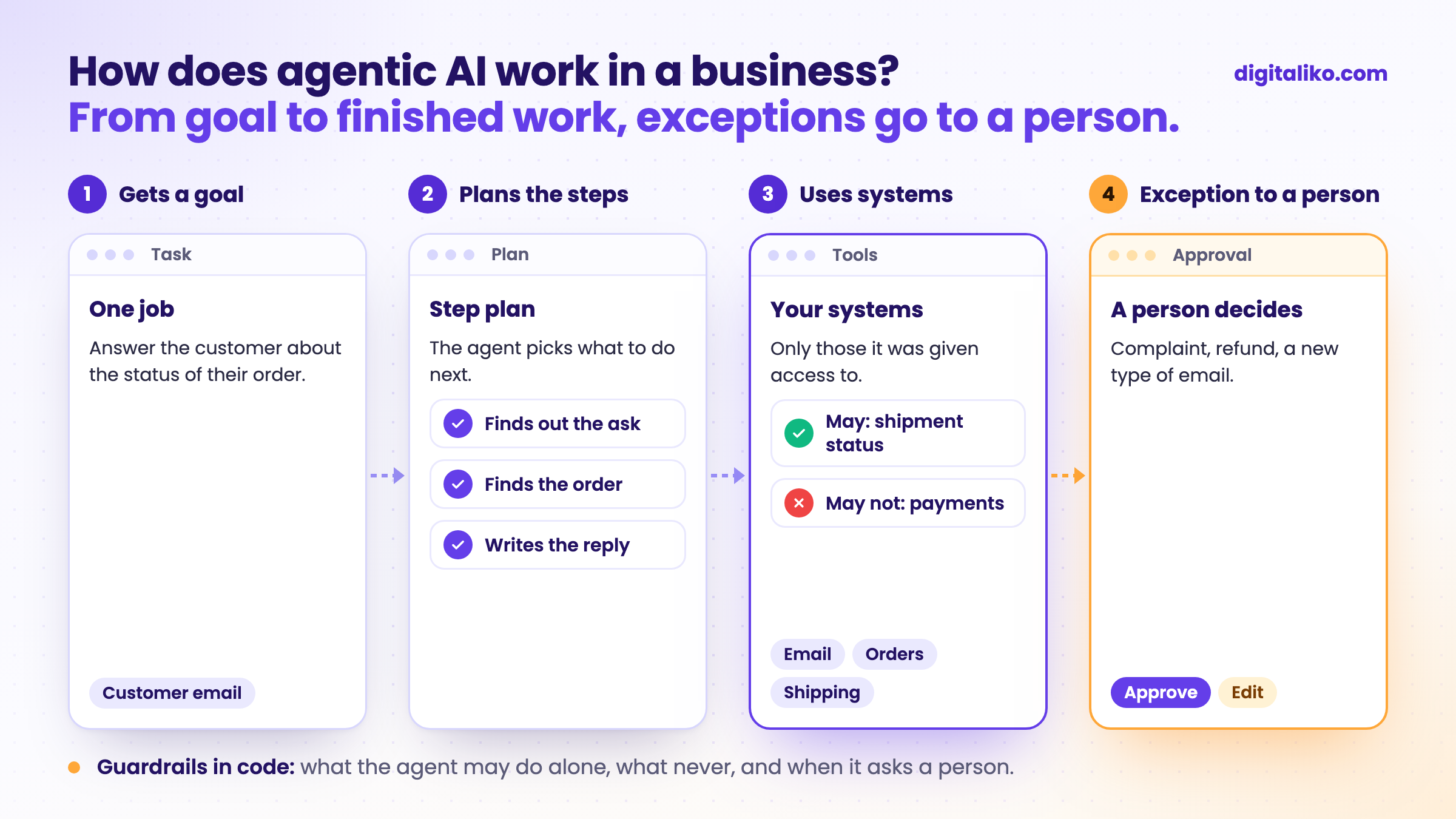
In practice, this means AI agents connected to company systems. Every agent has four parts:
- A goal. One job, for example "answer the customer about their order status".
- Tools. Access to email, orders, stock or the CRM.
- Guardrails. What it may do alone, what never, and when it has to ask.
- A person for exceptions. A specific person who gets what the agent does not know.
You can also find a short definition in the glossary.
Agentic AI vs generative AI vs automation
Vendors mix these three terms in their offers. Yet each one is rolled out differently, costs differently and is checked differently.
| Generative AI | Classic automation | Agentic AI | |
|---|---|---|---|
| What it does | Creates a text or draft on request | Follows the same steps every time | Picks the next step based on what it reads |
| Who acts | The person who uses the result | A rule | The agent, within guardrails |
| Example | A draft quote in a chat | An invoice from email into accounting | A reply to a customer about their order |
| Where it goes wrong | Makes up a fact that is not true | Fails on an exception nobody expected | Picks the wrong step if the rules are unclear |
| What it needs | A person who checks the result | A written process | A process, examples, guardrails and a person for exceptions |
The rule we use: when the work always goes the same way, automation is enough. It is cheaper and more reliable. An agent makes sense when a person reads free text all day and chooses between several steps. Why AI sometimes makes up a fact is explained in AI hallucinations: why AI makes things up, how to limit it.
Where does agentic AI pay off in a business?
Where the work repeats every day, but every case looks a little different. Typically:
- Customer emails. Order status, change of address, a question about a product.
- Orders and enquiries. They arrive by email in different formats and someone retypes them into the system.
- Documents. Invoices, delivery notes, contracts that data has to be pulled out of.
- Overviews. Data from several systems that someone assembles into a report every week.
For a client selling online we built a customer support agent. The agent reads the email, finds the order and the shipment status and writes the reply. When it is not sure, it hands the email to a person.
- Reply time to customers. Customer support now handles only the complex cases.
- < 5 min
Where is agentic AI hype?
Agentic AI is often described today as "digital employees" who can handle everything. We disagree. An agent runs on a language model, and that model works with probabilities. Sometimes it gets things wrong, and it does so confidently.
The analyst firm Gartner sees it similarly:
Most agentic AI projects right now are early-stage experiments or proof of concepts that are mostly driven by hype and are often misapplied.
In our view, three things follow. Do not start the project with a tool, start with the work you want off your plate. Start with one task, not an "agent for everything". And decide up front how you will know it works: reply time, number of cases without a person, number of mistakes.
What do you need before you let an agent in?
Most of the time does not go into the model but into the preparation around it. This is the approach we recommend for every agent:
01
We pick one job
One that happens every day and can be measured.
02
We read real cases
Old emails, orders or documents. We write down which types come in.
03
We write down the guardrails
What the agent may do alone, what never, and when it asks a person.
04
The agent only drafts at first
A person approves every draft. That is how we find out where it goes wrong.
05
Autonomy bit by bit
Only for the types of cases where the drafts are right. Sensitive steps stay with a person.
Guardrails belong in code, not only in an instruction to the model. The model can overlook the instruction "never issue refunds". An agent that has no access to payments cannot issue them. What can happen when an agent reads someone else's text is in Prompt injection: how to protect an AI agent at work.
Count on running costs too: the model is paid by usage and the agent needs fine-tuning over time. What it costs is broken down in How much does an AI agent cost.
Is agentic AI right for your business?
Tick what applies to you:
When we do not recommend agentic AI
- The work always goes the same way. Forms, copying between systems, identical invoices. Classic automation is cheaper and more reliable.
- You want an "AI employee" for everything. There is no such thing. We start with one job, the next one comes when the first one runs.
- You expect 100 % accuracy without checks. If nobody can take over the exceptions, do not start.
- You just want to write faster. Quotes, translations, texts. An AI chat subscription is enough for that.
We describe the difference between a tool and finished work in AI agent: a tool or finished work?
Want to know if an agent would save you time?
Tell us which work you want to get rid of. We get back to you within two business days with a few questions about your work. Then you get a list: what will be done and how you can check it. If you do not need an agent, we will tell you that too.
How we build an agent is on the page Custom AI agent for business. If you'd rather talk first, book a 15-minute intro call.
In short
- Agentic AI does not just answer, it does the work itself within the guardrails you give it.
- Generative AI drafts, automation always goes the same way, an agent picks steps based on what it reads.
- It pays off for daily work with free text: emails, orders, documents.
- Start with one job, the agent only drafts at first and a person takes over the exceptions.
Frequently asked questions
What is agentic AI in simple terms?
AI that does not just answer but acts. It gets a goal, breaks it into steps, uses your systems and sees the result through. What it does not know or may not do, it hands to a person.
What is the difference between agentic AI and generative AI?
Generative AI creates a text, an image or a draft when you ask. Agentic AI also does something with the result: finds the order, records the data, prepares the reply to send. Agentic AI uses generative AI but adds tools, rules and a process.
Is agentic AI the same as an AI agent?
Almost. Agentic AI is the name of the approach, an AI agent is the specific software that uses it. When a company talks about agentic AI, in practice it rolls out one or more AI agents for a specific job.
Which businesses does agentic AI pay off for?
Businesses where people read free text every day and take several steps in systems based on it: customer emails, orders, enquiries, documents. When the work always goes the same way, classic automation is cheaper.
Can agentic AI work completely without a person?
On selected tasks, yes, but only after you have approved its drafts for a while and know where it gets things wrong. Sensitive steps, such as money, deleting data or promises to customers, should be approved by a person.
Ask AI about this article
The AI also draws on our other articles and experience from real projects.
ChatGPTClaudePerplexity

