Agentic workflow vs automation: which fits your process

Filip Papranecfounder of Digitaliko
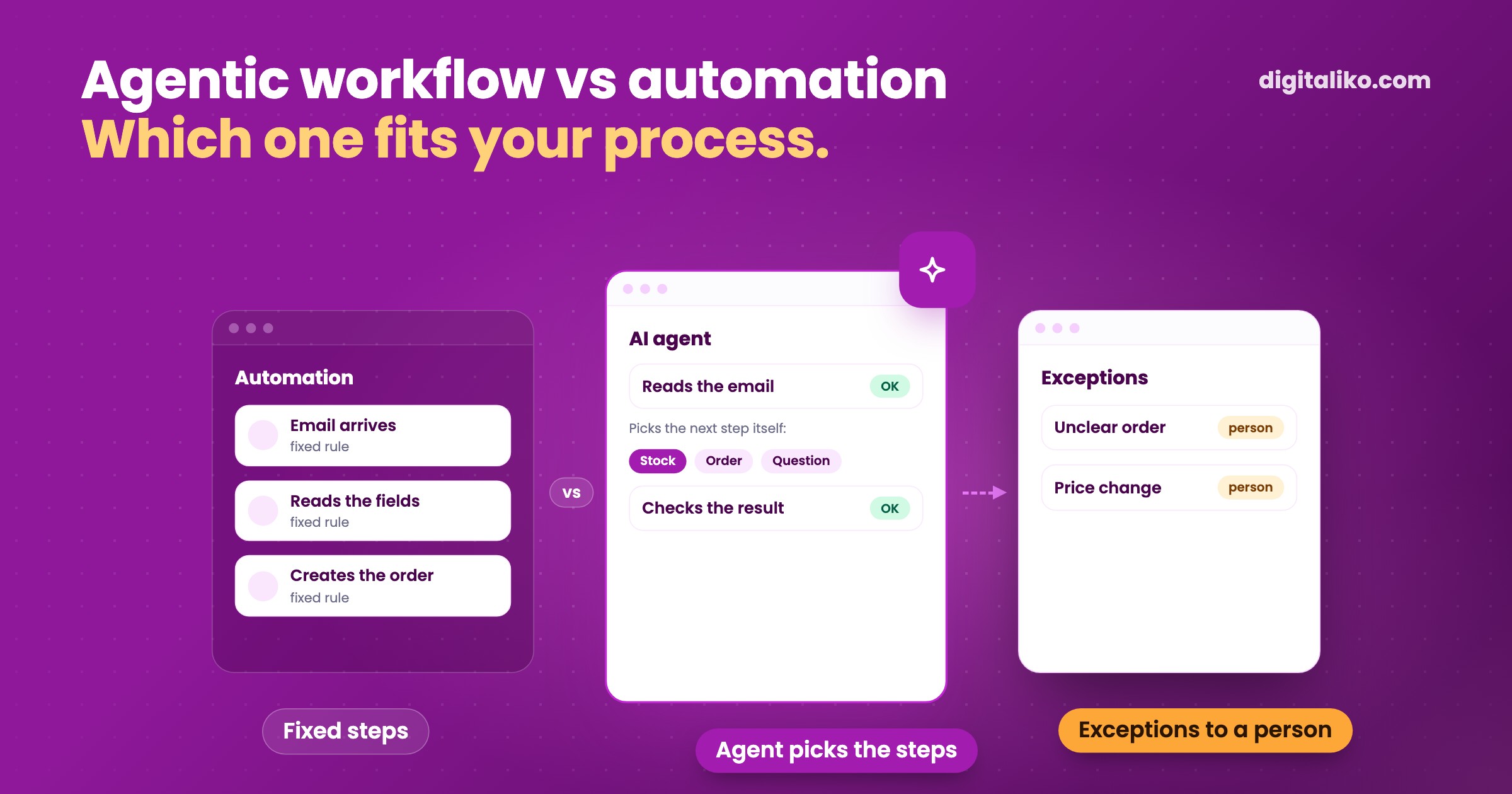
An agentic workflow is a process in which an AI agent picks the next step itself: it reads the input, uses tools and checks the result. Classic automation always follows the same steps, based on rules. If the work can be described by a rule, automation is enough. An agent makes sense only where someone has to read free text and choose between steps.
Below: the difference in a table, a test for when rules are enough, and an example from our own accounting. The short definition is also in our glossary.
What is an agentic workflow, simply put?
Take an order that arrives by email. It can be processed in three ways:
- Classic automation. Fixed rules: an email from a form, fields by template, the order is created. It works as long as the email always looks the same.
- Automation with an AI step. The steps are just as fixed. AI only reads the free text and pulls the data out of it. Rules do the rest.
- Agentic workflow. The agent reads the email and decides what to do next: check stock, create the order or ask the customer. Then it checks whether the result is right.
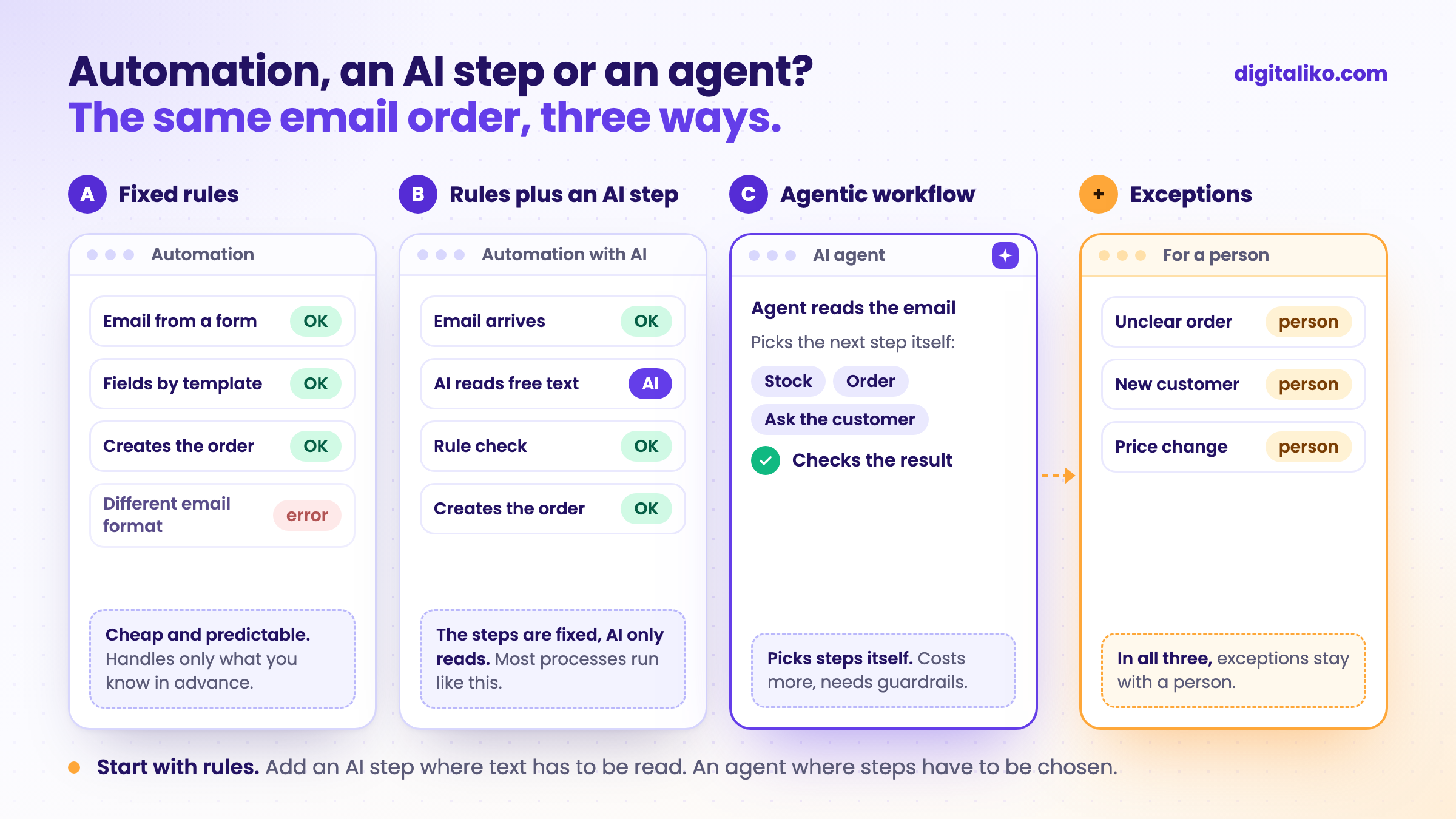
In all three, exceptions stay with a person. The difference is how many decisions the software makes on its own.
Agentic workflow vs classic automation: what is the difference?
| Classic automation | Automation with an AI step | Agentic workflow | |
|---|---|---|---|
| Steps | Fixed | Fixed | The agent picks them |
| Input | Always the same shape | Free text that AI reads | Free text and varied situations |
| Exception | An error, goes to a person | An uncertain value goes to a person | The agent handles what it knows, the rest goes to a person |
| Running cost | Almost nothing extra | The model on every read | The model on every decision |
| Predictability | Highest | High | Lower, needs guardrails |
| Example | Form into a CRM | Invoice from email into accounting | Reply to a customer about their order |
Most search results put agentic workflows against automation as the new generation against the old. In practice it is a ladder. Each rung up costs more and is less predictable. Climb only as high as the process really needs.
When is classic automation enough?
More often than people write today. Tick what applies to your process:
If most points apply, an agent adds nothing. It only adds model costs and one more place where something can break.
When do you need an AI step, and when an agent?
You need an AI step when the steps are clear but the input is not. Invoices are the typical example. Every supplier formats them differently, and one fixed template does not fit them all.
That is exactly how we automated our own accounting. Invoices arrive by email, AI reads the data and rules write it into the accounting system. The steps are fixed, AI only reads. Honestly: by the definition above, this is not an agentic workflow but automation with an AI step. For invoices, that is enough.
- Processing one invoice in our accounting
- 10-15 min → <1 min
- Of invoices go through with no person involved
- 70 %
You need an agent when the steps change too. A customer asks about an order, files a complaint or changes an address. Each wants something different, and the right next step depends on what they wrote. We built such an agent for customer support for a client selling online. How an agent differs from a chatbot is in What is an AI agent?
How do you choose for your process?
Do not start with “which tool”. Start with the process and climb the ladder from the bottom:
01
Describe the process, exceptions included
What comes in, what people do with it and when the steps do not fit. On real examples.
02
Automate what a rule can do
Moving data, checks, writing into a system. Cheap and predictable.
03
Add an AI step where text has to be read
An invoice, an email, an order in free text. The steps stay fixed.
04
An agent only where steps have to be chosen
Every case is different and the right step depends on the content.
05
Exceptions to a person
At every rung, decide who takes over what the software cannot do.
It often turns out that you need an agent in one place only. Rules handle the rest of the process. What this looks like for orders is in Automate email order processing.
Who handles the exceptions?
Exceptions do not disappear with an agent. They only change. With rules, an exception is anything they did not know in advance. With an agent, it is whatever it is not sure about, plus steps that cost money or cannot be undone.
That is why, for every process, we decide who gets the exception and what they do with it. Which steps a person should approve and when to let the agent work alone is in Human in the loop: when should an AI agent wait?
When we don’t recommend it
- You want an agent because it is trendy. If most points of the test above apply, automation is enough. We will tell you so.
- Nobody has written the process down. The agent has nothing to learn from and nobody can write the rules. We describe it together first.
- The result must be the same and verifiable every time. Accounting, reports, prices. Rules win here. Let AI only read.
- An agent for the whole process at once. Start with one place where rules are not enough. The next comes once the first is running.
Not sure what your process needs?
Tell us which work you want to hand to software. We get back to you within two business days with a few questions about your work. Then you get a list: what will be done and how you can check it. We will also tell you if you do not need an agent.
If you’d rather talk first, book a 15-minute intro call.
How we automate processes in companies is on Business process automation.
Which work in your company repeats the same way every time, and a person still does it?
In short
- Agentic workflow: an AI agent picks the next step itself. Classic automation follows fixed steps.
- In between is automation with an AI step: fixed steps, AI only reads the text. Most processes need just that.
- Each rung up costs more and is less predictable. Climb only as high as the process needs.
- In all three, exceptions stay with a person.
Frequently asked questions
What is an agentic workflow?
An agentic workflow is a process in which an AI agent plans the steps, uses tools and checks its own result. It does not follow fixed steps; it picks what to do next based on what it is reading. It sends exceptions to a person.
What is the difference between an agentic workflow and automation?
Classic automation always follows the same steps, based on rules you described in advance. An agentic workflow picks its steps itself. Automation is cheaper and more predictable; an agent handles cases that do not fit the rules.
When is classic automation enough?
When the input always arrives in the same shape, the process can be drawn without the words “it depends”, and exceptions are rare. Moving data from a form into a system, for example. Then automation is cheaper and more reliable than an agent.
Is AI in an automation the same as an AI agent?
No. If AI only reads an invoice or an email inside fixed steps and rules do the rest, it is automation with an AI step. It becomes an agent only when the AI itself chooses which step to take next. Most processes need only the AI step.
Is an agentic workflow more expensive than automation?
Usually, yes. An agent calls a language model for every decision and needs guardrails, a log of its steps and a person for exceptions. It pays off where fixed rules are not enough and manual work costs more.
Ask AI about this article
The AI also draws on our other articles and experience from real projects.
ChatGPTClaudePerplexity

