Pay for an AI tool, or for finished work?
Trends and what they mean for you · Updated

Filip Papranecfounder of Digitaliko
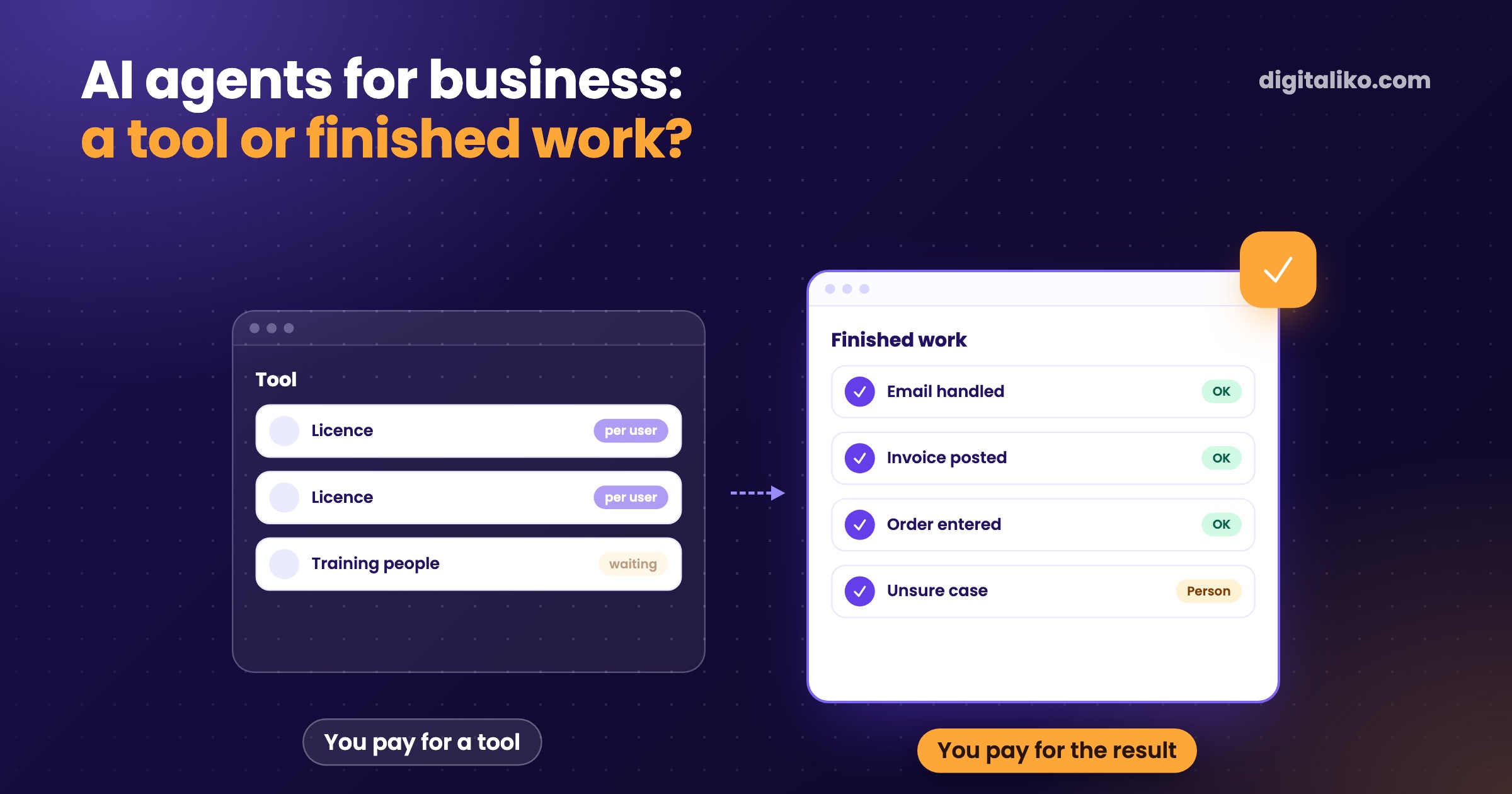
What it means for you: a commentary on Sequoia Capital's essays about AI that sells work (2024 and 2026).
You can buy an AI agent for your company in two ways. Either you pay for a tool your person operates, or for finished work the agent hands over. For a company running on Excel and a full inbox, the second usually makes more sense, but only for work that can be checked.
The venture firm Sequoia Capital is pushing this idea today. Below is what it actually says, where we agree, where we do not and what it looks like in our work. If you are not sure what an agent is yet, start with What is an AI agent?
What does Sequoia say about AI agents?
In March 2026 Julien Bek of Sequoia wrote the essay Services: The New Software. His main argument: companies spend about six times more on services than on software. So the biggest AI companies will not sell tools, they will sell finished work.
Bek sums it up in one line:
A copilot sells the tool. An autopilot sells the work.
A copilot is a tool in the hands of a professional who is responsible for the result. An autopilot delivers the result straight to the company that needs it. He advises starting with work companies already pay outsiders for.
The older piece Generative AI's Act o1 by Sonya Huang and Pat Grady (October 2024) points the same way. In it, an agent is paid per resolved case, not per user. The authors also describe the path: first deploy AI with a person who checks it, and only with practice let it work alone.
Our view
We agree with the core. An owner of a Slovak or Czech company does not want another tool people have to learn. He wants the invoices posted and the emails answered.
Do not sell the app, sell the outcome. The software is just the tool. For the team, the outcome should be an efficiency gain.

The examples do not fit. Sequoia writes about US lawyers, insurance brokers and auditors. A company with 20 people in the office has no contracts department. Its work is smaller and scattered: emails, orders, invoices, retyping between systems.
"Finished work" is not a switch. We have not seen an agent that works alone from day one actually work. The Huang and Grady path, first with a person and then alone, is exactly what we do.
A tool or finished work: what is the difference for your company?
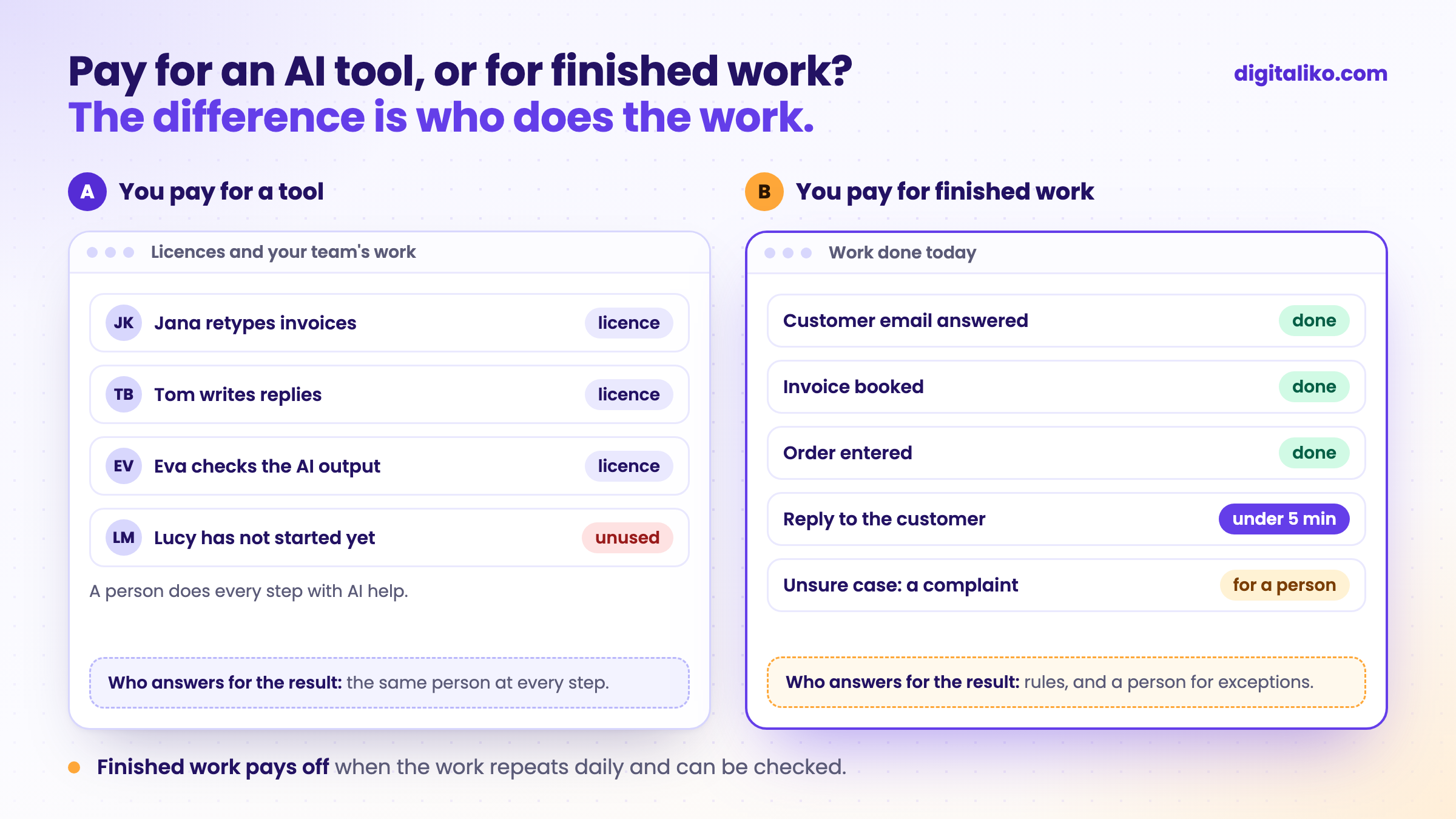
The difference is not the technology. It is who does the work and who is responsible for the result.
| You pay for a tool | You pay for finished work | |
|---|---|---|
| What you buy | A licence for every user | Handled emails, posted invoices |
| Who does the work | Your person, helped by AI | The agent, a person only on exceptions |
| Who checks the result | The same person at every step | Rules, plus a person on unsure cases |
| What you need | People's time to learn it | A written process, examples, a person for exceptions |
| When it pays off | The work is different every time | The work repeats daily and can be checked |
| Most common risk | Nobody uses the tool after a month | The agent answers wrongly in your name |
Most companies buy the left column today, because they know it from SaaS. The right column needs more preparation, but saves more time. How an agent differs from plain automation is covered in AI agent or automation: what do you need?
Filip decides this for himself in a simple way:
When I understand something, I use AI and check the result myself. When I don't, I pay someone who does. They may well use AI too.
What does finished work look like for us?
For a client with an online shop we built an agent for customer support.
- Reply time to the customer. Customer support now handles only the complex cases.
- under 5 min
The client did not buy a tool they had to learn. They got answered emails. In the first weeks, though, the agent only drafted, and we sent the replies by hand.
The person did not leave the process. Customer support handles the complex cases and the ones the agent is not sure about. It is similar with invoices in our own accounting: 70 % go through without a person, a person checks the rest.
Our view
Here we part ways with Sequoia on emphasis. For an investor, the interesting part is that the person leaves the process. For an owner, what matters more is who catches the remaining cases. Finished work without a person on the exceptions is just a faster way to make a mistake in your name.
One more thing. Sequoia describes paying per resolved case. We do not bill that way today. We work on a monthly subscription and the solution is yours from day one.
What to do this month?
01
Pick one job
One that a single person does all day today, or that you pay someone outside for. For example customer emails, retyping invoices or orders from email.
02
Measure it
How many cases a week, how many minutes each, how many of them are exceptions. Without these numbers you cannot judge any offer.
03
Ask about the result, not the features
What happens to an unsure case? Who gets it? How will you measure that the agent works well?
How we build such an agent for you is described on Custom AI agent for business.
When we don't recommend it
Tick what is true for you:
Not sure whether a tool or finished work pays off for you?
Tell us which work you want gone. We get back to you within two business days, and together we pick what to fix first. We will also tell you if a tool is enough.
If you'd rather talk first, book a 15-minute meeting with Filip.
Which work would you most like to get finished, rather than as one more tool?
In short
- You can pay for AI as a tool for your person, or for finished work.
- Finished work pays off for work that repeats daily and can be checked.
- The agent drafts first and a person approves. Only then does it send on its own.
- The person for exceptions does not leave the process. Without them, finished work is just a faster mistake in your name.
Frequently asked questions
Is an AI tool better, or an agent that does the work?
It depends on the work. If it is different every time and judgement decides, buy a tool for a person. If it repeats every day and the result can be checked, finished work with a person on the exceptions pays off.
Will an AI agent replace an employee?
Usually not a whole one. It takes the repeated part of the work and leaves the exceptions to a person. For a client with an online shop, the agent answers customers within 5 minutes and customer support now handles only the complex cases.
Do you charge per handled case?
No. We work on a monthly subscription you can cancel any month. The solution is yours from day one, so the agent keeps running even if we stop working together.
Where should a company start with an AI agent?
With work one person does all day today, or that you pay someone outside to do. Count the cases per week and the exceptions. The agent first only drafts and a person approves; only then does it send on its own.
Sources: Julien Bek, "Services: The New Software", Sequoia Capital, 5 March 2026, sequoiacap.com. Sonya Huang and Pat Grady, "Generative AI's Act o1", Sequoia Capital, 9 October 2024, sequoiacap.com. The retelling is ours; Sequoia has nothing to do with this article.
Ask AI about this article
The AI also draws on our other articles and experience from real projects.
ChatGPTClaudePerplexity