Vibe coding: what it is and why software got cheap
Trends and what they mean for you · Updated

Filip Papranecfounder of Digitaliko
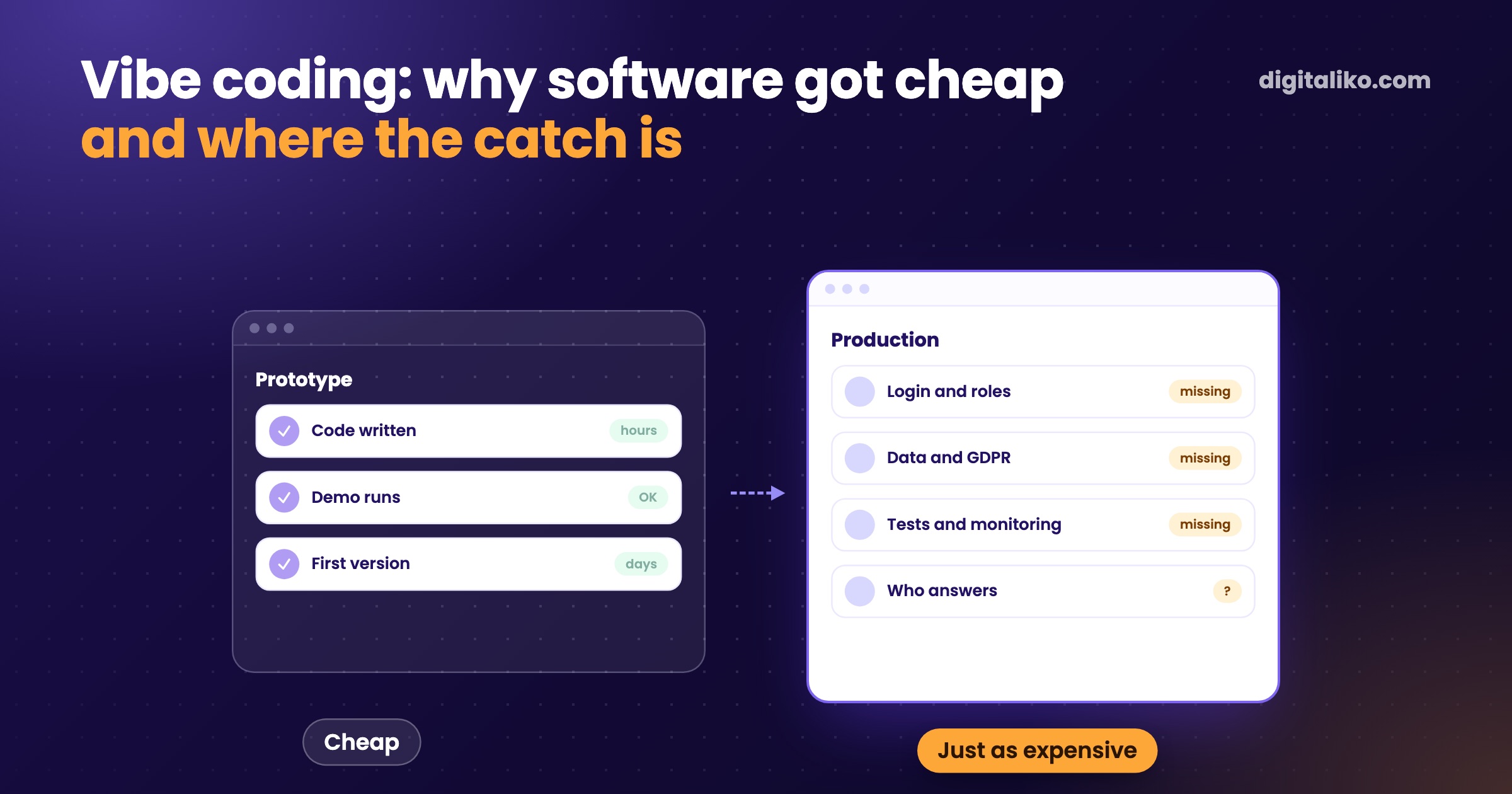
Vibe coding is building software by telling an AI what you want in plain sentences and letting it write the code, without reading the code yourself, only checking whether the result works. Andrej Karpathy coined the term in 2025.
What it means for you: a commentary on Andrej Karpathy's talk "Software Is Changing (Again)" (Y Combinator, 2025) and Sam Altman's essay "Three Observations" (2025).
Software got cheaper because AI now writes code from a plain sentence and the price of AI falls fast every year. The catch is that only the code got cheap. Login, data, security and responsibility for production cost almost what they did before.
Below is what two people say about it, people you mostly hear about second hand. With each idea we add where we agree, where we do not and what we see in our own work.
Why did software suddenly get cheap?
In June 2025 Andrej Karpathy gave the talk Software Is Changing (Again) at Y Combinator's AI Startup School. Karpathy previously worked at OpenAI and Tesla, and he is the one who introduced the term "vibe coding". He says we are in the era of "Software 3.0": the program is a brief written in plain language, and the model does the rest. So suddenly anyone who can describe what they want can program.
The other half of the explanation comes from Sam Altman of OpenAI. In February 2025 he wrote in the essay Three Observations that the price of the same AI capability falls roughly tenfold a year:
The cost to use a given level of AI falls about 10x every 12 months, and lower prices lead to much more use.
Our view
We agree, we see it every day. Today AI writes all of our code. We handed over the first version of one project in under 10 working days. A few years ago that would have been months of work.
We disagree with "anyone can program". Anyone can build a demo. Not everyone can tell whether it has a hole that leaks customer data. On one task we noticed that the tests the agent wrote checked a side issue. A junior would have waved them through as fine.
Altman's curve is the price of the model, not the price of your project. The model gets ten times cheaper; the hour of the person who decides and is responsible does not. That is why a project gets less cheap than the headlines suggest.
Knowing what to deliver and how is not cheap. Responsibility when it falls over six months later is not cheap. And that is exactly what you pay for.

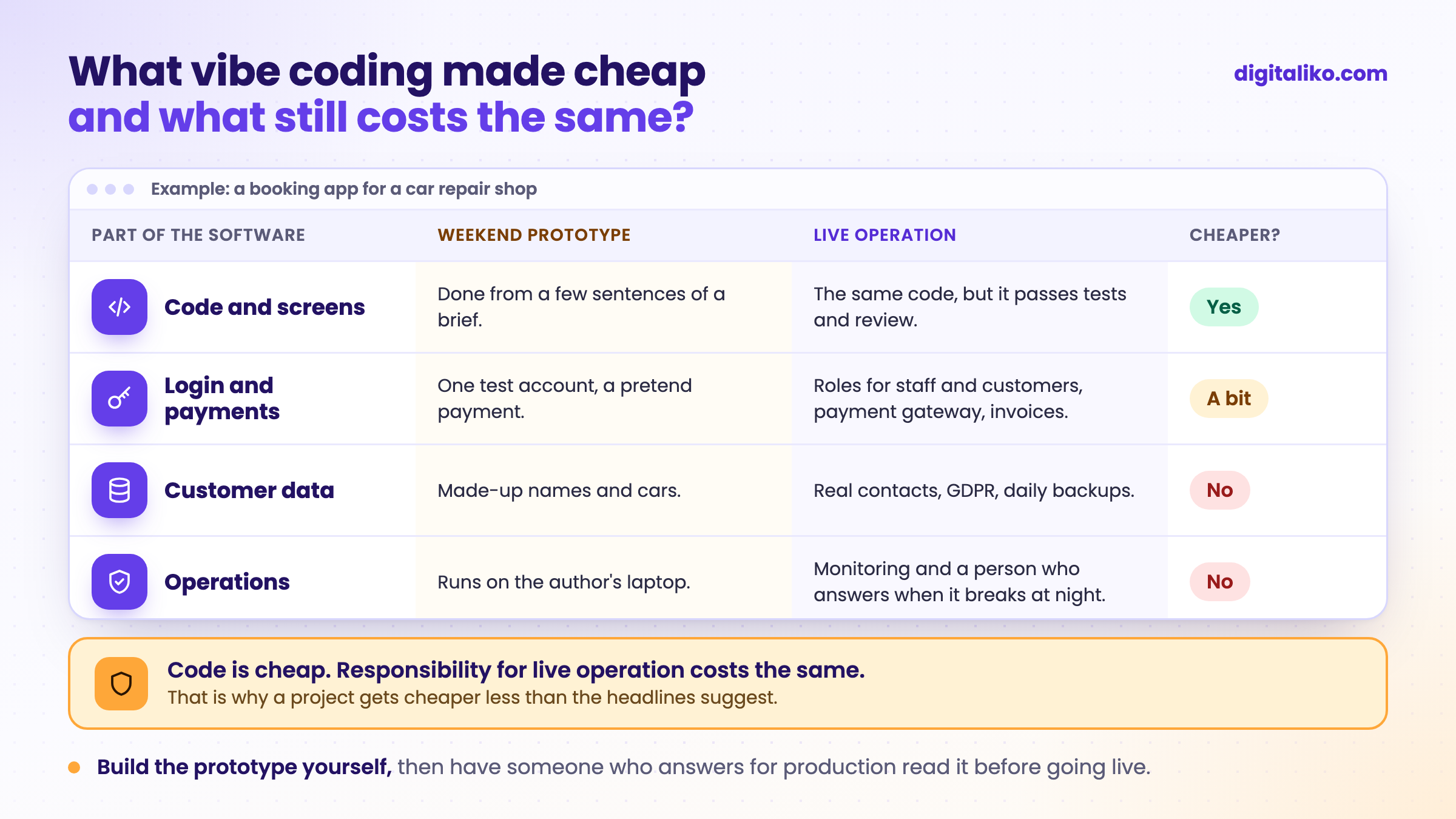
For one small app it looks like this:
Where is the catch?
Karpathy describes it best himself. In the same talk he talks about MenuGen, a small app he vibe coded. The demo worked on his laptop quickly. Most of the work came when he tried to make it real: login, payments, a domain, deployment. That, he says, was really hard.
And most of it actually was when I tried to make it real so that you can actually have authentication and payments and the domain name and Vercel deployment. This was really hard.
Karpathy and Altman both also repeat that AI needs a person. Karpathy advises keeping AI "on a leash" and letting a person check every output quickly. Altman writes that even a future AI software engineer will need a lot of human supervision.
Our view
A prototype and production are two different things. For a company, that road is longer. Karpathy built the app for himself. A company has customers, invoices, GDPR and people who expect the system to run in the morning. Here is the difference in one table:
| Part of the software | Did it get cheaper? | Why |
|---|---|---|
| Writing the code | Yes, sharply | AI writes it from a description |
| A first version to show | Yes | Hours to days instead of months |
| Login, roles, payments | A little | AI writes the code; setting up and checking stays with a person |
| Data and moving off the old system | No | It has to be understood, cleaned and checked |
| Security and GDPR | No | A mistake shows up only at the customer |
| Tests | Partly | AI writes them; a person decides what must hold |
| Operations and responsibility | No | Someone has to answer when it goes down at night |
What exactly a prototype lacks for production is covered in Vibe coding to production: what the prototype is missing. If you have an app from Lovable, see Lovable to production: code export and app security.
How do we do it?
We use the same tools as vibe coding. The difference is what happens around them. One sentence holds with us: today AI writes all the code, and Filip answers for production.
In practice that means three things. Before deployment the code passes tests and checks that must be green. A senior reads it and decides whether it goes on. And after launch we stay through the transition into operation.
- to launch the whole system on one project
- within a month
- of support during the transition into operation
- 30 days
That is also how we launched one project within a month. Vibe coding gets you a prototype. We build software that runs a business.
What to do this month?
You do not need to pay a supplier right away. Go in this order:
01
Build the prototype yourself
Vibe coding is great for testing an idea. Show it to your first customers before you put more money in.
02
Write down what must hold in production
Who logs in, what data the system keeps, what happens on an error and who fixes it.
03
Have the code read by someone who answers for production
Before you let real customers and their data in.
If you want the first version built for production from the start, see MVP development for founders.
When we don't recommend it
- You are building a tool for yourself or a few colleagues. Without sensitive data and payments, vibe coding is enough. You do not need us.
- You only want to test whether there is interest. A prototype and a few customer conversations are cheaper than a finished system.
- You expect cheap code to mean a project without decisions. AI will not make the decisions about data, roles and exceptions for you.
- The prototype must not change. If you insist it only needs "polishing" when the foundation needs rebuilding, do not start.
Vibe-code a holiday app over the weekend, seriously, you save money. But if a company is going to run on it, you have to keep quality high all the time.
Not sure whether the prototype is still enough? Tick what is true of your app.
Sources
Andrej Karpathy, "Software Is Changing (Again)", Y Combinator AI Startup School, June 2025, youtube.com, transcript at ycombinator.com. Sam Altman, "Three Observations", blog, 9 February 2025, blog.samaltman.com. The retelling is ours; the authors have nothing to do with this article.
Have a prototype and not sure what next?
Send us what you have. We get back to you within two business days, and together we pick what to fix first. We will also tell you if the prototype is enough for now.
If you'd rather talk first, book a 15-minute meeting with Filip.
What is stopping you from putting the prototype in front of your first customers today?
In short
- Software got cheap because AI writes code from a plain sentence and the price of AI falls fast.
- Only the code is cheap. Data, security and responsibility for running it cost about the same.
- Build the prototype yourself and test the idea with your first customers.
- Before going live, have the code read by someone who answers for production.
Frequently asked questions
Why is software development cheaper today?
AI now writes code from a description in plain language, and the price of the same AI capability falls fast. A first version that used to take months is done in days. Data, security and operations did not get cheaper.
Is vibe coding suitable for a company?
For a prototype, testing an idea or a small internal tool, yes. For a system with customer data, payments or many users, not without more work. Someone has to read the code and be responsible for running it.
What does a vibe coding prototype lack for production?
Most often login and roles, safe handling of data, tests, backups, monitoring and a person who knows what to do when it goes down. The code is usually the smallest problem.
Who is responsible for code written by AI?
Always a person. AI carries no responsibility. With us, AI writes all the code and Filip answers for production: the code passes tests and checks before it reaches users.
Ask AI about this article
The AI also draws on our other articles and experience from real projects.
ChatGPTClaudePerplexity