The end of per-seat pricing? AI agents and SaaS prices
Trends and what they mean for you · Updated

Filip Papranecfounder of Digitaliko
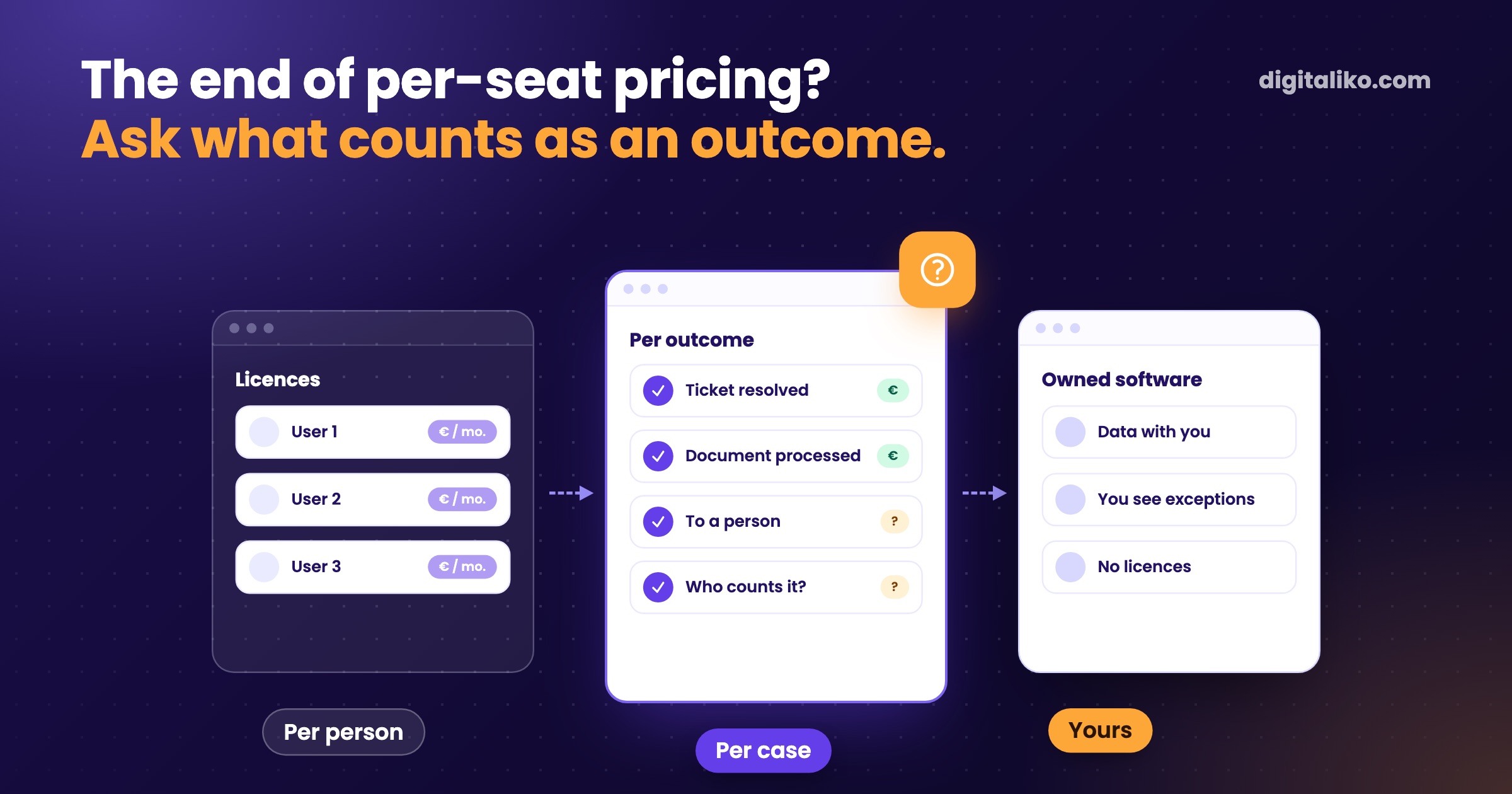
What it means for you: a commentary on texts by a16z (2024) and Bessemer Venture Partners (2026) on software pricing in the age of AI agents.
Per-seat SaaS pricing stops fitting where an AI agent does the work. When the agent handles part of the requests, you need fewer people in the system, and so fewer licences. Vendors are therefore moving to paying per use or per outcome. That leaves you with a new question: what exactly is an "outcome", and who counts it.
Below is what two well-known investors write about it, where we disagree and seven questions for your vendor.
What do a16z and Bessemer say about SaaS pricing?
In December 2024, Ivan Makarov, James da Costa and Bobby Pinero wrote in the a16z newsletter that AI is starting another shift in software pricing. The first one came with SaaS and per-seat pricing. Now AI does work people used to do, such as customer support or back-office admin. New AI vendors charge per use, per outcome or a mix. Established players, they note, mostly stay with seats.
Per-seat is no longer the atomic unit of software.
In February 2026, the Bessemer editors added the other side in their AI pricing playbook. With classic SaaS, one more customer costs the vendor almost nothing. With AI, every request to the model costs money. Paying per outcome fits value best, but the vendor carries the risk of swinging costs. A base subscription plus usage gives both sides predictability.
Our view
We agree with the core. Paying for every person in software whose whole point is that fewer people do the work makes no sense.
Do not sell the app. Sell the outcome.

So we see outcome pricing as the right direction for us too. We do not offer it today. Why, we show below with our own invoices.
Both texts are written for vendors, not for you. They advise founders on how to price their product. The business owner buying the software sits on the other side of the table. With outcome pricing, the owner does not decide what counts as an outcome.
Volumes in Central Europe are smaller and seasonal. An invoice that grows with the number of cases is hard to plan. Bessemer itself admits companies want a fixed budget for technology.
Both texts barely mention the third option. Owning the software and paying for building and running it, not for people or for cases.
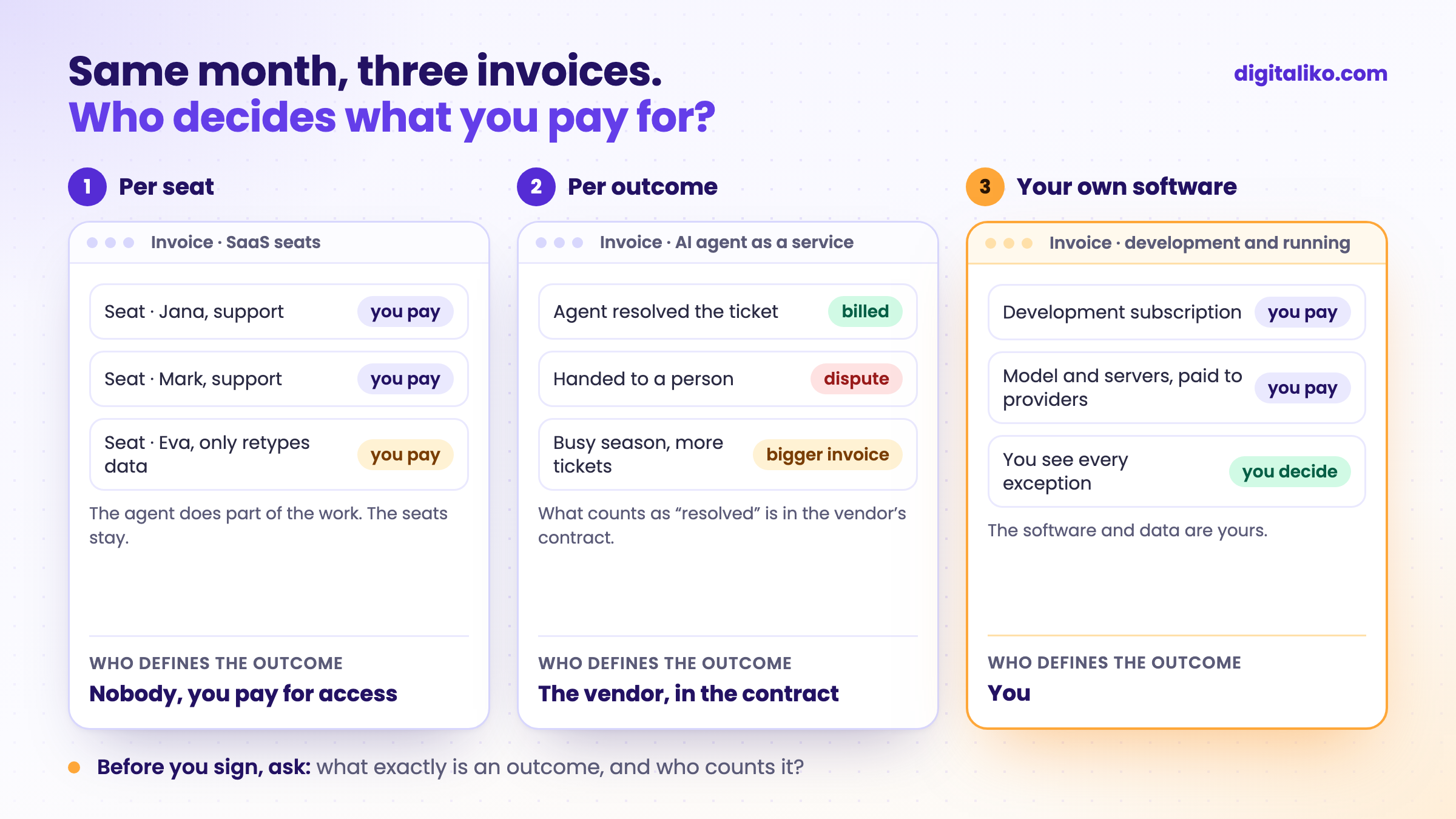
Per seat, per outcome, or owned software?
| Per seat (SaaS) | Per outcome (AI agent as a service) | Owned software | |
|---|---|---|---|
| What you pay for | Every person with access | A resolved ticket, a processed document | Development and running it |
| When you grow | Price grows with headcount | Price grows with the number of cases | Only model and server costs grow |
| Who defines the outcome | Nobody, you pay for access | The vendor, in the contract | You |
| Where the data is | With the vendor | With the vendor | With you |
| Main risk | Price rises, the box cannot handle your exceptions | An unpredictable invoice, disputes about what counts | You need someone to maintain it |
| When it fits | A standard process, a few people | High volume of clear-cut tasks | A process your company runs on |
The table shows they differ mainly in one thing: who decides what you pay for. With seats nobody does, with outcomes the vendor, with owned software you.
What would outcome pricing look like for our invoices?
In our own accounting, processing invoices from email is automated. One invoice used to take 10 to 15 minutes. Today it takes under a minute, and 70 % go through with no person at all.
- per invoice, down from 10 to 15 minutes
- < 1 min
- of invoices go through with no person
- 70 %
If we paid for this per outcome, a question would come up at once: what about the other 30 %? Do we also pay for invoices that end up with a person? Who decides whether an invoice was processed correctly? With owned software we do not have these questions. We see every exception and decide ourselves what to do with it.
What should you ask a vendor changing its pricing?
When a vendor switches its pricing, you are locked in a box. You either pay the new price or plan your exit.
If your SaaS vendor offers an AI add-on or a new price list, ask in writing. Tick what you already have an answer to.
How to get your data out, we cover in Migrating data from SaaS to your own system. The comparison with owned software is in How much does custom software cost?
How do you pay with us?
Neither per seat nor per outcome. You pay a monthly subscription for development, and the software is yours.
Try the first month. If we miss what we wrote down, we refund 50 %. Monthly subscription from €3,980 excl. VAT, pause or cancel any time. Or a fixed price per project: tell us what you need and we send you a quote. Code, data and infrastructure owned by the client from day one.
If you want an agent that does the work instead of more licences, see AI agent for business.
What to do this month?
No need to switch vendors right away. Three steps are enough:
01
Count your licences
How many users you pay for and how many really use the system every week.
02
Ask for the definition of an outcome
If the vendor offers outcome pricing, get it in writing, with data for the last three months.
03
Pick one expensive process
Compare what it costs a year in licences and what it would cost as owned software.
Where this does not apply
- A few people and a standard process. Per-seat pricing is the cheapest for you. Change nothing.
- Tools people work in all day. Email, accounting, design. The value comes from the person, so the licence fits.
- The outcome cannot be measured. In consulting or creative work, outcome pricing has nothing to count.
- Headlines about "the end of SaaS". They are about vendors' share prices, not your licences. And this is not investment advice.
Paying for licences an agent could replace?
Tell us which system costs you the most and what people do in it. We get back to you within two business days, and together we pick what to fix first. We will also tell you if the change does not pay off.
If you'd rather talk first, book a 15-minute meeting with Filip.
How many licences do you pay for people who only retype data in the system?
In short
- When an AI agent does the work, per-seat pricing stops fitting. Vendors move to pricing per use or per outcome.
- With outcome pricing the vendor decides what counts as an outcome. Ask about the cap, the exceptions and the cases that end up with a person.
- The third way is owned software: you pay for development and running, and the outcome and data are yours.
- For a few people and a standard process, per-seat pricing is still the cheapest.
Frequently asked questions
What is SaaS?
Software you do not install but use over the internet for a subscription. Most often you pay per user. The software and often the data sit with the vendor, and the vendor sets the price list.
Why is AI changing SaaS pricing?
When an AI agent does part of the work, a company needs fewer people in the system, and so fewer licences. Vendors are therefore moving to paying per use or per outcome, such as per resolved ticket.
What is outcome-based pricing?
You pay for a finished unit of work, not for access. For example a resolved customer request or a processed document. The contract defines what counts as an outcome, and the vendor usually writes it.
Is paying per outcome better for a company?
Often yes, when the outcome is clear and you can check it. When volume swings with the season and the vendor defines the outcome, the invoice is hard to plan. Ask about a cap and about exceptions.
What is the alternative to per-seat pricing?
Paying per use, paying per outcome, or owning the software. With owned software you pay neither for people nor for cases, but for development and running it. The software and the data are yours.
Sources: Ivan Makarov, James da Costa and Bobby Pinero, "AI Is Driving A Shift Towards Outcome-Based Pricing", a16z Enterprise Newsletter, 19 December 2024, a16z.com. Atlas Editors, "The AI pricing and monetization playbook", Bessemer Venture Partners, 10 February 2026, bvp.com. The retelling and conclusions are ours. The texts reflect their authors' views as of their publication date; neither a16z nor Bessemer has anything to do with this article.
Ask AI about this article
The AI also draws on our other articles and experience from real projects.
ChatGPTClaudePerplexity