AI bubble: if it bursts, what happens to your software?
Trends and what they mean for you · Updated

Filip Papranecfounder of Digitaliko
What it means for you: a commentary on David Cahn's essays on the AI bubble at Sequoia Capital (2024).
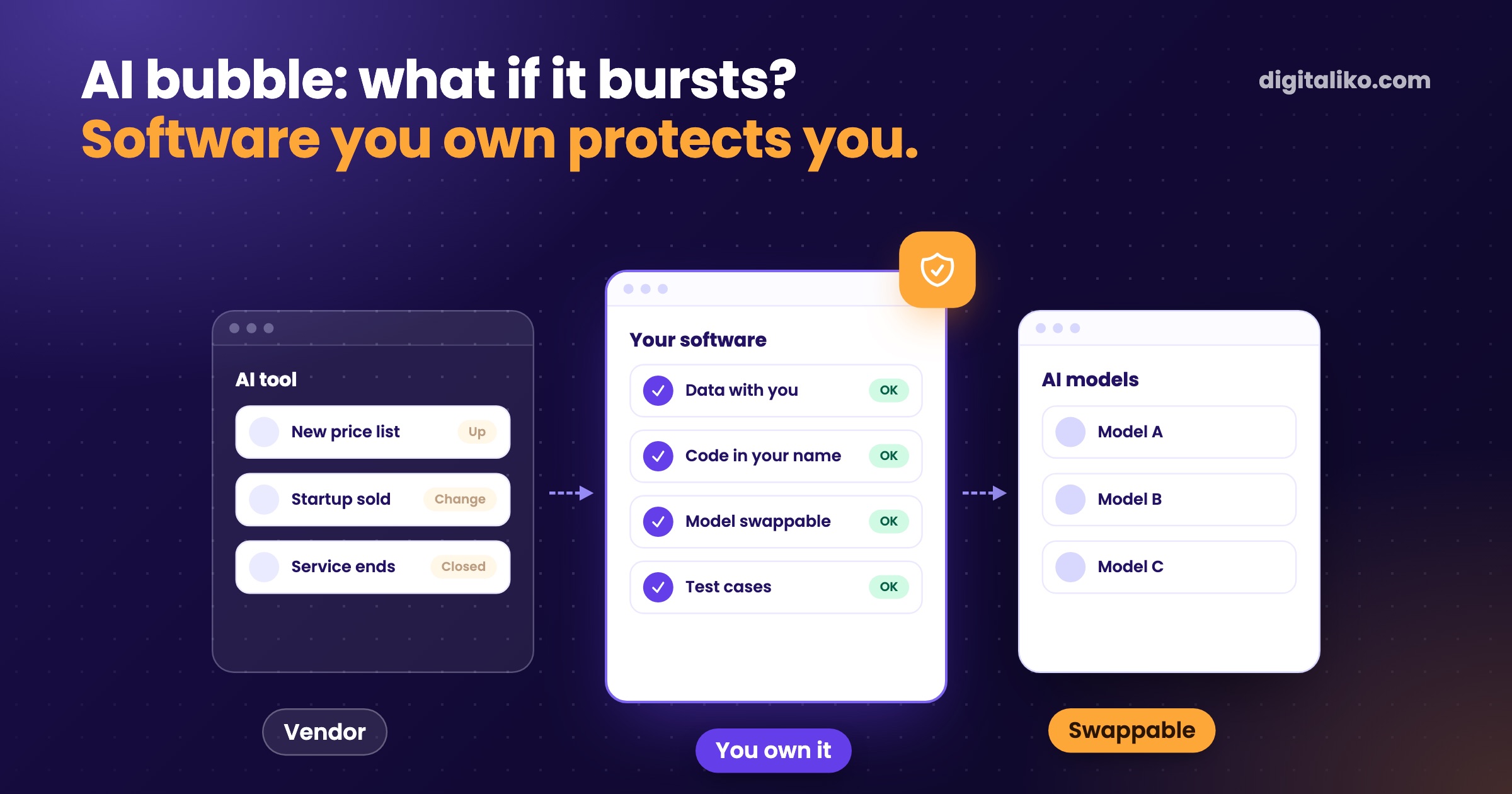
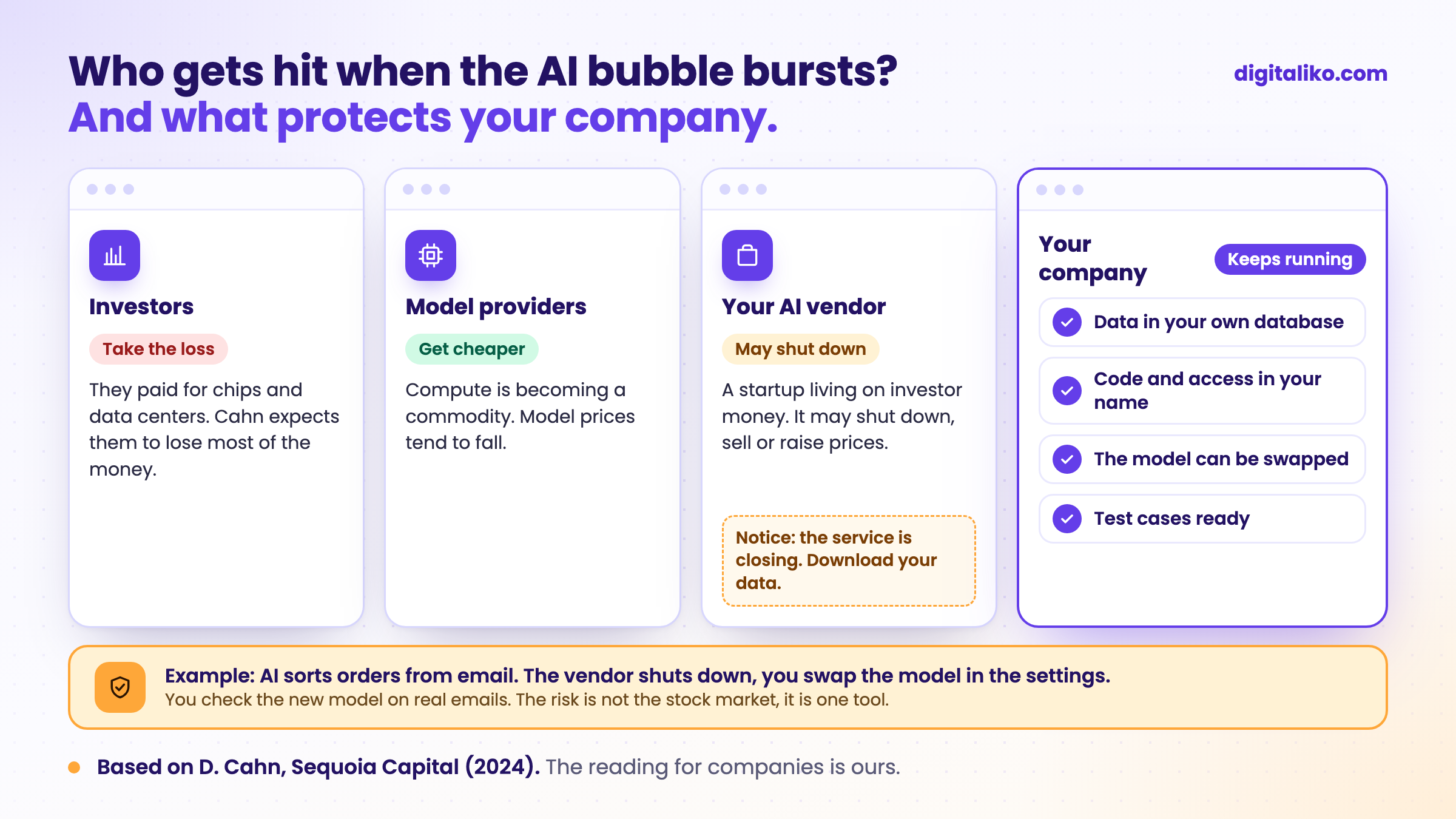
If the AI bubble bursts, Sequoia's David Cahn expects investors to take most of the loss, not the companies that use AI. For your company, the risk sits one floor lower. The vendor of the AI tool your process runs on may shut down, raise prices or change the model. What protects you is software and data you own, and a process that does not hang on one AI provider.
What does David Cahn say about the AI bubble?
In June 2024, David Cahn of Sequoia Capital wrote the essay "AI's $600B Question". He calculated how much AI would have to earn each year to pay back the money spent on data centers. He arrived at roughly $600 billion a year. AI revenue of that size does not exist yet.
He argues that AI compute is becoming a commodity sold by the hour. Prices fall and older chips lose value fast. On who pays for it, he is direct:
If my forecast comes to bear, it will cause harm primarily to investors.
Companies building products on AI, in his view, get cheaper compute.
In July 2024 he added in "AI is Now Shovel Ready" that new data centers will push AI costs down further. Whether there will be enough demand to fill them, he says, nobody knows yet.
Our view
We agree with the main point. If you use AI, there is no reason to wait for the bubble to deflate. Cheaper compute helps those doing real work with AI.
It does not fit companies in Central Europe. Cahn writes for investors and founders in Silicon Valley. An ordinary company in Slovakia does not buy chips or data centers. It buys an AI tool from a startup that often lives on investor money. When investors tighten their belts, exactly these vendors shut down, sell or raise prices.
Cheaper AI does not mean a cheaper vendor. Model prices can fall while your monthly fee rises. The vendor writes the price list, not the chip market.
What does it mean for your company's software?
If the bubble deflates, it will not hit you as a chart on the stock market. It will hit you through a specific tool that one day stops working like yesterday.
| Risk | How it shows | What protects you |
|---|---|---|
| The AI tool vendor shuts down | The tool stops working, sometimes with a month's notice | Data in your own database, the process written down outside the tool |
| A bigger company buys the vendor | The product is merged, features disappear, prices change | A contract with a notice period and data export |
| The vendor raises prices | The invoice grows and you have nowhere to go | Code and access in your company's name |
| The AI provider changes or retires a model | Answers change, accuracy drops | The model as a swappable part, a set of test cases |
| AI prices fall | Helps you only if you pay for the model directly | Your own account with the model provider, not a markup inside the tool price |
Our view
We have lived through one dependency failing. On a client's online marketplace, the crawler stopped running in December 2025. Traffic dropped from 250,000 to 66,000 pageviews a month. It was not AI and not a bubble. One part we thought was running was enough.
We know this from AI tools too. One tool we worked with stopped being available, and we had to switch to another. Another updated itself the day before a live demo and stopped working. So for every system, ask one thing first: what stops when one thing you do not control fails. With AI, that thing is most often the vendor or the model.
How do you avoid depending on one AI provider?
Run this test for every process that matters to you. Tick what is true.
More on code ownership in Who owns the source code of custom software? Warning signs of dependency are in Vendor lock-in: warning signs.
With us, leaving has a rule in the contract too. When you leave, we fix the bugs from the last month. The solution is yours from day one, so it keeps running without us. How we build custom software like this is on the service page.
We have left a provider ourselves, with a client's online marketplace. The managed cloud was too expensive for it.
The managed solution was very expensive. So we bought a plain box, a VPS, and moved it there.

What to do this month?
01
List the AI tools the company pays for
For each, write down what stops if it shut down tomorrow.
02
Try the export for the three most important ones
Not in the price list, for real. Check whether the data is usable without the tool.
03
For one process, find out who swaps the model
If the answer is "the vendor, when they decide", you have your first task for next month.
Where this does not apply
- You only use AI to write text. You can replace an AI chat subscription in a week. Nothing to protect.
- AI comes as part of a big suite. For example an office suite from a large company. The risk of it shutting down is small, the risk of price rises stays.
- You can move the process back to Excel in a day. Protection would cost more than the outage. Leave it.
- It is critical infrastructure. Payments or invoicing belong with a large vendor that has contracts and liability. There, the dependency is fine.
- You are an investor. This article is not for you and is not investment advice.
We do not fear a dependency even on a small vendor when the tool runs on our side and asks for no monthly fee. This is how Filip explained choosing one tool:
Lifetime license, no more monthly subscriptions. It runs fully local. It is open source from one independent developer.
Even if one person builds the tool, it has no way to stop you. It runs on your side and its code is open.
Not sure what your process depends on?
Tell us which AI tool or process worries you. We get back to you within two business days, and together we pick what to fix first. We will also tell you if everything is fine.
If you'd rather talk first, book a 15-minute meeting with Filip.
Which tool would stop your company if it shut down tomorrow?
In short
- If the AI bubble bursts, Sequoia's David Cahn expects investors to take most of the loss.
- For a company, the risk is one AI vendor that shuts down, raises prices or changes the model.
- Data in your own database, code and access in your name and a swappable model protect you.
- This month, list your AI tools, try the export and find out who swaps the model.
Frequently asked questions
What is the AI bubble?
A state where far more money goes into AI than AI earns so far. In 2024, Sequoia's David Cahn calculated that data center spending implies about $600 billion of yearly AI revenue that does not exist yet.
What happens to companies if the AI bubble bursts?
According to Cahn, investors lose most of the money. Companies that use AI may get cheaper compute. Your risk is a specific AI tool vendor that shuts down, raises prices or changes the model.
Should I wait with AI until the bubble bursts?
We think not. Waiting saves nothing, it only postpones work people now do by hand. Start with one process where you own the data and the code and the model can be swapped.
How do I avoid depending on one AI provider?
Keep data in your own database, code and access in your company's name, and the model as a swappable part. Build a set of real cases to test a new model in a day.
Is this article investment advice?
No. We do not write about stocks or where to invest. We write about the software your company runs on and how to protect it from a vendor failing.
Sources: David Cahn, "AI's $600B Question", Sequoia Capital, 20 June 2024, sequoiacap.com. David Cahn, "AI is Now Shovel Ready", Sequoia Capital, 8 July 2024, sequoiacap.com. The retelling and conclusions are ours; Sequoia has nothing to do with this article.
Ask AI about this article
The AI also draws on our other articles and experience from real projects.
ChatGPTClaudePerplexity