How much does an AI agent cost for a business?
AI agents · Updated

Filip Papranecfounder of Digitaliko
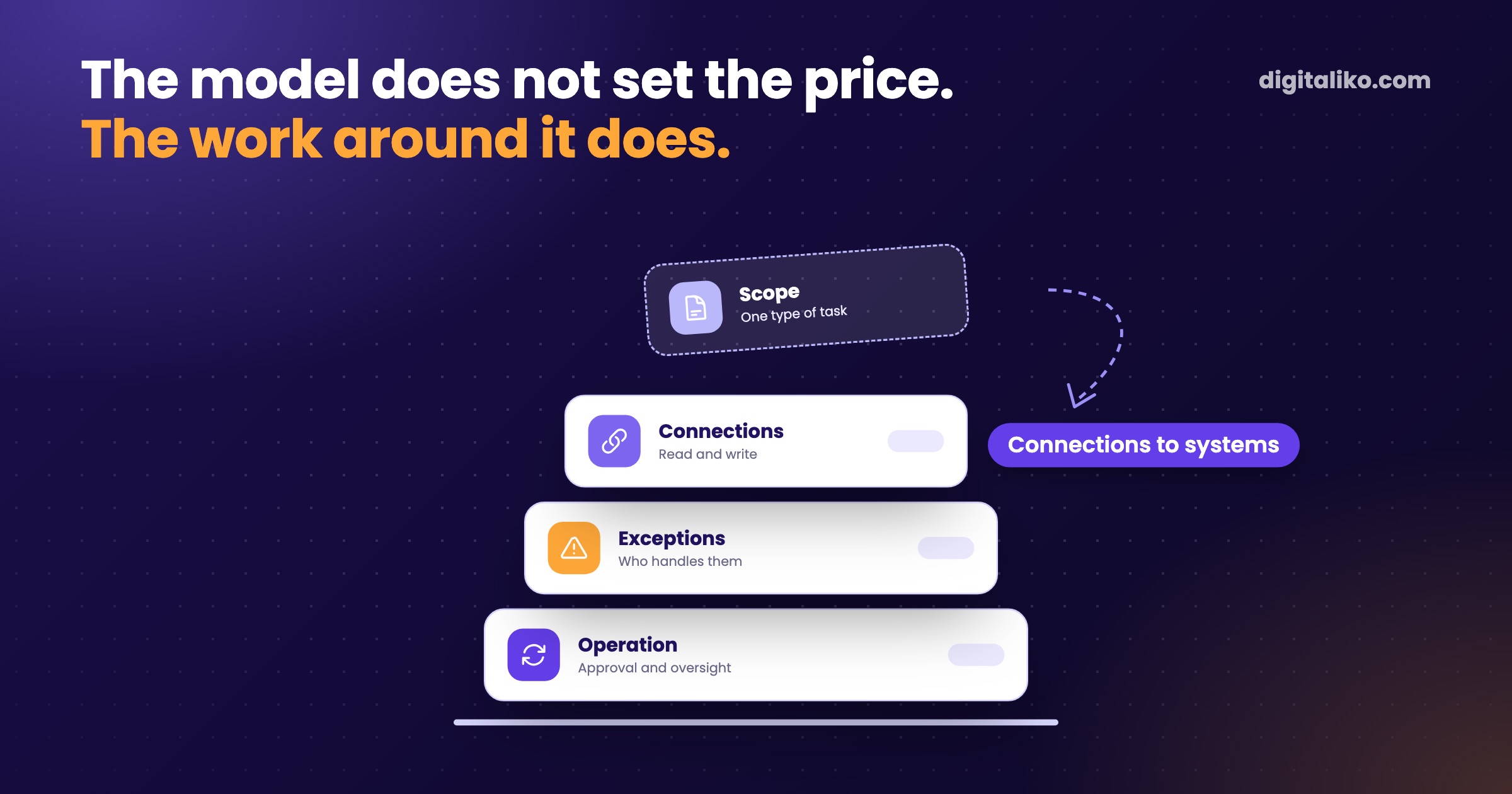
With us, an AI agent for a business is part of a monthly subscription from €3,980 excl. VAT. A clearly bounded project we also do for a fixed price. The price is not set by the AI model itself but by three things: scope of work, connections to your systems, and operation. You can pause or cancel the subscription any time.
Below is what actually moves the price, how to work out whether an agent pays off, and what to prepare so it costs less. We do not compare other vendors' price lists. We only speak for ourselves.
How much does an AI agent cost with us?
Try the first month. If we miss what we wrote down, we refund 50 %. Monthly subscription from €3,980 excl. VAT, pause or cancel any time. Or a fixed price per project: tell us what you need and we send you a quote. Code, data and infrastructure owned by the client from day one.
Two options:
Fixed price
- A clearly bounded scope for one price. It can be less or more than the subscription.
- Tell us what you need and we send you a quote.
- Fits when you know exactly what the agent should do.
Monthly subscription
- From €3,980 a month excl. VAT, pause or cancel any time.
- Direct contact with Filip, a new version every week.
- The agent and its changes after launch.
Why a subscription and not a one-off payment? Because an agent does not end at launch. Customers start writing differently, prices change, a new type of order appears. Someone has to watch what the agent does and fix it. The subscription pays for exactly that work.
After launch you get 30 days of support. Then you pause the subscription. When something needs changing or adding, you resume it and we carry on.
And we have to earn your trust every month. If the agent does not deliver what we agreed, you cancel the subscription. What exactly we build for you is on the page AI agent for business.
What determines the cost of an AI agent?
Scope, connections and operation. Plus two things people forget: exceptions and source material. Each has a cheaper and a more expensive version.
| What moves the price | Cheaper | More expensive |
|---|---|---|
| Scope | One type of task, such as order status questions | Everything that lands in the inbox |
| Connections to systems | The agent reads from one system | The agent reads from and writes to three systems, one of them old and without an interface |
| Exceptions | Exceptions are named and one person owns them | The rules live only in an experienced colleague's head |
| Operation | A person approves drafts, the agent only sends verified types | The agent sends everything on its own and mistakes show up at the customer |
| Source material | You have examples of correct replies and documents | The examples have to be created first |
Notice what is missing from the table: the AI model itself. What you pay for using it grows with the volume of messages. You pay it directly to the model provider, just like hosting.
Most of the work sits in the connections and the exceptions. An agent that can reply but cannot look into the order is just a smarter chat.
We saw this with the customer support agent. Most of the old mail was not customer questions but payment and system messages. The work went into the source material and the company's real language, not the model.
How do you work out whether an AI agent pays off?
Before you compare prices, work out what the task costs you today. One line is enough:
times per day × minutes each × number of people × ~21 working days × 12 months
That is what you pay if nothing changes. If you'd rather not do it by hand, use the automation ROI calculator. On first calls almost nobody has this number. Nobody hides it, they have just never worked it out. An estimate is enough: ten a day, or a hundred?
For us it came out with invoices. One invoice took 10 to 15 minutes by hand. Today our own accounting processes an invoice in less than a minute, and no person ever sees 70 % of them. It was not an agent. Automation was enough.
- per invoice, down from 10 to 15 minutes
- < 1 min
- go through with no person at all
- 70 %
Then ask one more question: what will you use the saved time for? An hour saved in the office often ends up in more paperwork. An hour in sales can bring in an order. If you do not know where that time will go, an agent does not pay off for you yet.
When is an AI agent needlessly expensive?
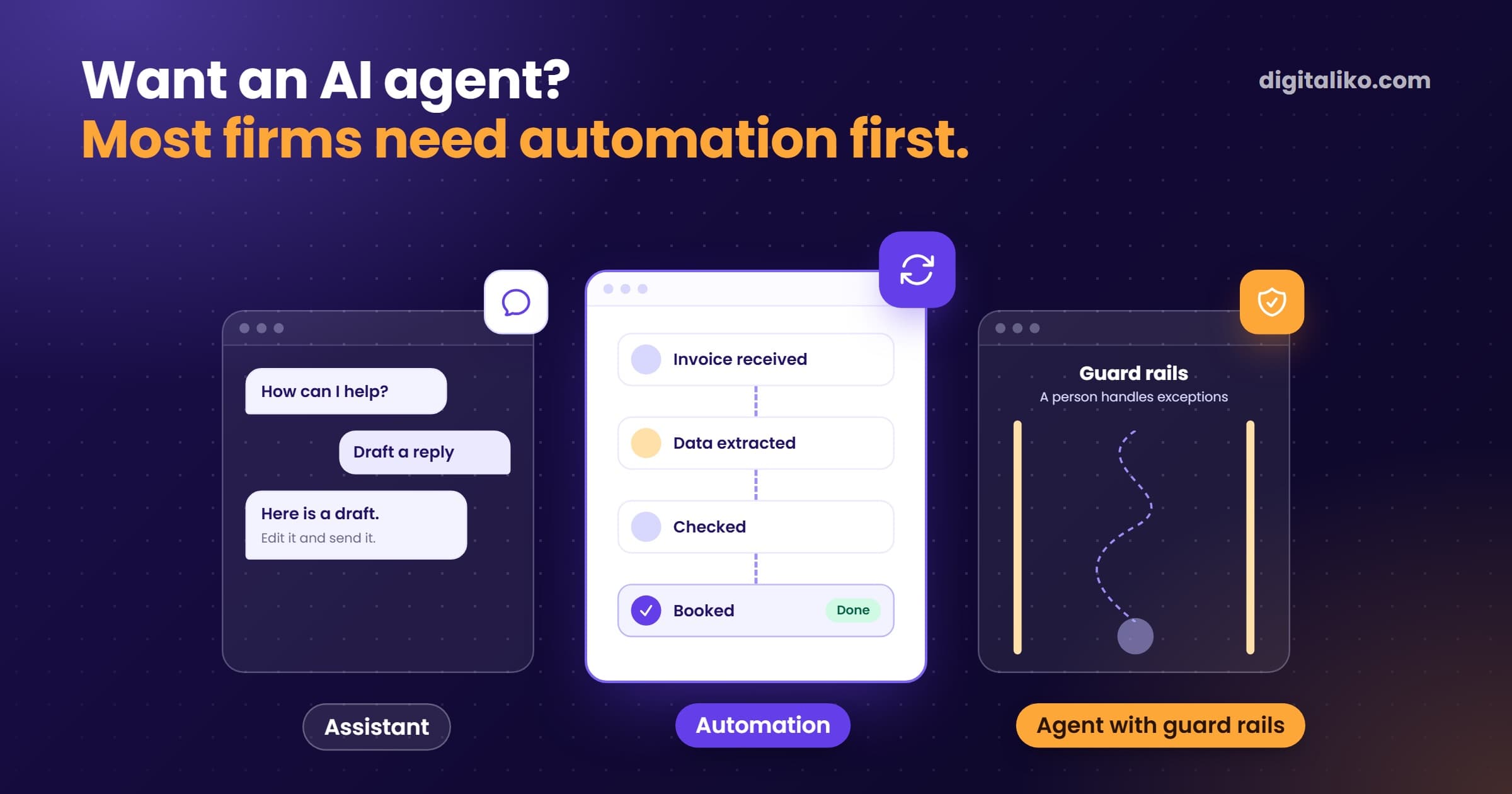
When something simpler would do. Almost everyone who comes asking for an agent needs automation first. It runs the same way every time and a person only approves the exceptions. It is cheaper to develop and cheaper to run.
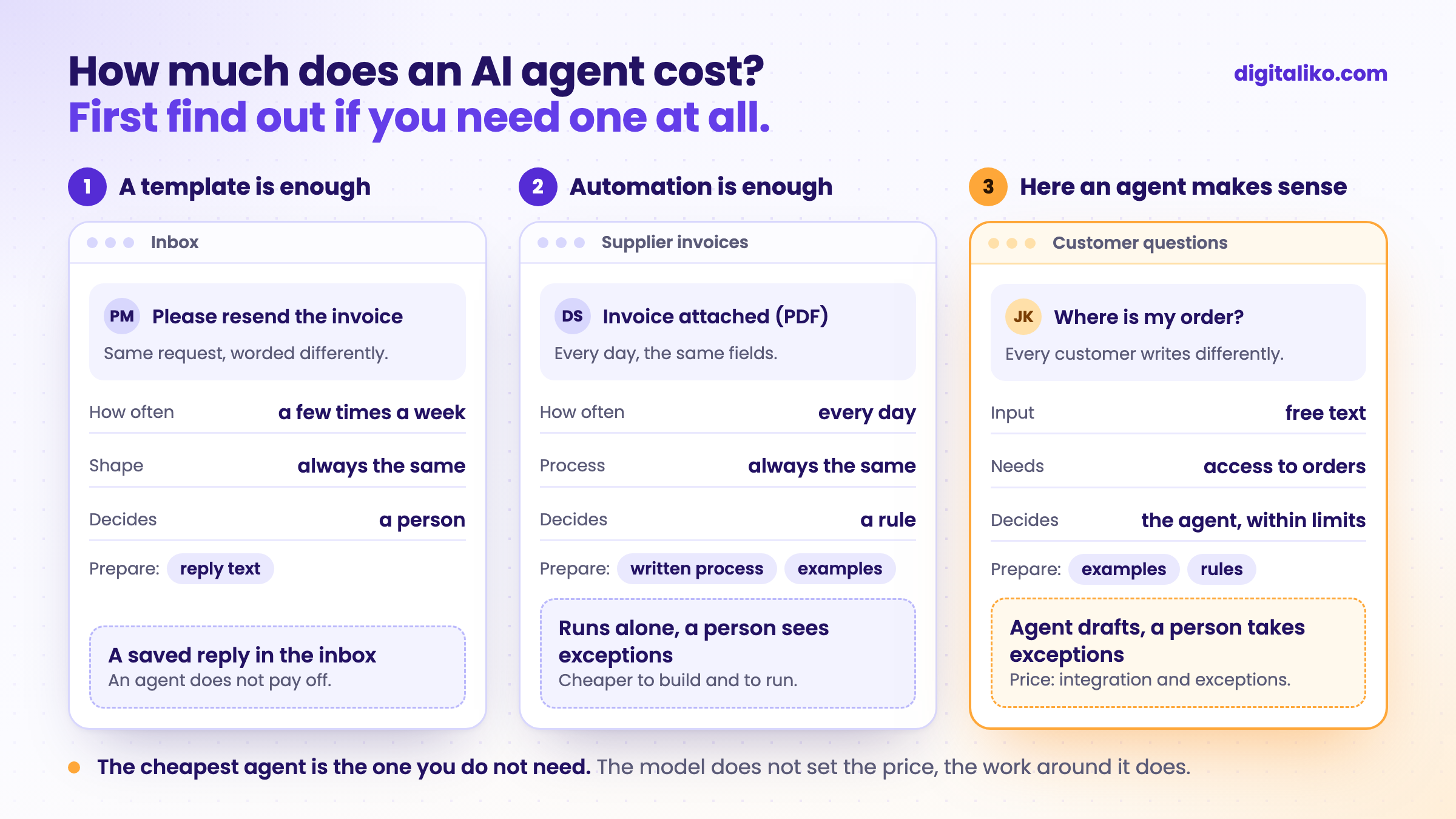
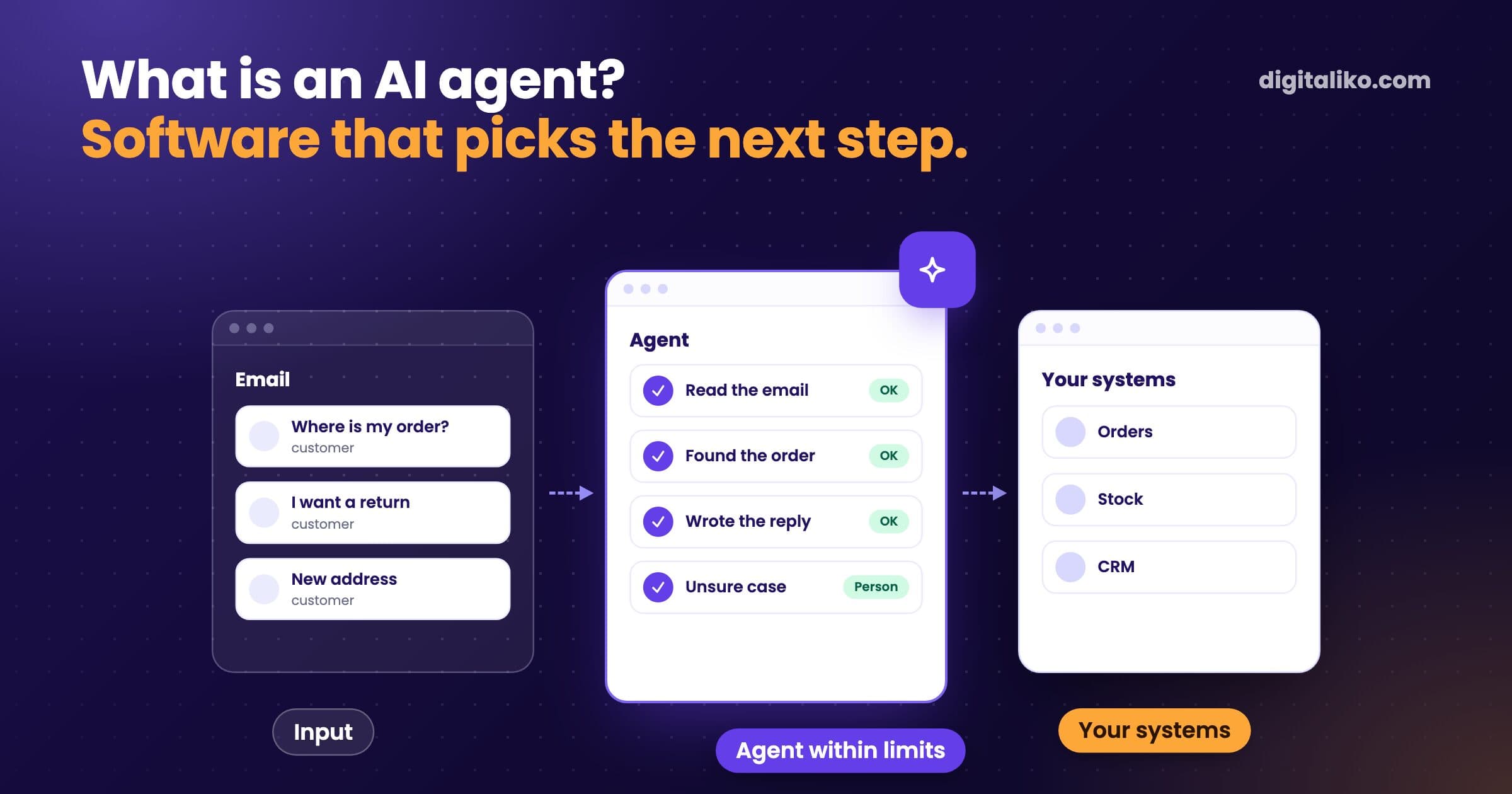
An agent makes sense when the input has no fixed shape. Typically customer emails, where everyone writes differently. We explain the difference in detail in What is an AI agent?
If I saw another solution that was more stable, clearer and more predictable, I would not build an agent.

An agent you cannot take with you is expensive too. Before signing, ask who will own the software and the data. And how you get them out if you leave. More in Who owns the source code of custom software?
What to prepare so the agent costs less
Each item on this list shortens the first month:
01
One task to start with
Not the whole inbox, just the most common type of message.
02
3 to 5 real examples per type
Emails or documents, together with the correct reply.
03
Exceptions on paper
What the agent should do when it is unsure, and who it hands over to.
04
Access to your systems
Where the orders, customers and prices are.
05
One person who approves
For the first weeks they will read the agent's drafts.
If you have these, the first month goes into the agent, not into hunting for material. What such a start looks like with emails is in AI agent for customer emails.
Download the plan: An AI agent in your company, the first 30 days (PDF)
When we don't recommend it
Tick what is true for you:
Want to know what yours would cost?
Tell us what work the agent should do and how many times a day it happens. We get back to you within two business days, and together we pick what to fix first. If automation is enough, we will tell you.
If you'd rather talk first, book a 15-minute meeting with Filip.
Which repetitive task would come out highest once you multiply it by 12?
In short
- With us, an AI agent is part of a subscription from €3,980 a month excl. VAT, or a fixed price.
- The model does not set the price. Scope, integration, exceptions and operation do.
- First work out what the work costs you today, and where the saved time will go.
- When the process is always the same, cheaper automation is enough.
Frequently asked questions
How much does an AI agent cost for a business?
The monthly subscription starts at €3,980 excl. VAT, and AI agents are part of it. Pause or cancel any time. Have a clearly bounded scope? Tell us what you need and we send you a fixed price.
Why is an AI agent usually on a subscription?
Because the work does not end at launch. Emails, prices and rules change, and someone has to watch what the agent does and fix it. The subscription pays for exactly that work. A clearly bounded project we also do for a fixed price.
What costs the most in an AI agent?
In our experience, not the AI model itself. Most of the work sits in connecting to your systems and in the rules for exceptions, meaning what the agent should do when it is unsure.
How do I find out whether an AI agent pays off?
Work out what the task costs you today: times per day, times minutes, times number of people, times about 21 working days, times 12 months. Then write down what you will use the saved time for. If for nothing, the agent does not pay off.
Who owns an AI agent I have built for me?
Ask every vendor before you sign. With us, software, data and infrastructure belong to the client from day one, even if you cancel the subscription.
Ask AI about this article
The AI also draws on our other articles and experience from real projects.
ChatGPTClaudePerplexity