Who owns the source code of custom software?
Software ownership and vendors · Updated

Filip Papranecfounder of Digitaliko
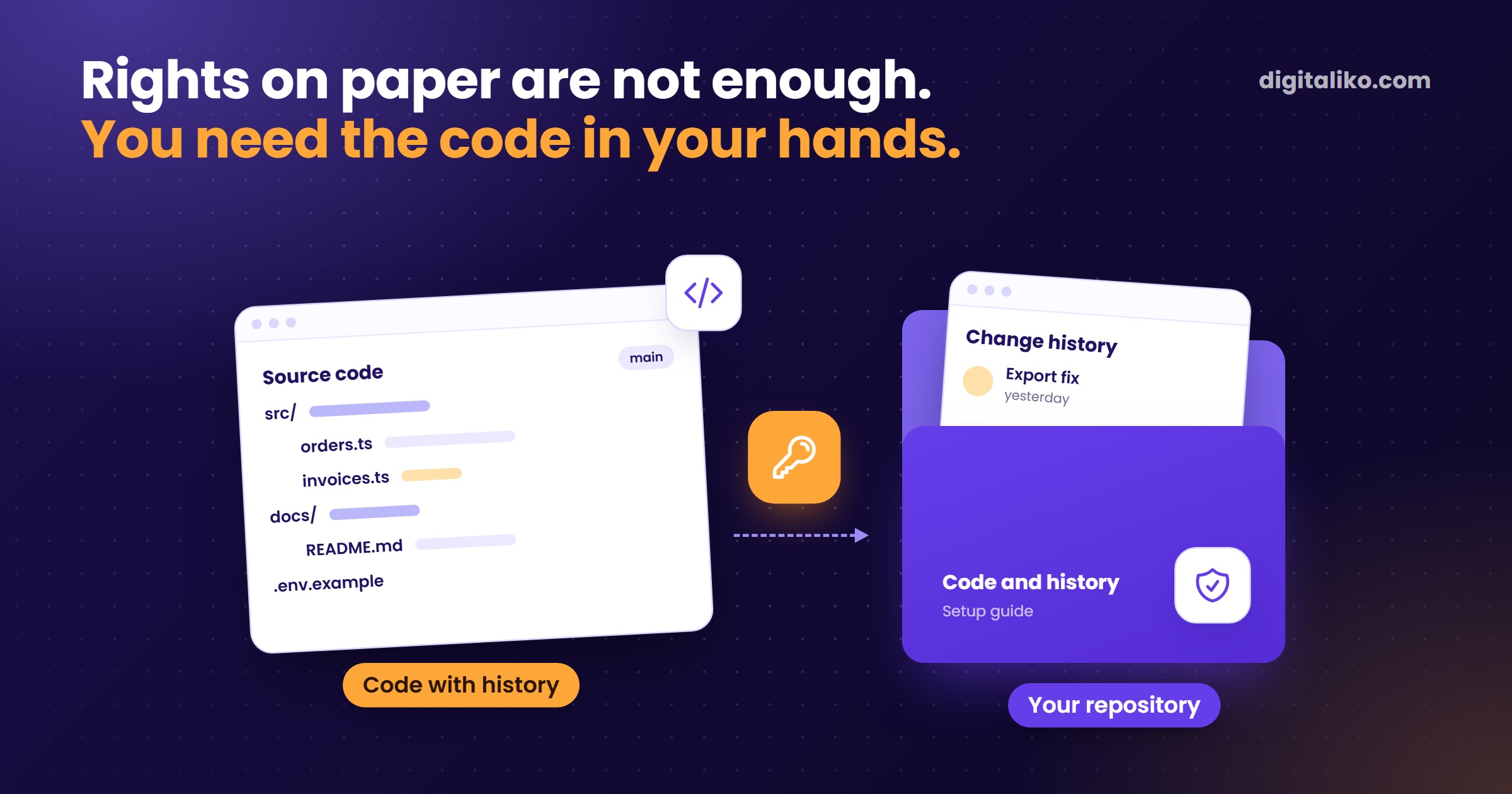
For software made to order, the client exercises the economic rights. In Slovakia, Section 91(4) of the Copyright Act says so directly. That still doesn't mean you have the code in your hands. Three things decide: what exactly you ordered, what the vendor brought ready-made, and where the code actually sits.
Since 2023 we have delivered 15+ production projects. Below are general principles and what we learned from our own contracts. We are a Slovak company, so this describes Slovak law. We are not lawyers, and this is not legal advice. In other countries the rules differ.
What does copyright law say about software made to order?
For a computer program or database made to order, the employee-work regime applies. The client is treated as the employer (Section 91(4), Act No. 185/2015 Coll.).
In practice, you exercise the economic rights in your own name and on your own account. Directly by law, with no transfer and no licence. This covers everything made for you to order.
For other outputs, such as documentation or texts, an exclusive licence is agreed. With no territorial or time limit and covering all forms of use.
Rights by law are only half of it, though. The other half must be in your hands.
Why doesn't "transfer of all rights" work in a contract?
Because under Slovak copyright law, authors' economic rights cannot be transferred. They cannot be assigned or waived. A clause saying "the vendor assigns all economic rights to the client" is therefore invalid.
In practice a court will read it as the widest possible licence. But the client's lawyer will flag it, and the contract looks careless.
What isn't yours even though you paid for it?
What the vendor had before the contract or created independently of it. Distinguish four cases:
| What | Who owns it | What you get |
|---|---|---|
| Software made for you to order | You (you exercise the economic rights) | Everything |
| A ready-made product or SaaS they only customised | The vendor | A licence under the contract |
| The vendor's libraries, templates and tools | The vendor | A permanent licence for your business |
| Open source parts | Their authors | Their licence, usually permissive |
The third row is fair. A vendor who gave away their tools couldn't use them for the next client. What matters is that you may use them permanently, not only while you work together.
If the vendor works with subcontractors, ask whether they have settled the rights with them.
Owning the rights isn't enough. What must you have in hand?
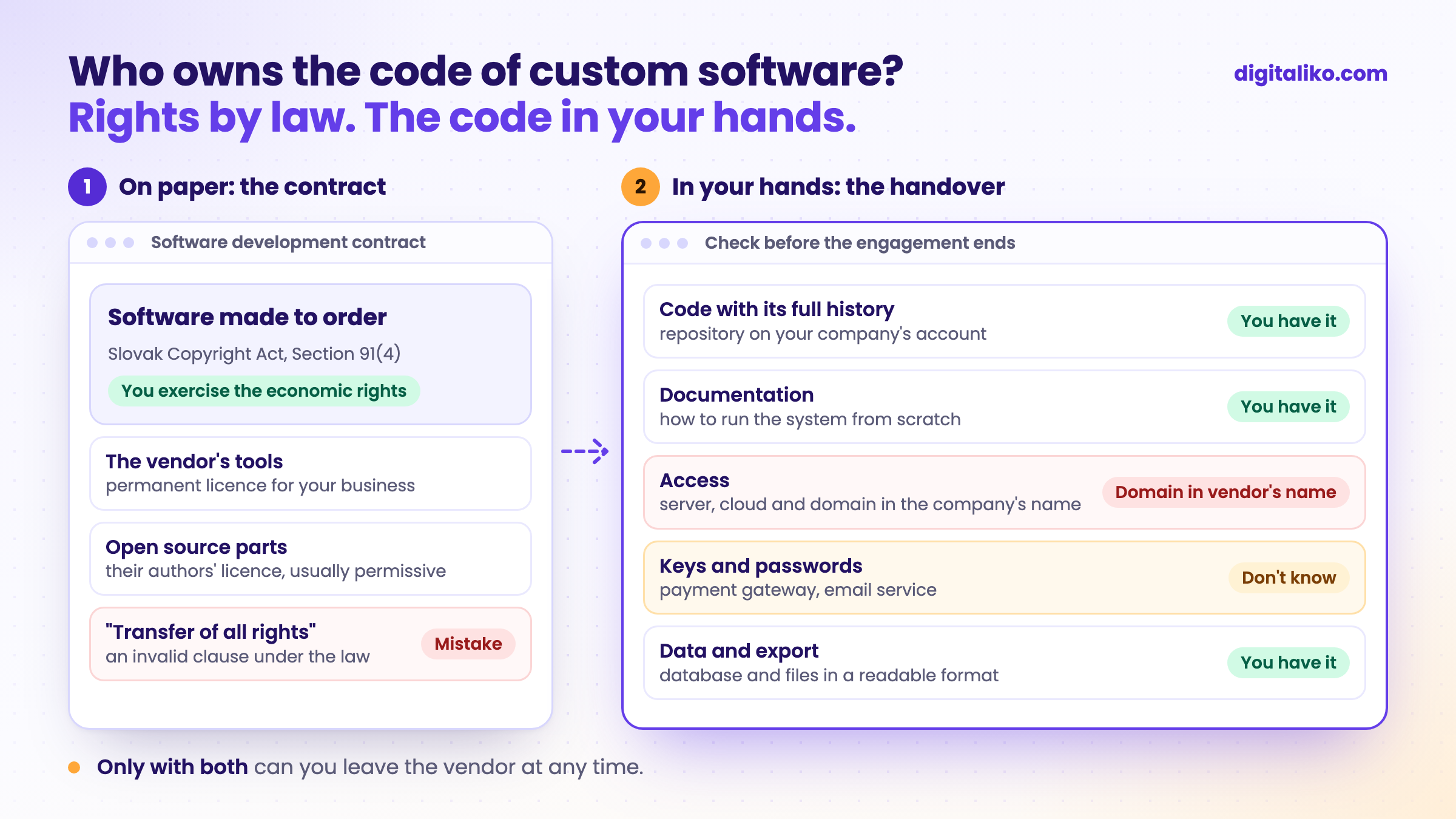
Rights without code are just paper. Before the engagement ends, ideally all along, check:
With us, the repository can live on your account or ours, as we agree. You have access to it from day one. If it is on ours, we move it to your account (GitHub or similar) whenever you ask, at the latest when the contract ends.
The full list and a sample request letter are in one PDF. Download the checklist: Leaving a software vendor (PDF).
If even the domain isn't in your company's name, leaving the vendor will hurt. What it looks like when someone else holds your data, we described in Vendor won't release your data? What to do. Code, data and infrastructure belong to the client from day one, for example at the freight forwarder whose system we built and run.
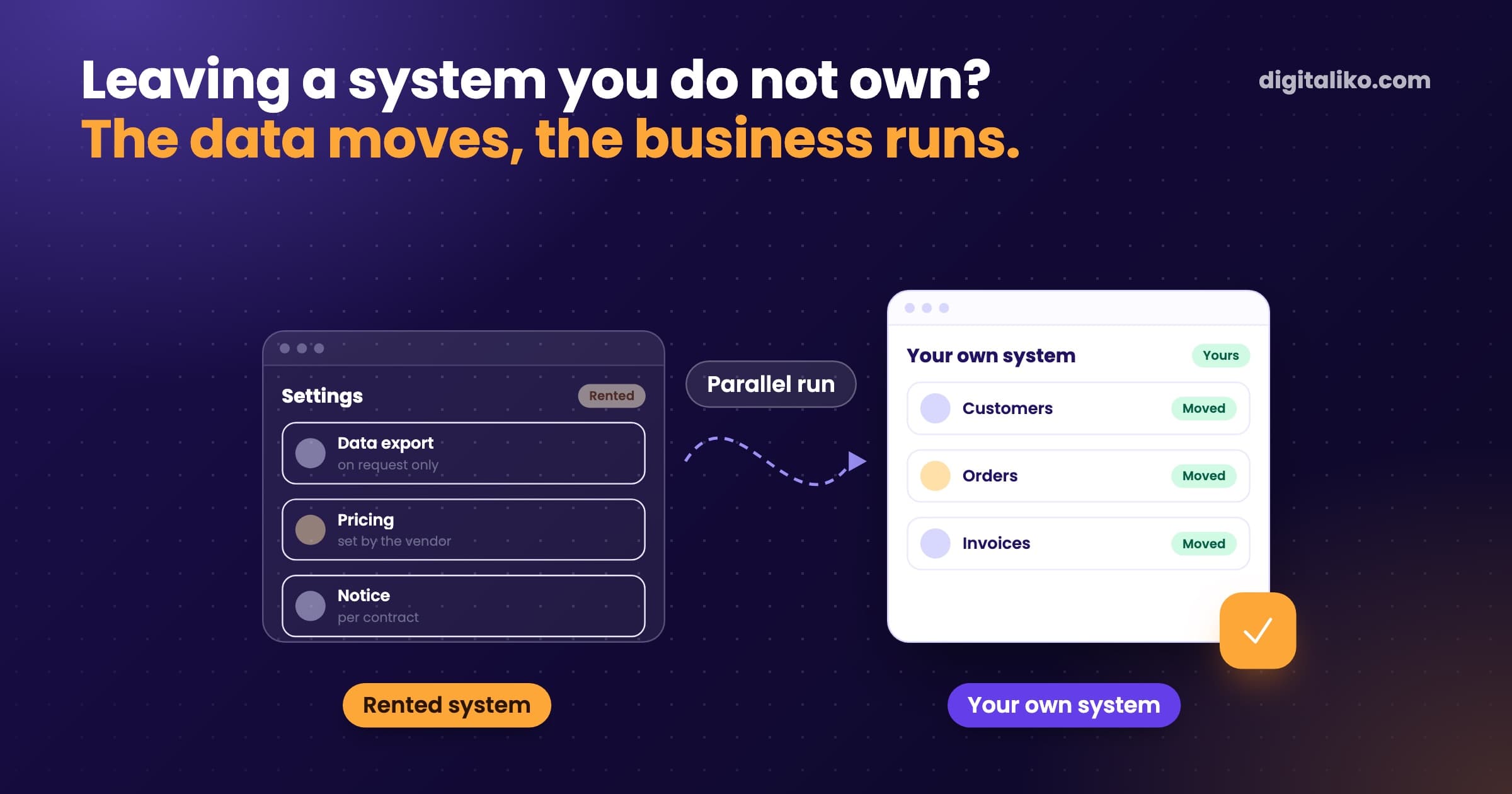
What does leaving a vendor look like in the contract?
Every vendor writes down how things start. Ask how they end, too. In our contract it is a separate article with four points:
01
Notice in any month
No reason needed.
02
Handover
All code, documentation and access.
03
Help with the switch
We hand over the code and help you move to another vendor.
04
Fixes
We fix last month's defects.
It has a weakness. For a large system, the switch takes a while. That is why we try to write documentation during the project, not at the end. It works this way for all the custom software we build.
When you read the next vendor's contract, turn to the end first. If it doesn't say what you get when you leave, you won't get it.
What if your contract is already signed?
Pull it out and find three places. The intellectual property clause: does it rely on work made to order, or does it "transfer all rights"? The clause on pre-existing work: do you have a permanent licence to the vendor's tools? And the termination clause: what do you get when you leave?
If something is missing, you don't need a dispute right away. Ask for an amendment at the next contract change. A serious vendor won't mind. That is how we handle our own contracts.
When to call a lawyer?
Bring in a lawyer when:
- it is a larger contract or involves exclusivity,
- the contract covers rights beyond the project,
- liability has no cap,
- the vendor sends their own contract with a "transfer of all rights",
- the contract is governed by a law other than Slovak.
If you are still deciding whether you need custom software at all, start with When is Excel no longer enough for a business?.
When we don't recommend it
- You use an off-the-shelf SaaS without changes. Do not worry about code ownership. Guard your data export.
- Your vendor works well, the contract just misses a clause. No dispute and no new vendor needed. Ask for an amendment at the next contract change.
- You want to own the vendor's tools and libraries too. Do not ask for that. A perpetual licence for your business is enough.
- It is critical infrastructure. Invoicing or payment software belongs with a vendor that has certifications, a contract and carries the liability.
When you own something, you have more control over it. But also more responsibility. You need the capacity for that.

Want this clear from day one?
Tell us what you need to solve. We get back to you within two business days, and together we pick what to fix first.
If you'd rather talk first, book a 15-minute meeting with Filip.
Whose name is your system's domain registered in today?
In short
- For software made to order, you exercise the economic rights directly by law (Section 91(4) of the Slovak Copyright Act).
- A "transfer of all rights" is invalid under Slovak law. The contract should rely on work made to order.
- The vendor's tools and libraries stay theirs. A permanent licence for your business is enough.
- Rights without code are just paper. Have the code with its history, documentation, access, keys and data in your hands.
Frequently asked questions
Who owns the source code of custom software?
Under Section 91(4) of the Slovak Copyright Act, for a computer program made to order the client is treated as the employer and exercises the economic rights directly by law. This covers what was made to order, not ready-made parts the vendor brought. Other countries have different rules.
Can the vendor transfer all rights to the code to me?
Not in that form under Slovak law. Authors' economic rights cannot be transferred, so a clause transferring them is invalid. A correct contract relies on work made to order and, for the rest, an exclusive licence.
Do I own everything I paid for?
Not always. If the vendor only customised their ready-made product, you have a licence. Libraries, templates and tools the vendor had before the contract stay theirs, and you may use them.
Are rights in the contract enough?
No. You also need the code itself with its history, documentation, access to servers, domains and accounts, and instructions to run the system. Without these, your rights exist only on paper.
When do I need a lawyer?
For a larger contract, exclusivity, rights beyond the project, uncapped liability, a contract under foreign law, and whenever a vendor sends you their own contract with a transfer of rights.
Ask AI about this article
The AI also draws on our other articles and experience from real projects.
ChatGPTClaudePerplexity