B2B portal or B2B e-commerce store? How to choose
Software ownership and vendors · Updated

Filip Papranecfounder of Digitaliko
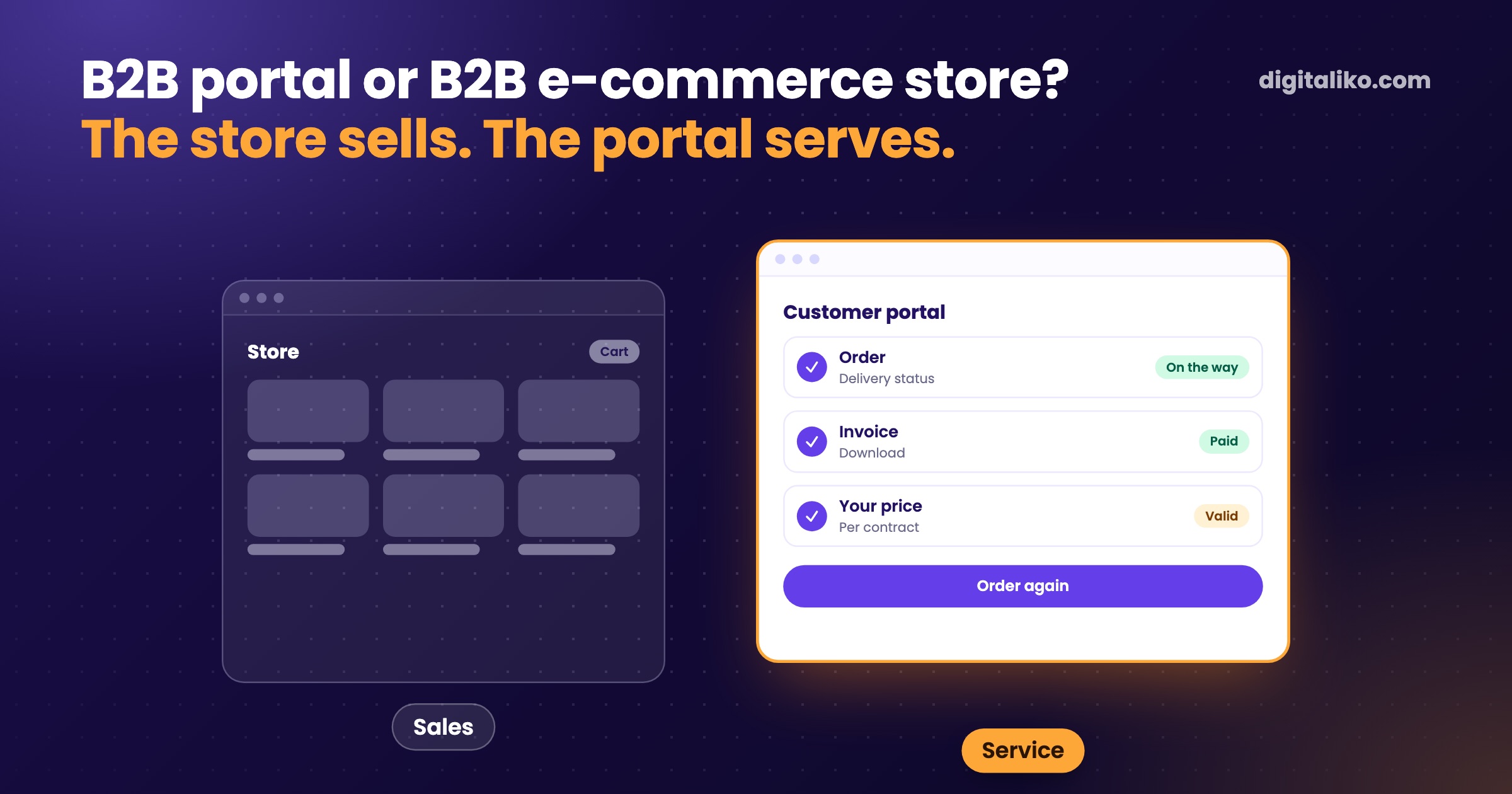
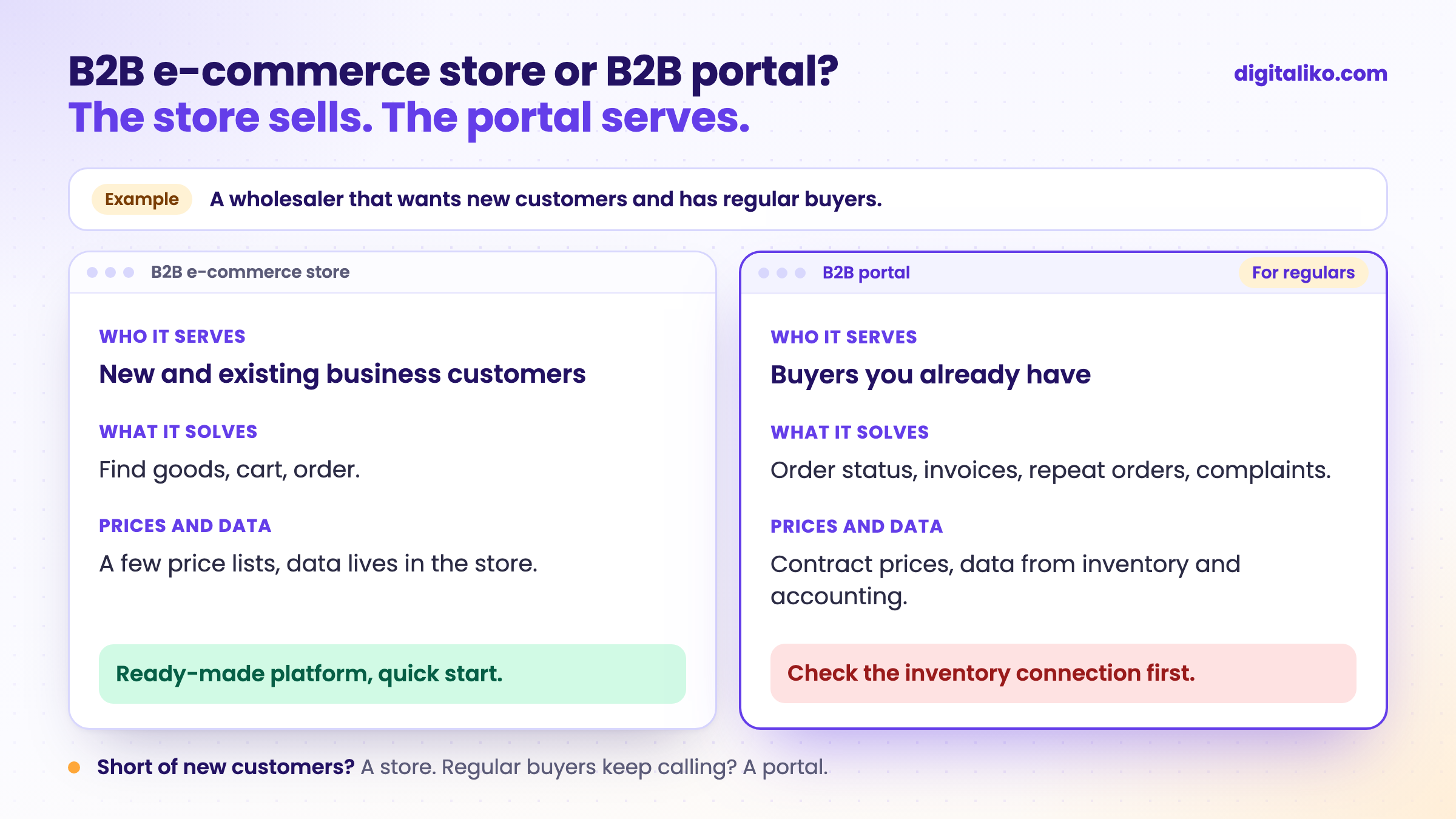
A B2B e-commerce store sells to new business customers: catalog, cart, order. A B2B portal serves the buyers you already have: their own prices, repeat orders, delivery status and invoices, connected to your inventory and accounting. If you are short of new customers, you want a store. If your regular customers call you every day, you want a portal.
Below is the difference in one table, a test that tells you what you need, and what drives the cost of a portal.
What is the difference between a B2B portal and a B2B e-commerce store?
| B2B e-commerce store | B2B portal | |
|---|---|---|
| Who it serves | New and existing business customers | Buyers you already have, after login |
| What it solves | Sales: find goods and order | Service: orders, delivery status, invoices, complaints |
| Prices | A few price lists or discount groups | Each buyer's prices and terms from their contract |
| Where it ends | When the order is sent | At delivery, the invoice and the next order |
| Data | Lives mainly in the store | Comes from inventory, accounting or ERP |
| How it is built | A ready-made e-commerce platform | Custom, connected to your systems |
One does not rule out the other. A company can have a store for new customers and a portal for regular ones. The question is what costs you more today: missing orders, or the hours your people spend on the phone and in email.
When is a B2B store enough and when do you need a portal?
A store is enough when you want to grow through new customers and your prices fit into a few price lists. Ready-made e-commerce platforms often offer a B2B mode and are faster and cheaper than anything custom.
You need a portal when the work happens after the order. The buyer calls to ask where their goods are. The salesperson searches Excel for this customer's price. Accounting sends the same invoice a second time. A store is not built for this, because it cannot see into your inventory or accounting.
Which one do you need?
Tick what is true for your company:
If the third row applies to you, also read Automate email order processing. Sometimes that is the first step, even before a portal.
What drives the cost of a B2B portal?
Two things matter most. The connection to inventory, accounting or ERP, meaning the system where the company keeps stock, orders and invoices. And how complex your pricing rules are. The portal screens are the smaller part of the work.
Try the first month. If we miss what we wrote down, we refund 50 %. Monthly subscription from €3,980 excl. VAT, pause or cancel any time. Or a fixed price per project: tell us what you need and we send you a quote. Code, data and infrastructure owned by the client from day one. How to read quotes is covered in How much does custom software cost?
How to start without paying for everything at once?
A portal does not have to do everything from day one. Start with what costs your people the most phone calls today:
01
One question
Pick what buyers ask about most often. Usually order status or invoices.
02
Read-only connection
At first the portal only shows data from inventory and accounting. It changes nothing in them.
03
First buyers
Let a few regular customers in and watch whether the phone calls drop.
04
Orders and prices
Only then repeat orders and contract prices directly in the portal.
This is how we build custom web applications. The portal runs in the browser on the computer and the phone, with nothing to install.
What does it look like in practice?
We know retyping documents from our own company. In our accounting we automated invoice processing:
- per invoice, previously 10 to 15 minutes
- under 1 min
- of invoices go through with no human at all
- 70 %
A B2B portal works on the same principle. We do not rebuild the whole company. We take one job that repeats over and over and hand it to software.
When we do not recommend it
- You have a few buyers and orders once a month. A portal will not pay for itself. Email and a good spreadsheet are enough.
- Your prices fit into a few price lists and you mainly want new customers. Buy a ready-made B2B store.
- You only want a brochure website with a catalog. We do not build websites.
You don't adapt to the software. It adapts to you.

Not sure whether you need a portal or a store?
Tell us what your buyers ask you about most often and which system you use for inventory and invoices. We get back to you within two business days, and together we pick what to fix first.
If you'd rather talk first, book a 15-minute meeting with Filip.
How many calls a day do you handle only because a buyer cannot see the status of their order?
In short
- A B2B e-commerce store sells to new business customers. A B2B portal serves the ones you already have.
- A store is enough when you want new customers and your prices fit into a few price lists.
- You need a portal when the work starts after the order: delivery status, invoices, contract prices, repeat orders.
- The cost of a portal is driven mainly by the connection to inventory and accounting. Check it first.
Frequently asked questions
What is the difference between a B2B portal and a B2B e-commerce store?
A B2B e-commerce store is a shop for business customers: catalog, cart, order. A B2B portal is self-service for the buyers you already have: their own prices, repeat orders, delivery status, invoices and documents, connected to your inventory and accounting.
When is a B2B e-commerce store enough?
When you want to win new business customers, your prices fit into a few price lists and the order ends when it is sent. Then a ready-made e-commerce platform is faster and cheaper than a custom portal.
When do I need a custom B2B portal?
When regular buyers call and email about order status, invoices or prices, each one has their own terms, and someone retypes orders into the inventory system by hand. The portal answers them by itself and gives your people their time back.
How much does a B2B portal cost?
What matters most is the connection to your inventory, accounting or ERP and how complex your pricing rules are. With us a monthly subscription starts at €3,980 excl. VAT, or we send you a fixed price for a clearly bounded scope.
Can a B2B portal connect to our accounting or ERP system?
Yes, if the system offers an export or an interface for moving data. That is why we check it first, before the price. The connection is the biggest unknown in a B2B portal.
Ask AI about this article
The AI also draws on our other articles and experience from real projects.
ChatGPTClaudePerplexity