Vendor won't release your data? What to do
Software ownership and vendors · Updated

Filip Papranecfounder of Digitaliko
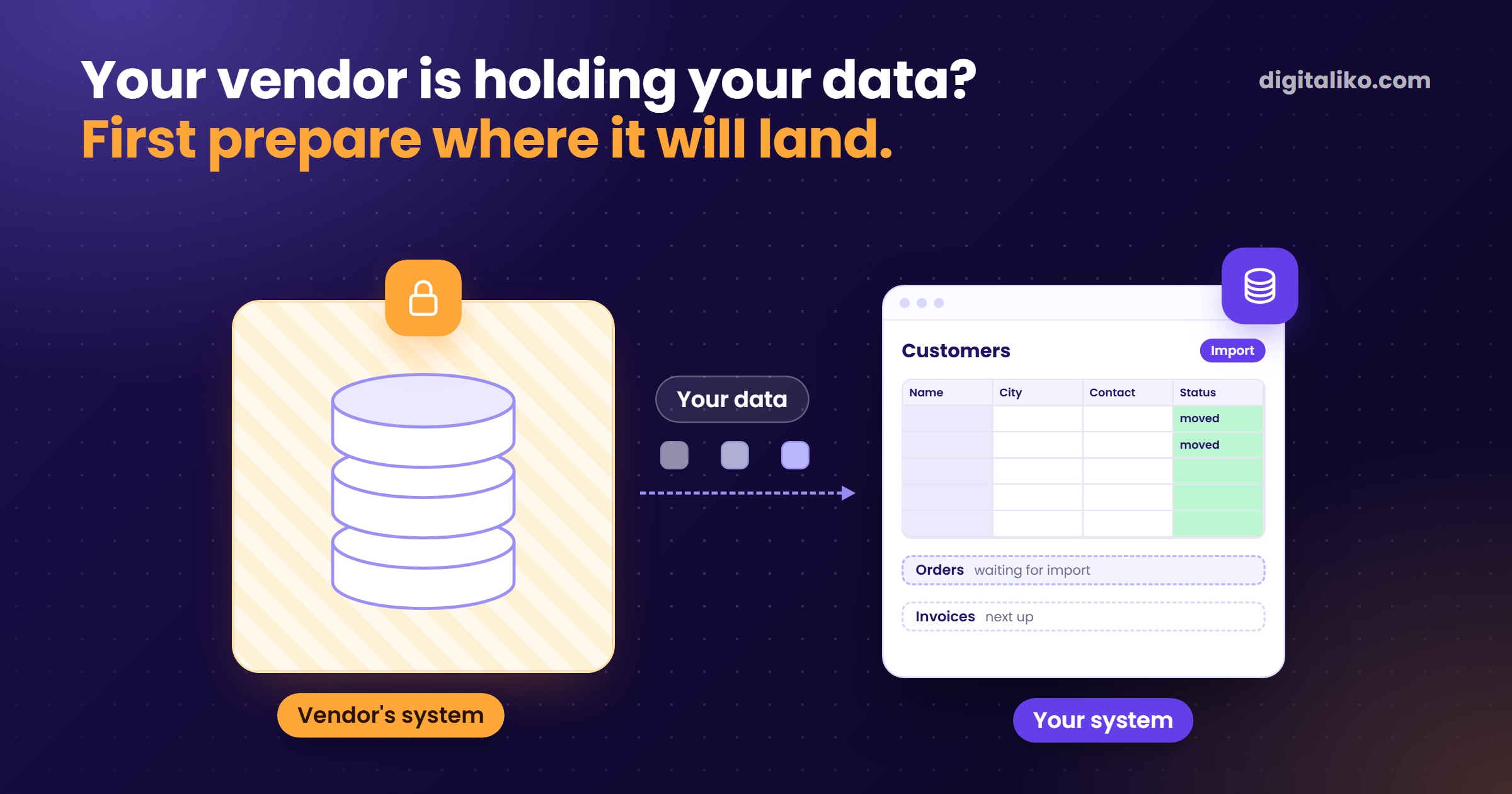
If your software vendor won't release your data, don't start with a fight. First prepare where the data will land. Then ask in writing and narrowly, only for the data you entered yourself. Only if that fails comes a formal request and a lawyer.
We went through this with one client. A request for the data got the answer that it couldn't be released for security reasons.
A business owner was refused his own data from an off-the-shelf system. By all accounts he had a right to it. In the end they came to an agreement, even though the vendor dodged for a long time.

Below is the approach we wrote down along the way.
Which data are you entitled to?
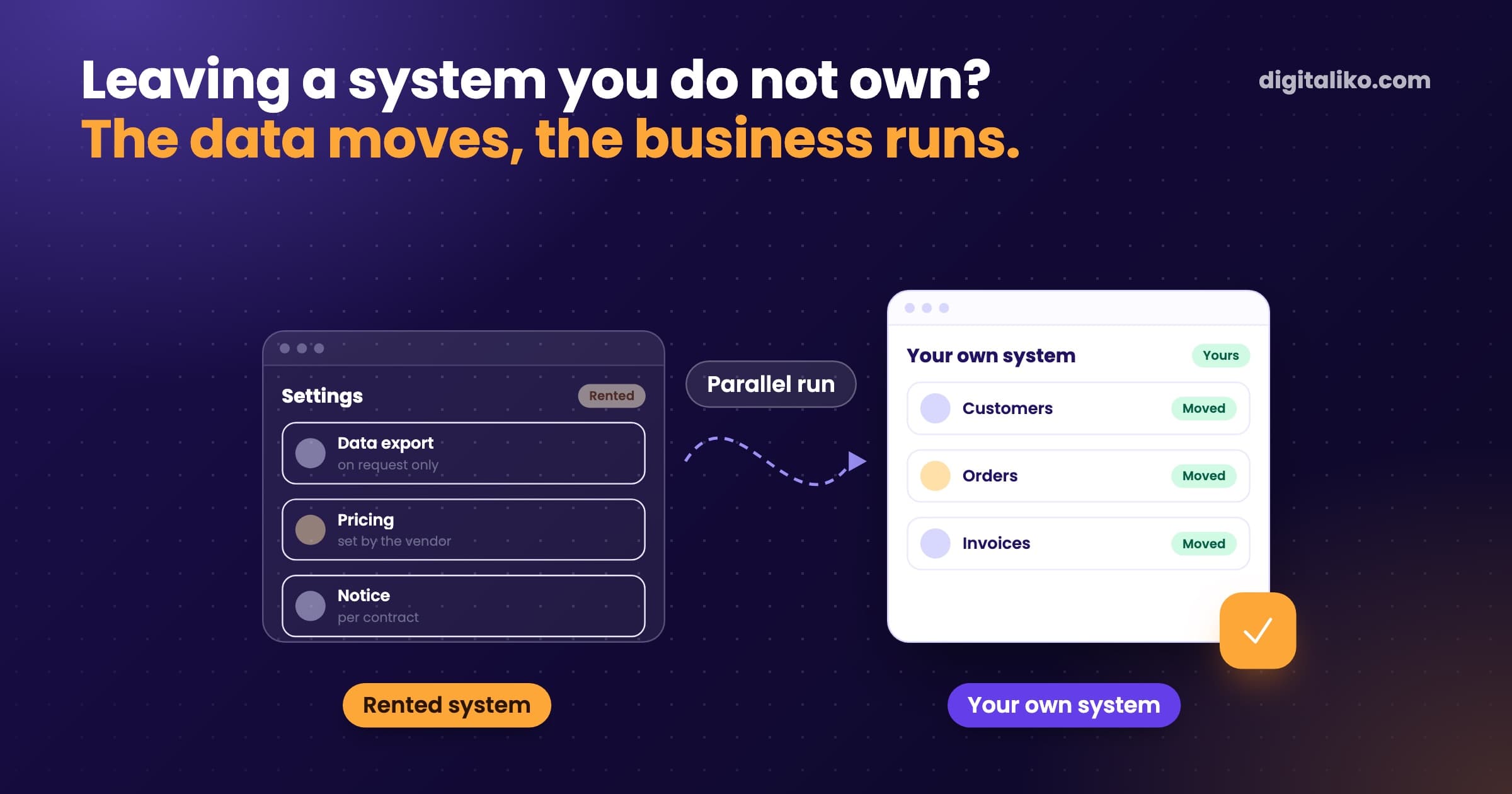
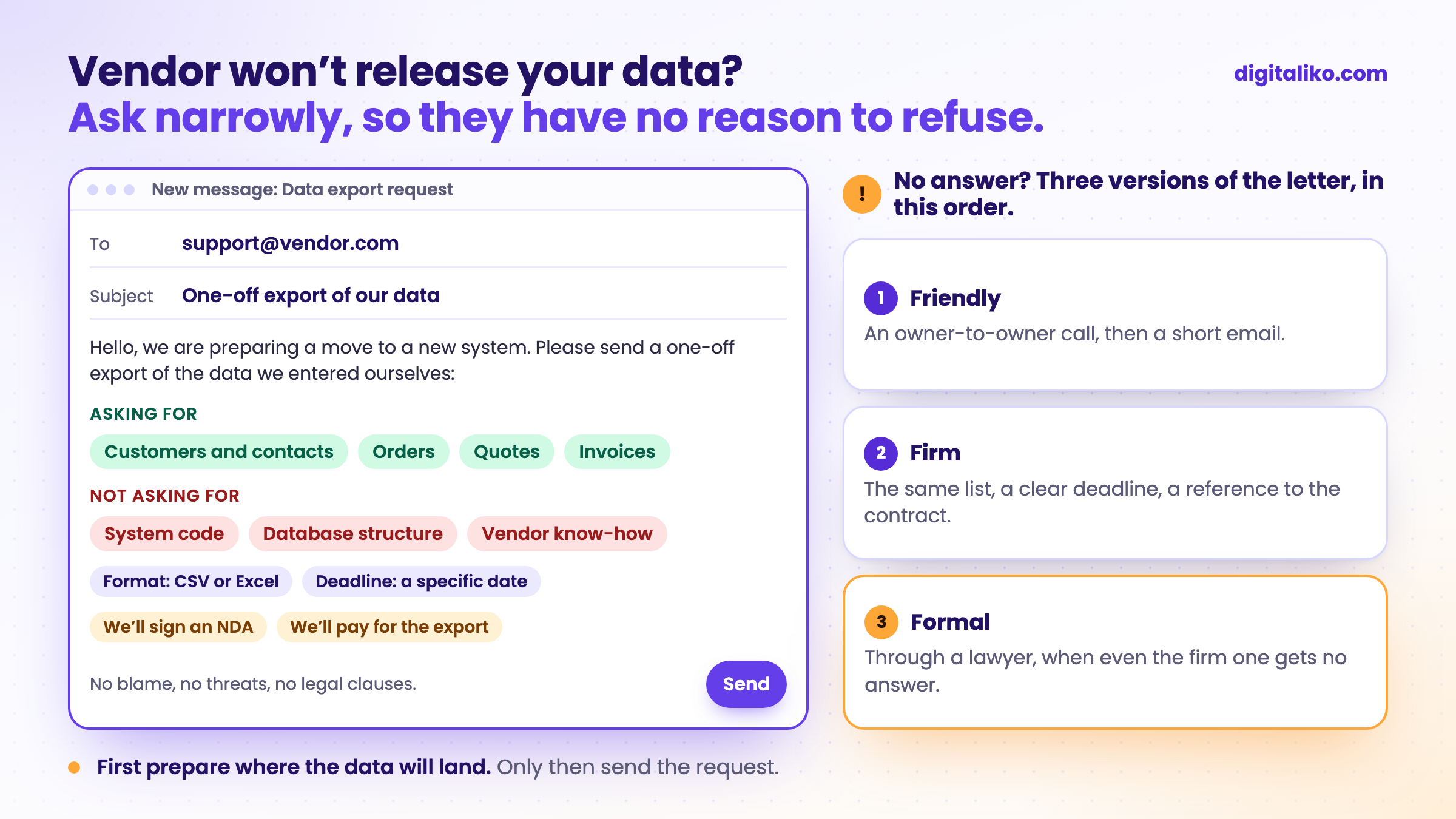
The data you entered or that came from your work. These are your records of your business. You are not entitled to the inside of the system. And you don't need it: a new system works with the data alone.
You are entitled to this
Your data: ask for it
- Customers and contacts
- Orders and quotes
- Invoices
The inside of the system: you don't need it
- The system's code
- The database design
- The vendor's know-how
The exact scope depends on your contract. Look at the sections on termination, export and confidentiality. If export isn't there, your position is weaker, but not hopeless.
How to ask so the vendor has no reason to refuse?
Ask narrowly and make "yes" easy. This is how we do it:
01
Prepare where the data will land
First the new system, at least its core. Otherwise you'll have data with nowhere to go and a licence still running.
02
Start with a phone call
Owner to owner, politely. A lot gets solved without letters.
03
Write a narrow request
A list of what you want (orders, contacts, invoices), the period, the format (CSV or Excel) and a deadline. Not "everything".
04
Offer reassurance
A non-disclosure agreement and payment for a one-off export. You remove both the vendor's excuse and their effort.
05
Have your request torn apart first
We let AI play the vendor and look for the strongest defence. Trade secrets protected only what we didn't need. So we dropped it from the request.
If the vendor still won't agree, keep three versions of the letter: friendly, firm and formal. Send them in that order and give each one time.
What a narrow request can look like
A few sentences are enough. For example:
Hello, we are preparing a move to a new system. Please send us a one-off export of the following data, which we entered ourselves: customers and contacts, orders, quotes and invoices for the whole period we have used the system. CSV or Excel format, one file per table. We need nothing from the inside of your system. We are happy to sign a non-disclosure agreement and to pay for the export. Deadline: within 30 days. Thank you.
Notice what isn't in it: no reproaches, no threats, no legal paragraphs. Those belong in the formal version.
All three versions of the letter and the list of what to ask for are in one PDF. Download the checklist: Leaving a software vendor (PDF).
What does the Data Act say, and when to call a lawyer?
The EU Data Act applies from 12 September 2025. For cloud and SaaS services it governs switching to another provider and exporting your data. Your provider should be able to tell you what can be exported. From 12 January 2027 they may no longer charge for switching.
A zero fee won't do the export for you, though. And not every system counts as a "data processing service" under the regulation. That is a question for a lawyer.
Call a lawyer when:
- the vendor doesn't answer even a formal request,
- the contract contains penalties or exclusivity,
- the data is something you must archive by law,
- the licence may end before you get the data.
Why not wait?
You have to keep invoices for years. Your accountant will tell you exactly how long. A half-finished migration is not an inconvenience. In a tax audit it is a problem.
The second reason is the deadline. The licence has an end date, and you need time to run both systems side by side. One rule from practice: never sync with a system you are about to switch off. Pull the data out once, properly, and keep the old system read-only.
How to avoid this with your next vendor?
Before signing, ask one thing before the price: how do I get my data out?
Tick what is true of the vendor you are considering. Every unticked item is a question to ask before signing.
For the last point, see Who owns the source code of custom software. And if you live in Excel today and are considering SaaS, first read when Excel is no longer enough. And when you build your own system, export and ownership are part of the contract from day one with the custom software we build.
When we don't recommend it
- The system works for you and you only want a data backup. Do not leave. Ask for a regular export and stay.
- The vendor will hand over the data, just slowly. No lawyer or dispute needed. Send a narrow request with a deadline.
- You do not have a new system yet. Hold the request. The data would have nowhere to land.
Leave critical infrastructure, like invoicing or payment software, to a vendor. There you need someone with certifications, contracts and liability.
Locked in a box?
Tell us which system holds your data and what you need from it. We get back to you within two business days, and together we pick what to fix first.
If you'd rather talk first, book a 15-minute meeting with Filip.
In short
- First prepare where the data will land. Only then ask for it.
- Ask narrowly: only the data you entered, in a specific format, with a deadline.
- Offer an NDA and a paid export. Then the vendor has no reason to refuse.
- The Data Act helps with cloud and SaaS services. Check with a lawyer whether it covers your system.
- Before signing with your next vendor, ask how you will get your data out.
Frequently asked questions
What to do when a software vendor won't release your data?
First prepare a system for the data to land in. Then ask politely, in writing and narrowly: only the data you entered, in a specific format, with a deadline. If that fails, send a formal request, ideally through a lawyer.
Which data am I entitled to?
The data you entered or that came from your work: customers, orders, quotes, invoices. Not the inside of the system, meaning its code and the vendor's know-how. The exact scope depends on your contract.
Does the EU Data Act help?
It can. The Data Act applies from 12 September 2025 and, for cloud and SaaS services, governs switching to another provider and exporting your data. From 12 January 2027, providers may no longer charge switching fees. Check with a lawyer whether it covers your system.
Should I offer to pay for the export?
Often it pays off. A one-off export to CSV or Excel is little work for the vendor and the fastest way out for you.
How do I avoid this next time?
Before signing, ask how you will get your data out, in what format and at what cost. And have it written into the contract.
Ask AI about this article
The AI also draws on our other articles and experience from real projects.
ChatGPTClaudePerplexity