Claude vs ChatGPT at work: what each is really used for
Trends and what they mean for you · Updated

Filip Papranecfounder of Digitaliko
What it means for you: a commentary on the Anthropic Economic Index (2025) and the NBER study "How People Use ChatGPT" (2025).
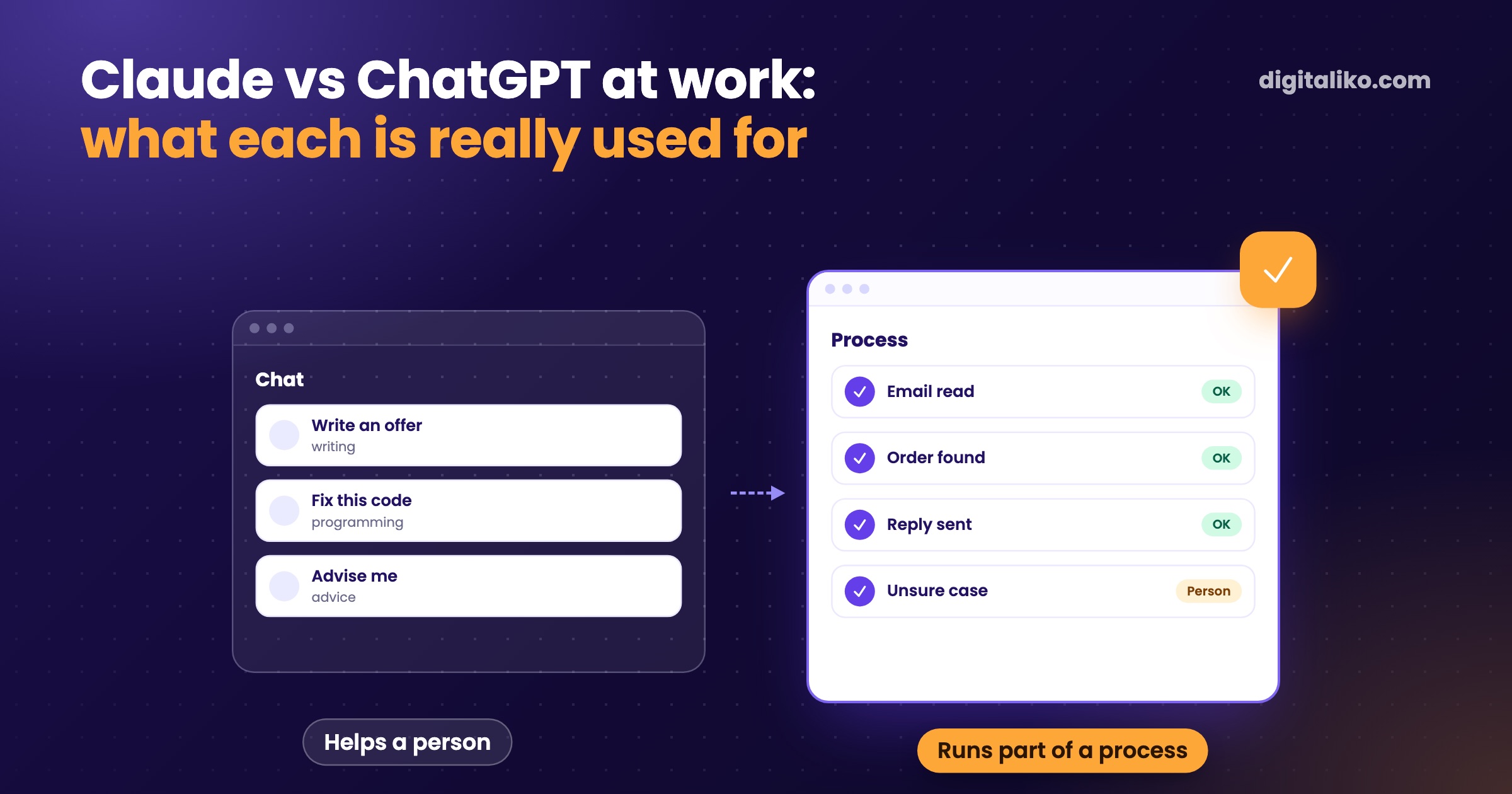
According to the available data, Claude is used most for programming, ChatGPT for writing, advice and looking up information. Both mostly help a person rather than replace them. For a company, what matters more than the brand is whether AI helps one person in a chat or runs part of a process connected to your systems.
Below is what the data actually says, where we trust it, where we do not, and how we use AI ourselves.
What is Claude used for, according to the data?
In February 2025 Anthropic published the first Anthropic Economic Index. It analysed about a million anonymised conversations on Claude.ai and mapped them to work tasks. The biggest share, 37.2 %, went to programming and computer work. Second was writing and editing text.
The way it is used is more interesting. In 57 % of cases AI collaborated with a person: checking, explaining, iterating. In 43 % it did the task on its own. Anthropic sums it up by saying that in just over half of cases AI was not replacing people at their tasks.
That is, in just over half of cases, AI was not being used to replace people doing tasks…
In September 2025 Anthropic added a second report with data from companies that call Claude through the API. There the picture is different: 77 % of business uses automate the task, against about half in the chat. The report adds that one bottleneck is whether a company can give the model the right context.
And what is ChatGPT used for?
In September 2025 the US NBER published the study How People Use ChatGPT by Aaron Chatterji and co-authors. By July 2025, it says, around 10 % of the world's adults used ChatGPT. But more than 70 % of messages are not related to work. The three most common topics are practical guidance, seeking information and writing. In work tasks writing dominates; programming is only a small share.
We agree that AI today helps more than it replaces. When an owner says they want AI, they usually want to simplify one piece of work. Like nobody retyping invoices anymore.
The data fits a Slovak or Czech company only in part. It is mostly individuals in a chat, many of them in the US. A smaller company with an office gains most elsewhere: when AI works with its orders, emails and invoices. Here we give Anthropic one point: without good context, even the best model is weak.
Claude or ChatGPT: which for what work?
The question "which one is better" has a short shelf life. The models change every few months. It is more useful to split the work.
| Work in the company | What the data says | What we recommend |
|---|---|---|
| Emails, offers, texts | For ChatGPT, the most common work task | Either one. Pick the one people will actually use |
| Programming | For Claude, the biggest category | Test both on your own code, not on demos from headlines |
| Advice and looking things up | For ChatGPT, among the top topics | Check sources; AI can be confidently wrong |
| A repeated process: customer emails, invoices | Via the API, companies mostly automate the whole task | Not a chat, but an agent connected to your systems |
| Working with company documents | The bottleneck is context, not the model | Get the data in order first |
How do we use AI?
We use it at both ends of the table. Today AI writes all of our code, and a person answers for production. That is a chat and a developer tool in the hands of a professional. For code we use Claude Code, and we regularly use up its plans.
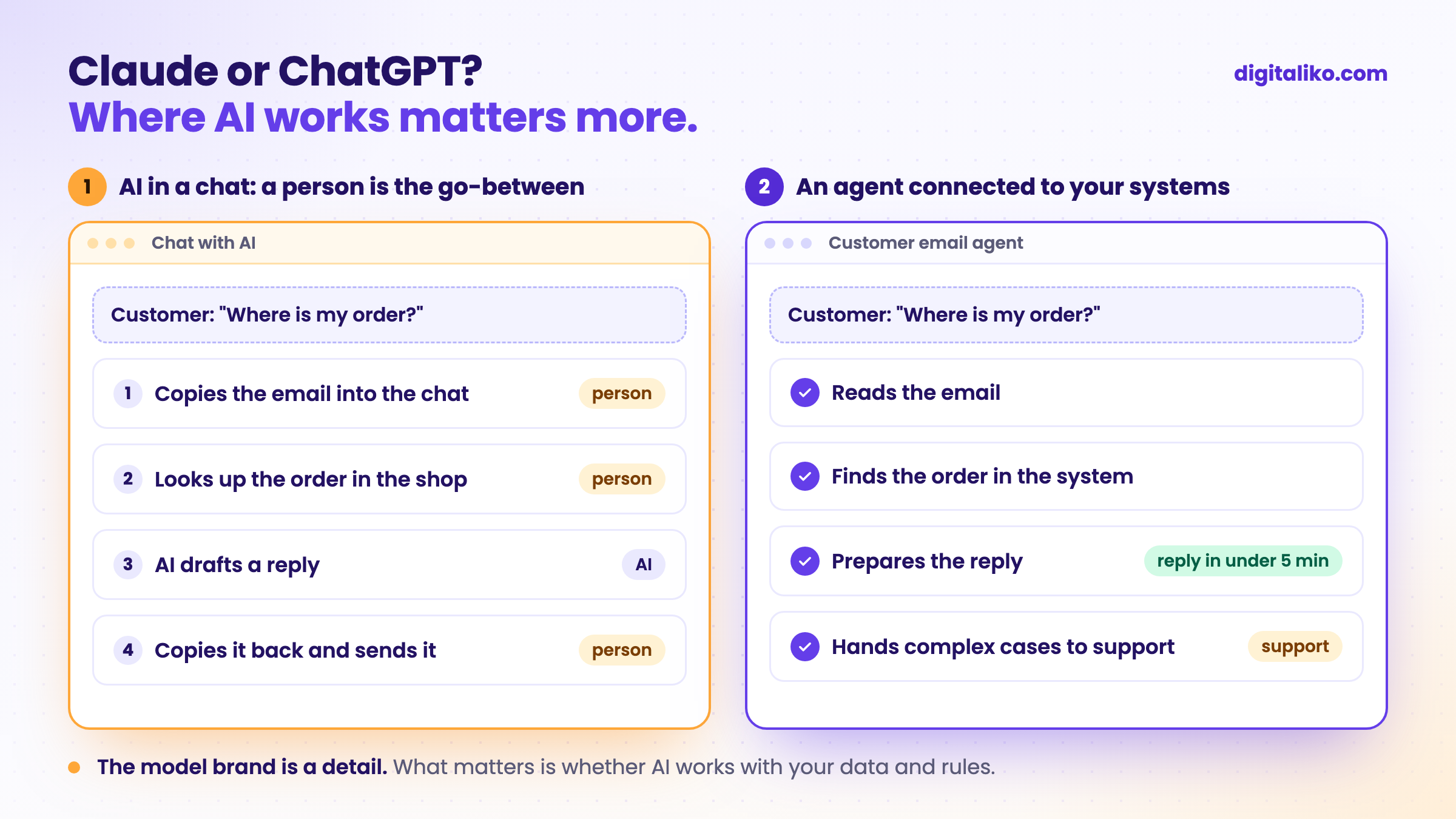
The other end is a process. For a client with an online shop an agent handles customer emails. It is not a chat someone copies text into. The agent reads the email itself, finds the order and prepares the reply. Customers get an answer within 5 minutes. Customer support now handles only the complex cases.
With an agent like that, the model's brand is a detail. What matters is who holds the rules, the data and the exceptions. And that the solution is yours from day one, not locked in with one vendor.
Models also check each other's work. A second model sees mistakes the first one missed.
Claude writes a text and ChatGPT reviews it. ChatGPT writes code and Claude gives feedback. A different model catches the blind spots the first one missed.

If you are deciding whether you need an agent or simpler automation is enough, see What is an AI agent? If you are a CTO with your own team, continue with How to introduce AI into a development team.
What to do this month?
01
Find out who already uses AI
Usually on private accounts and without rules. Ask what for and with which data.
02
Pick one tool for people and give it rules
One company account, the data processing terms actually read, and a short list of what does not belong in the chat.
03
Find one repeated process
Work where a person copies text into a chat and back all day. That is where an agent connected to your systems makes sense.
How we build such an agent for you is described on Custom AI agent for business.
When we don't recommend it
- You only need to write faster. A Claude or ChatGPT subscription is enough. You do not need us.
- You choose by rankings from headlines. In a month they will be different. Decide by your own work and your own data.
- You want an agent, but the data lives in heads and on paper. Write it down first. Only then does connecting it make sense.
- Sensitive data goes into private accounts. Fix that before choosing a tool. Even for dictation we picked a tool that runs locally, so the voice never leaves the machine.
When I understand something, I use AI and check the result myself. When I don't, I pay someone who does. They may well use AI too.
Before you start with an agent, tick what is true for you:
Sources
Source: Anthropic, "Introducing the Anthropic Economic Index", 10 February 2025, anthropic.com. Anthropic, "Anthropic Economic Index report: Uneven geographic and enterprise AI adoption", 15 September 2025, anthropic.com. Aaron Chatterji et al., "How People Use ChatGPT", NBER Working Paper 34255, September 2025, nber.org. The retelling is ours; the authors have nothing to do with this article.
Not sure where AI saves you the most?
Tell us which work you do by hand today. We get back to you within two business days, and together we pick what to fix first. We will also tell you if a plain AI chat is enough.
If you'd rather talk first, book a 15-minute meeting with Filip.
What do your people use an AI chat for today, and what should they not use it for?
In short
- By the data, Claude is used most for programming, ChatGPT for writing, advice and information.
- Both mostly help a person rather than replace them.
- The bigger difference than the brand is whether AI works in a chat or in a process connected to your systems.
- Start with rules for the AI chat and one repeated process.
Frequently asked questions
Is Claude or ChatGPT better for a company?
For writing and advice both work; pick the one people will actually use. According to Anthropic data, Claude is used most for programming. Whether AI is connected to your data and processes makes a bigger difference than the brand.
What do companies use AI for most often?
In a chat, mostly for writing, editing text, advice and programming. When companies connect AI through the API directly to their systems, they mostly automate whole tasks. According to Anthropic, that is 77 % of such uses.
Is AI replacing people in companies?
According to the available data, it helps more than it replaces for now. In Anthropic's first index, 57 % of cases were collaboration with a person. Whole occupations were not automated; AI takes over individual tasks.
Is a private AI chat account enough for employees?
Not for work data. Set up one company account, read the data processing terms of the plan you pay for, and write down what does not belong in the chat. Otherwise you cannot see where company data goes.
Ask AI about this article
The AI also draws on our other articles and experience from real projects.
ChatGPTClaudePerplexity