Is AI a bubble? The view of an investor who uses AI
Trends and what they mean for you

Filip Papranecfounder of Digitaliko
In our view, AI is probably a bubble: prices and investment are running ahead of profits. At the same time, we use AI every day at work and see how fast it moves. When the bubble bursts, the people who bought the story lose the most. The companies that put AI to real work survive.
Is AI a bubble, or just an expensive beginning?
Filip is the founder of Digitaliko and also invests. Asked whether AI is a bubble, he answers like this:
I invest mostly passively. I buy individual stocks only when I understand the company or want to take a deliberate risk. Is AI a bubble? Probably yes. And at the same time I see every day how fast it moves.

Why probably yes? Because the money runs ahead of the profits. According to CNBC, Microsoft plans to invest $170 billion this year and Alphabet $195 to $205 billion, mostly in data centres for AI. Next year, spending by the big cloud companies is expected to top $1 trillion.
On the other side are the profits. Anthropic, the maker of the Claude model, filed its IPO prospectus in October 2026. Its revenue in the first half of 2026 grew 1,300 % year on year, to $16.3 billion. Still, it writes that it has made a loss in every year since its founding.
And the companies that buy AI? An MIT study from 2025 found that 95 % of organisations get no measurable return from their generative AI investments.
This is the typical picture of a bubble. The technology is real, but the price runs ahead of what it earns so far. It looked very similar around 2000.
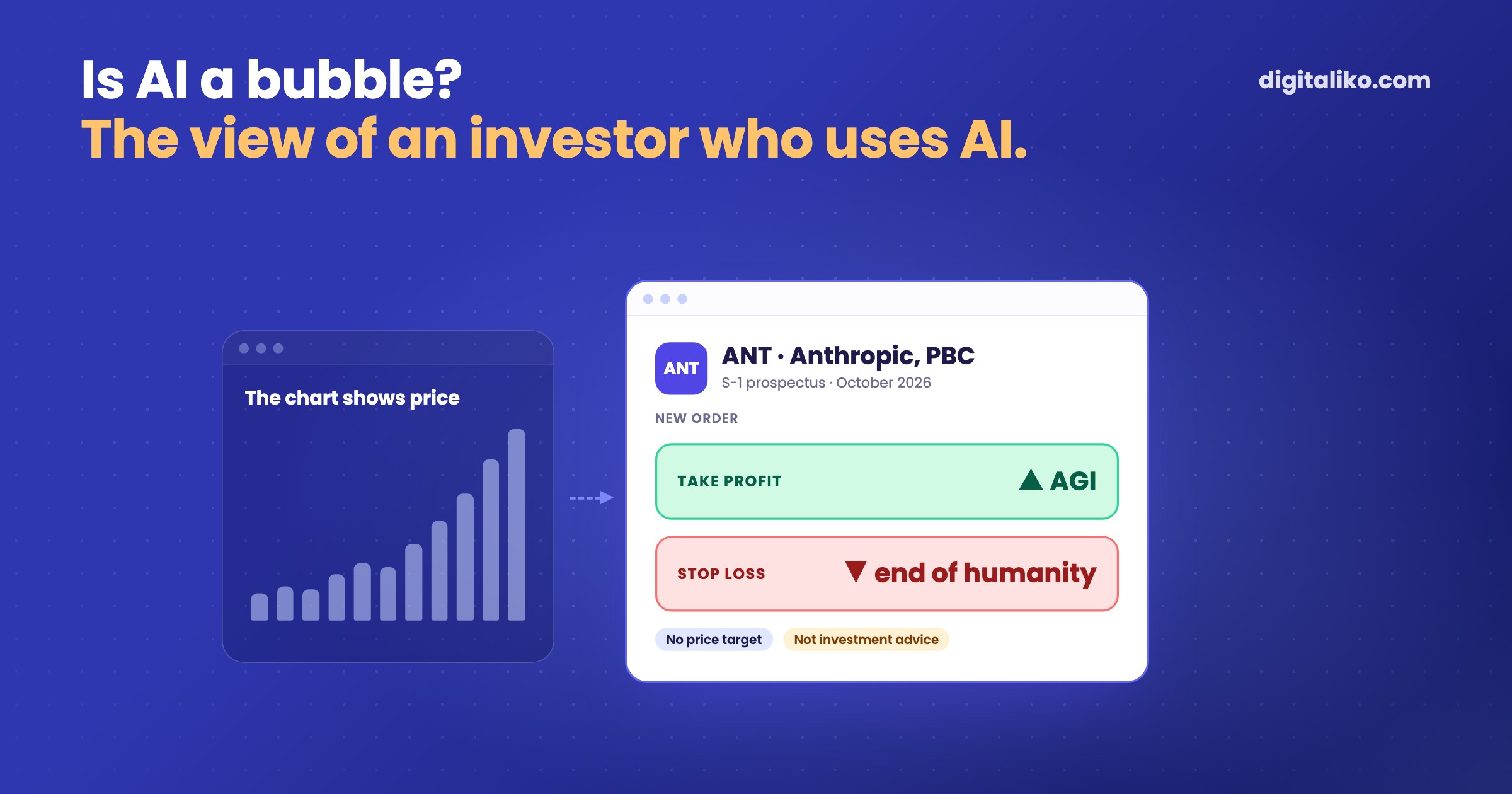
Anthropic’s prospectus makes for interesting reading too. Among its risks, it lists concerns that sufficiently advanced AI could “pose catastrophic or existential risks to humanity”. Filip summed it up on LinkedIn in his own way:
Take profit: AGI. Stop loss: The end of the world.
What we see from the inside: AI writes all our code
A stock chart shows the price. It does not show whether AI does real work in an ordinary company. We see that, because all our work runs on AI.
I pay for two top-tier Claude Max plans. AI agents write all our code today. I do not own Anthropic stock.
AI agents write the code here. Our job is deciding what is worth building and answering for what runs in production. A senior reviews every change. We describe how that works in practice in the project AI agent as a colleague.
- production projects since 2023
- 15+
What do the companies we build for actually use? Not a chat with AI, but AI wired into a specific process:
- Customer support. A client selling online used to answer customers within a few hours. With an AI agent, it answers within 5 minutes, and people handle only the complex cases. More in the project AI agent for support.
- Invoices. In our own accounting, processing one invoice took 10 to 15 minutes. Today it takes under a minute.
Neither depends on whether AI stocks halve tomorrow. The process keeps running and the model can be swapped.
The dot-com bubble: the internet stayed, those who used it won
The closest parallel is the dot-com bubble. On 10 March 2000 the Nasdaq closed at a record 5,048 points. On 9 October 2002 it stood at 1,114, roughly 78 % lower.
The internet did not stop. Between 2000 and 2015, according to the ITU, the share of people online grew almost seven-fold, from 6.5 % to 43 % of the world population. Even the companies that survived went through the crash. Amazon stock lost more than 90 % of its value in two years.
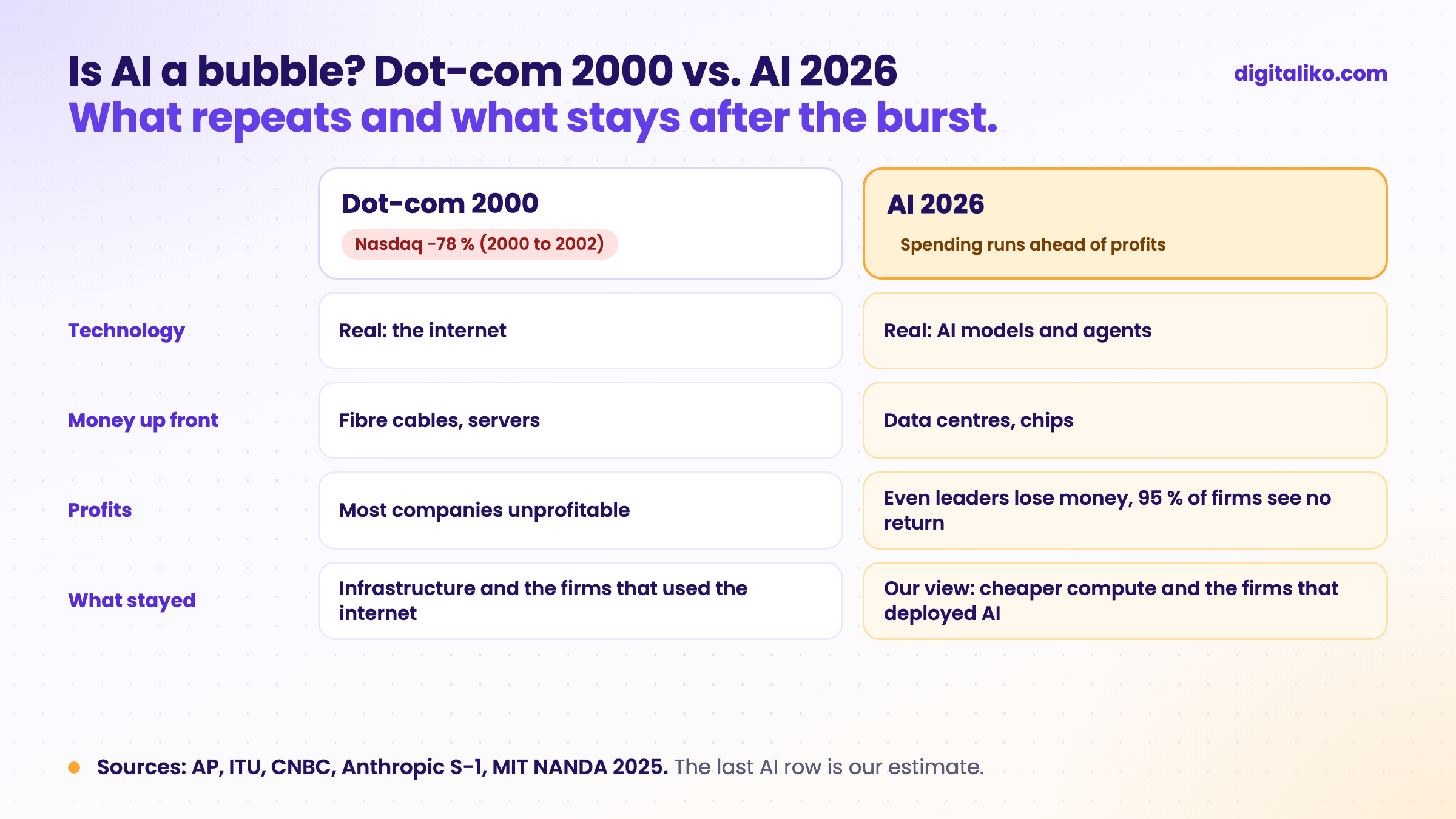
| Dot-com 2000 | AI 2026 | |
|---|---|---|
| Technology | real, the internet | real, AI models and agents |
| Money up front | fibre cables, servers | data centres, chips |
| Profits | most companies unprofitable | even leaders lose money, 95 % of firms see no return |
| What stayed after the burst | infrastructure and the firms that used the internet | our view: cheaper compute and the firms that deployed AI |
We take one lesson from the dot-com years. The bubble destroyed the price, not the technology. Whoever used the internet in 2002 for sales, orders and communication had a head start on those who waited to see how it turned out.
How to tell a company that only mentions AI from one that deployed it
The word “AI” is now in almost every annual report. Back in 2024, the US SEC charged two investment advisers for claiming to use AI when they did not. It called this “AI washing”.
The MIT study shows where the difference lies. Tools like ChatGPT mainly raise personal productivity, not company results. Successful companies want AI for a specific process, wired into their systems, and measure it by business outcomes. We look at the difference between a tool and finished work in the article Pay for an AI tool, or for finished work?
That gives four signs you can check without access to the company:
This is not a stock-picking model. It is a question to ask about every company that gets credit for an AI story.
If you own a company, the question is different
Many investors also own or run a company. For them, another question matters more. If you own a company, the question is not whether the bubble bursts, but which side you will be on.
One side: companies that bought AI as a promise and get no result from it. The other side: companies that wired it into specific work, own their data and code and can swap the model. When the bubble deflates, the second group gets cheaper compute. The first is left with the invoice.
01
Pick one process
The one that costs you the most manual work today. For example customer emails or retyping documents.
02
Measure it before you start
How many minutes one case takes and how many cases there are a month. Without that, you will not know whether AI helped.
03
Deploy it so that it is yours
Data in your own database, code and access in the company’s name, the model as a replaceable part.
What a burst means for a company and how not to depend on one vendor is covered in the article AI bubble: if it bursts, what happens to your software? How we build this kind of custom software and an AI agent for your business is described on the service pages.
Tell us which process in your company AI should handle. We get back to you within two business days with a few questions about your work. Then we agree on what we do first.
This is not investment advice
This article is not an investment recommendation. We do not say what to buy or sell, and we give no price targets. Filip does not own Anthropic stock. We write about what we see in daily work with AI. Filip also writes about investing and AI on LinkedIn.
Which side will your company be on when the bubble deflates?
In short
- In our view, AI is probably a bubble: investment and prices run ahead of profits.
- In the dot-com bubble the Nasdaq fell by roughly 78 %, yet the internet kept growing.
- You can tell a company that deployed AI by a specific process and a measurable result.
- If you own a company, what counts is whether AI does real work and whether it belongs to you.
- This is not investment advice.
Frequently asked questions
Is AI a bubble?
In our view, probably yes. Big tech companies are spending hundreds of billions of dollars a year on AI, and most companies that buy AI do not yet see a measurable return. The technology is real, though, and people use it in everyday work.
When will the AI bubble burst?
Nobody knows. A bubble is usually recognised only in hindsight. The more useful question is which companies survive the burst: the ones that wired AI into specific work and can show a result.
Is the AI bubble like the dot-com bubble?
In some ways, yes. Money runs ahead of profits and the technology is real. After 2000 the Nasdaq fell by roughly 78 %, yet the internet kept growing and the firms that used it had the edge. The difference is that today’s AI leaders already have large revenue, even though they still lose money.
How can you tell a company that really uses AI?
Look for a specific process, a measurable before-and-after result, AI wired into its own systems and an answer to what happens when the vendor raises prices. The word “AI” in an annual report is not enough.
Is this article investment advice?
No. We do not recommend any stocks or price targets. We write about what we see in daily work with AI and what it means for companies.
Sources: Anthropic, PBC, Form S-1, October 2026, sec.gov. CNBC, 29 Oct 2026, cnbc.com. AP / Fox Business, Milestones for the Nasdaq composite index, 2015, foxbusiness.com. ITU, 26 May 2015, itu.int. CNBC, 18 Dec 2018, cnbc.com. MIT NANDA, The GenAI Divide: State of AI in Business 2025, July 2025, pdf. SEC, 18 Mar 2024, sec.gov. The 78 % Nasdaq drop is our calculation (1,114 / 5,048).
Ask AI about this article
The AI also draws on our other articles and experience from real projects.
ChatGPTClaudePerplexity

